Showing posts with label saudi arabia. Show all posts

Friday, 12 December 2014

What will the impact of falling oil prices be?

So, oil prices are falling again - down to close to $60, compared to over $100 just a few months ago. Good news for economies and motorists around the world? Or a sign of problems to come?

Prices last fell dramatically in 2008, dropping from $145 in July to $30 in December of that year. Of course, this was due to falling demand caused by a global financial crisis - brought on in part by the rising price of oil forcing homeowners to default on their sub-prime mortgages in order to keep buying ever more expensive food and gasoline. Since then, the oil price crept steadily back up again as economies recovered and expensive oil production was mothballed, clearing $100 in 2011 and staying around that level until the recent fall.

So what's happening this time? Well, two key factors are the risk of weakening demand in some parts of the world due to economic issues, and the increase in USA oil production through the fracking of shale oil. Possible falling demand combined with rising supply has reduced the price. Normally, OPEC would act at this point, reducing oil production to support prices. But this time Saudi Arabia has political motivations, as noted by the BBC recently, wanting to punish countries like Russia and Iran, who are being badly hurt by the falling oil price right now. Saudi Arabia is hurt too, but it has a much bigger financial cushion, so can survive for some time yet on lower prices.

So what will the impact be, beyond lower transport costs in the short term? Most of the new oil supply that has come from US fracking needs a high oil price to be profitable - higher than the price is right now (estimates vary from $65 to $80), so fracking companies will be wondering whether they should pause or halt production, and save the oil for a time when prices are higher and they can make a profit selling it. But the problem is they've borrowed money to get started, and that money has to be paid back no matter what the oil price is. Some people even think this might trigger a new financial crisis, as there is over $200 billion in 'junk bonds' in the energy sector. This isn't a USA-specific issue, Barclays is involved in an $850 million loan which may not be paid back in full.

Looking further ahead, when demand for oil picks up again, the shutdown of expensive oil production like fracking, and also tar sands, would mean that prices could jump up significantly, as it would take time to bring this production back online.

Tar sands in alberta 2008

Finally, there's another factor affecting future oil production - the risk of falling investment. Anybody who's grasped the climate change issue understands that if we want to keep global temperatures from rising too high we can't burn all the fossil fuel resources we know about, never mind resources we haven't found yet. But companies, and even whole countries, are valued by stock and bond markets according to the quantity of fossil fuel reserves they own or have a right to produce. If some of these reserves have to be left in the ground, then the shares of these companies and the national debt of certain countries could be over-valued right now - a 'carbon bubble'. In fact, The Bank of England is researching the risk of this right now, as reported by The Guardian:
The Bank of England is to conduct an enquiry into the risk of fossil fuel companies causing a major economic crash if future climate change rules render their coal, oil and gas assets worthless.

The concept of a “carbon bubble” has gained rapid recognition since 2013, and is being taken increasingly seriously by some major financial companies including Citi bank, HSBC and Moody’s, but the Bank’s enquiry is the most significant endorsement yet from a regulator.

The concern is that if the world’s government’s meet their agreed target of limiting global warming to 2C by cutting carbon emissions, then about two-thirds of proven coal, oil and gas reserves cannot be burned. With fossil fuel companies being among the largest in the world, sharp losses in their value could prompt a new economic crisis.

CarbonBubble ENG

The UK Energy Secretary, Ed Davey, has also been talking about this issue with regard to pension funds, as reported by The Telegraph:
"One has got to worry about the investments for pensioners.

If pension funds are investing in companies or banks that have on their balance sheets huge amounts of assets in fossil fuels, and those assets don’t give the return that people expect – because of changes in technology where low-carbon becomes cheaper or because of the world having to take action against carbon emissions – one has got to protect those pensioners and those investments."
 In summary, there are more than simple market forces at play in the oil price right now, and the consequences of any action, or inaction for that matter, will be far-reaching. Governments would do well to give some serious thought to two key problems - how to get off our addiction to oil (and fossil fuels in general), and how how do it without causing another financial crisis as the big fossil fuel companies are wound down.

Click here to read the rest of this post.

Friday, 21 September 2012

Saudi Arabia burning more of its own crude oil

Following up on an earlier post about falling Saudi oil exports, there's some recent news illustrating the problem:

Saudi Arabia burned record monthly volumes of oil in June and July, official government figures show, contrary to the top crude producer's plan to temper its summer oil burning spree this year with more gas.
The report notes that from 2004 to 2010, Saudi domestic consumption of crude oil for power generation increased by 240%!!! Much of this goes to run air conditioning and desalination - both of which are important facilities when you live in a desert... This leaves ever smaller amounts remaining to be exported, so the only way Saudi can balance its budget is with prices steadily rising. But as that's happening anyway, they don't need to do anything on this front...

Full news article is here.

Mike

Click here to read the rest of this post.

Thursday, 6 September 2012

Saudi Arabia to stop exporting oil by 2030?

Interesting story in the Telegraph today, commenting on a report released by Citigroup on the Saudi petrochemical industry. The main issue is that domestic energy demand is rising fast in Saudi, so more and more of their oil production is being used at home, providing power for air conditioning, desalination, etc.

The report says Saudi could be an oil importer after 2030 - but this is of course not going to happen, as if they stop exporting oil they won't have any money, so importing is out of the question. That does leave me wondering what will happen as exports dwindle, as unless prices keep rising (and the world economy may simply not support that beyond a certain point), then Saudi won't have enough money to keep the country running - and we've seen what's happened in other Arab countries in recent years...

None of this is really news of course - the Export Land Model described the situation years ago - but it's interesting to see the same conclusion coming out of Citigroup!

The quote at the end of the article sums it up for me:

Jeremy Leggett, the head of the UK Taskforce on Peak Oil and Energy Security, says Britain is sleepwalking into a potential disaster by failing to prepare fully for a global supply crunch. The refusal to listen to warning signals is comparable to the complacency in the build-up to the financial crisis, he argues, but with graver implications for the British economy.

Mike

Click here to read the rest of this post.

Thursday, 8 September 2011

How much oil will Saudi Arabia have spare to export?

For a long time the Export Land Model has been used to argue that as a country's internal oil consumption rises, less is available for it to export. This makes sense, and as long as oil prices rise, the exporting country may continue to earn sufficient income from its reduced exports. Normally we think of this increased domestic oil demand as coming from greater economic activity, resulting in more cars and trucks driving around, or more oil being used in industry. In Saudi Arabia however there are two other significant sources of demand...

The first is air conditioning, which needs electricity. Most countries avoid burning oil or oil-derived fuels to generate electricity as they are too expensive, but Saudi Arabia burns crude oil in some of its power plants, so more air conditioning results in more domestic oil use.

The second is desalination. Saudi Arabia has very little water, and oil-fired desalination plants are used to produce the water needed for agricultural, industrial and domestic use.

A recent article from Reuters said:

The International Energy Agency and analysts at HSBC bank estimated Saudi Arabia's rate of direct crude burning more than doubled from 2008 to 2010 because of a rapid rise in power demand and a shortage of natural gas. How much of that went to desalination is not known but experts believe it is significant.
Of course, the ideal would be that water is used more carefully, but if this doesn't happen, and demand for aircon keeps rising, the rate of oil exports from Saudi Arabia could be falling pretty quickly before too long...

Mike

Click here to read the rest of this post.

Saturday, 23 April 2011

Saudi budget implies sustained high oil price

When the UK needs to balance it's budget we have to make cuts, but when Saudi Arabia needs to do it, it prefers to have a high oil price instead. An article in the FT says:

The break-even oil price the Gulf kingdom requires to balance its budget will jump from $68 last year to $88 this and then $110 in 2015, according to new estimates by the Institute of International Finance, a leading industry group.

Only a decade ago Saudi Arabia was able to balance its budget with oil prices averaging $20-$25 a barrel.
Given that Saudi Arabia exports about 7-8 million barrels a day, out of total net exports globally of just under 50 mbpd (source), it has a strong influence on price. The country is increasing spending to try and placate the masses, fearing an uprising similar to that in Egypt or Libya, but the money has to come from somewhere, and for Saudi Arabia that can only mean oil.

If Saudi needs a high oil price, we will get a high oil price, end of story.

Mike

Click here to read the rest of this post.

Friday, 15 April 2011

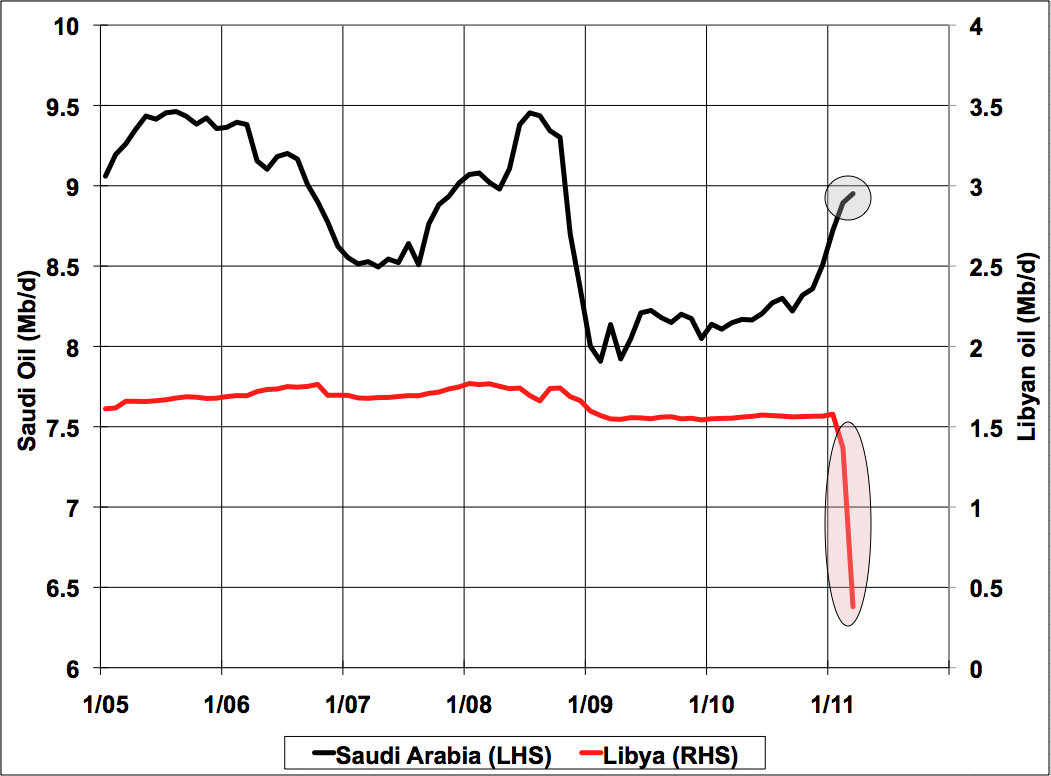
Saudi Arabia did not make up for Libyan oil

A very interesting post on The Oil Drum:

We can put the situation almost entirely down to two things: the fact that Libyan production has plummeted, and that Saudi Arabia has made no significant move to compensate. In fact, Saudi Arabia slowed down production increases that it had been making in prior months.
...
So the world has abruptly lost something like 1.3mbd of oil production between mid February and March.

Read the full story on TOD.

Click here to read the rest of this post.