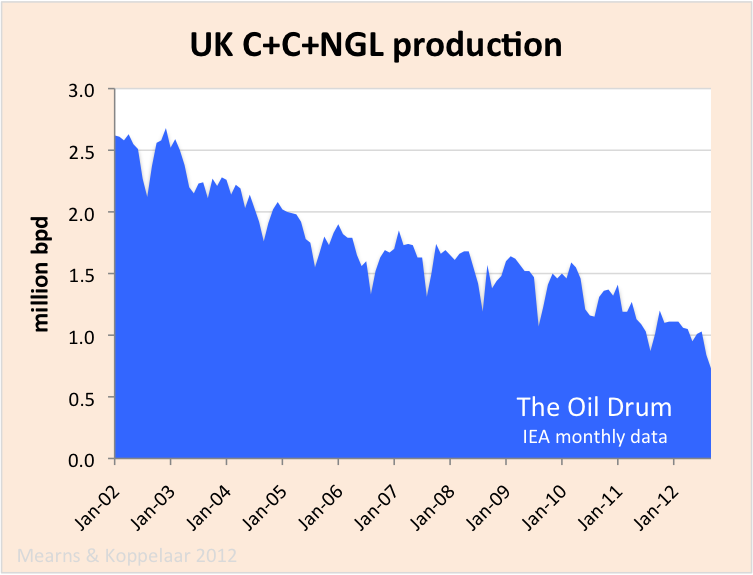
Just a quick note to say there's a good article over on The Oil Drum, looking at oil production trends in the OECD. This includes the UK, and I think this graph pretty much tells the story...
Click here to read the rest of this post.
Just a quick note to say there's a good article over on The Oil Drum, looking at oil production trends in the OECD. This includes the UK, and I think this graph pretty much tells the story...
I just read an interesting post on The Oil Drum. Not a new idea, but a good, clear explanation of it. Basically, it goes like this:
From a new post on the Oil Drum:
It looks to me as though 2012 is likely to be a truly awful financial year, with several crises converging:
...
- Either very high oil prices or recession,
- The US governmental debt limit crisis,
- The Euro crisis,
- The Chinese debt problem,
- Debt deleveraging in the US and elsewhere,
- Further MENA (Middle East/North Africa) political problems, and
- Conflict between need for greater resources and pollution issues.
If a person follows through the expected effects of high oil prices and debt, the financial system would appear to be the most vulnerable part of the system. The financial system would also appear to be what telegraphs problems from one part of the system to another. Unless a solution is found, failure of the financial system could ultimately bring down the whole system.
...
Nothing happens overnight with the world economy, so changes are likely to take place over a period of years, rather than all at once. We can’t know exactly what the future will bring, but the handwriting on the wall is worrisome.
A couple of interesting posts appeared on The Oil Drum this week, discussing the latest oil production figures. It looks like November 2010 oil production may have exceeded the previous peak of July 2008. A couple of points to consider though:
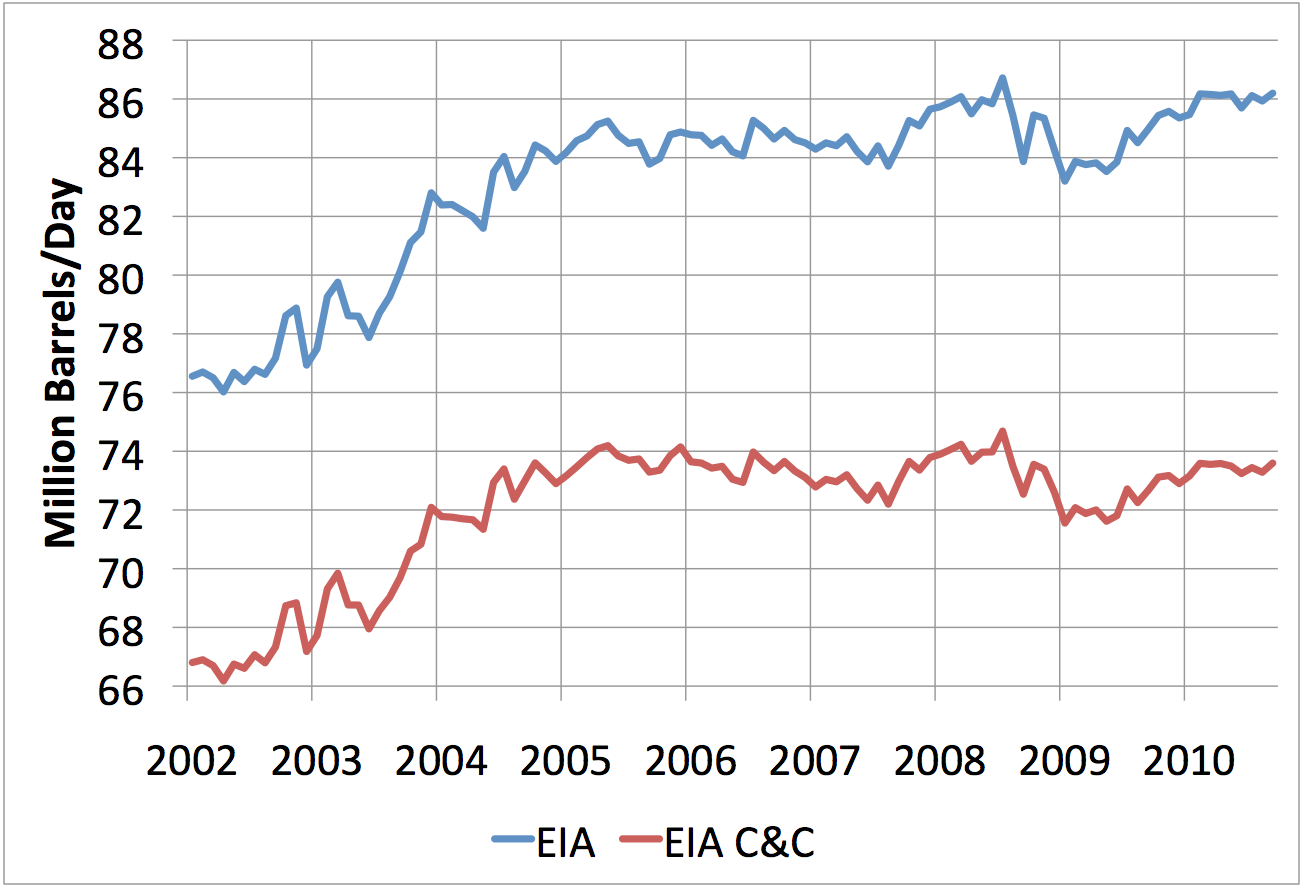
This week the IEA published its World Energy Outlook for 2010. The most interesting sentence is probably “Crude oil output reaches an undulating plateau of around 68-69 mb/d, by 2020, but never regains its all-time peak of 70mb/d reached in 2006.” So, they're basically admitting that peak oil has come and gone, at least for conventional oil.
Of course, there is still growing supply from unconventional sources, but the net energy, or EROEI, of these sources is lower, so it won't be long before we pass the peak of all energy supplies, if we haven't already.
You can read some critical analysis of the WEO2010 at The Oil Drum and ODAC.
Mike
Interesting discussion thread over on The Oil Drum, suggesting that if there's work that needs doing, and people that need work, then we should put the two together:
Over the next twenty years the US and the world will need to transition from an industrial agriculture model to one based on permaculture and more organic, labor intensive approaches to growing food. Oil is going to decline, meaning that diesel fuels to run tractors and combines will become increasingly costly. And natural gas, meaning fertilizers, will also go into decline. The era of agribusiness is coming to a close sooner than anybody might have imagined. And we are not prepared for what follows.Go to TOD to read the whole article.
The work that should be started soon and will be labor intensive is relatively straightforward enough. We need, literally, millions of men and women reconditioning and building soils capable of sustaining permaculture and local production/delivery of food. The Green Revolution has done a great deal to degrade so much of our natural soils through the increasing use of fertilizers and pesticides as well as irrigation. Now, without these petroleum-derived inputs, it is likely that food yields would drop significantly. Some land areas currently under cultivation might even fail completely. As far as oil-based transportation is concerned, the world is going to grow very large once again, and very round, once long-distance hauling is no longer cost effective. Foods will have to be grown and consumed locally and the only alternative to industrial agriculture that might hope to produce sufficient calories and nutrients to keep huge numbers from starving is permaculture. That is where the jobs will be. And the sooner we get started developing our skills and knowledge of how to do this, the better off we will all be.

