Showing posts with label gas. Show all posts

Friday, 16 October 2015

UK gas supply outlook for winter 2015/16

It was back in April that I blogged about the cut Centrica had made in the capacity at Rough, due to problems with some of the wells limiting the maximum operating pressure. At the time, Centrica hoped that by now the capacity would have been restored, but a press release in July said that they now didn't expect to know if this would be possible until some time between September and December 2016! The net result is that the capacity of Rough has been reduced by 25%.

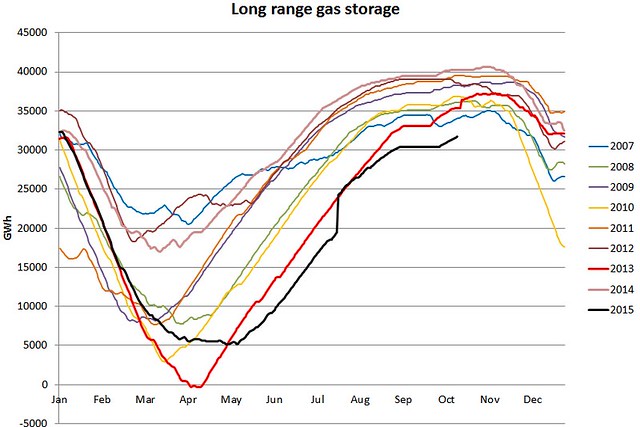
Clearly this presents a problem for UK winter gas supply, so it's not surprising that another July press release stated that the Oil and Gas Authority had given Centrica permission to reduce the minimum operating pressure of Rough, thus 'converting' some of the cushion gas (which would normally be left in the store) into working gas, which can be withdrawn and re-injected. This shows up on the chart below (black line = 2015), where a sudden jump up in July can be seen, due to the addition of about 4,625 GWh (or about 400 mcm). The same trick was pulled in 2013 (red line in chart below), after dipping into the cushion gas in April 2013, capacity was increased arbitrarily in the October 2013. It's a bit like keeping driving your car after the fuel gauge has gone into the red - it works OK for a while, but you can't do it for long...

Despite this bit of creative accounting, the chart below shows that we are still going into this winter with a record low amount of gas in storage, and National Grid's Winter Outlook notes this on page 43, saying storage is reduced by 14%, from 4.9 bcm to 4.2 bcm. It would have been 22% less if Centrica hadn't fiddled the figures by dipping even further into the cushion gas.

UK long range gas storage 16 Oct 2015

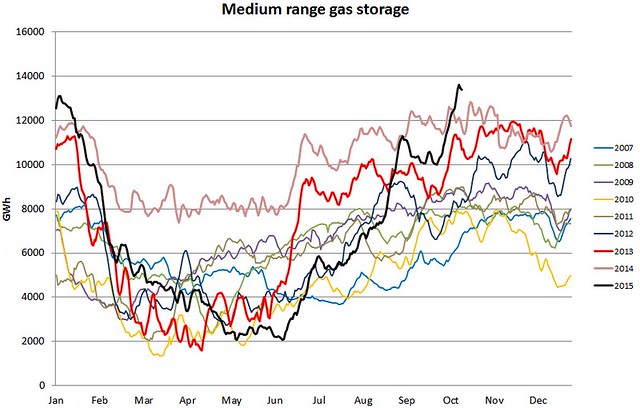
Medium range storage is looking better, with increased capacity and a record amount in storage, but nowhere near enough to make up for the shortfall at Rough.

UK medium range gas storage 16 Oct 2015

So, the big question has to be about demand. We have fewer coal power stations than we did a year ago (which is a good thing, of course!), which could in theory mean that more gas gets burned to generate electricity. But the big factor will be the weather as always, which is hard to predict at this stage, as there are several extra factors to bear in mind:
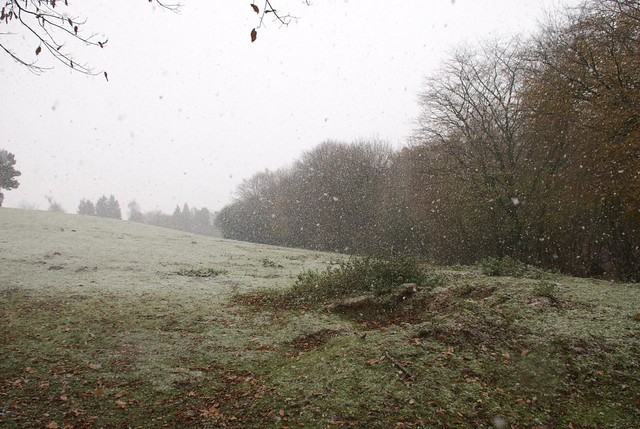
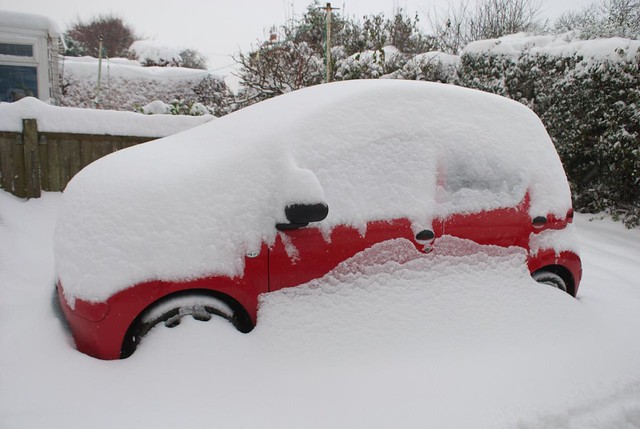
Time will tell, and we'll soon see if this winter looks like this:
DSC_5364

or like this:
DSC_5428

Click here to read the rest of this post.
Thursday, 28 November 2013

Blown fuse in Norway reduces UK gas supply

OK, well not a blown fuse literally, but a circuit breaker tripped and shut down a chunk of output from the Ormen Lange gas field, which is one of the main sources of gas for the UK, via the Langeled pipeline. This story indicates the cut should only be for 24 hours. You can see the effect on this graph of Langeled output taken from a National Grid website:

Langeled shortfall 28Nov2013
Not a huge problem today, but this is exactly the kind of thing that can cause dangerously low supplies when it happens in colder weather - of which there is more to come in the next few months...

Mike

Click here to read the rest of this post.
Tuesday, 12 November 2013

Gas Bills 'Could Rise' Due To Low Reserves

Good to see that some people are aware of the issues the UK has with gas supply - Sky News in this case!

Gas prices could soar this winter if the national supply runs short during another cold snap, an energy expert has warned. Industry analyst Peter Hughes told Sky News that a "perfect storm" last March of extreme weather and the shutdown of two major pipelines caused prices to double. And that could happen again because the Government has refused to support the storage of more gas. "It foreshadows things to come," he said.

"The situation in terms of the risks will only get worse as North Sea production runs down and demand rises. That's the double whammy. And if you don't have more storage that translates into real vulnerability."

Britain currently stores enough gas for 13 days of supply. But Germany has reserves to last 69 days, in case there is a problem with the supply from countries such as Russia.

Even the gas storage that we DO have is not always working properly... News out today from Reuters says that withdrawals from Centrica's Rough storage site, the largest in the UK, will be limited for a few hours today and for four days from 21 Nov. More importantly perhaps, no gas can be injected back into for two weeks starting on 18 Nov. Presumably this is all down to maintenance work, but that really should have been completed earlier in the year... Let's hope we get a mild winter!

Easington Langeled Terminal

Click here to read the rest of this post.
Monday, 14 October 2013

Keeping the lights on? UK gas supplies and prices in winter 2013/14

With the UK weather turning colder over the last week, it's time to take a look at how our creaking gas and electricity infrastructure might cope this winter. I'll look at two areas - first, National Grid's Winter Outlook for 2013/14, and second, my own analysis of their data on UK gas storage.

Most of National Grid's Winter Outlook is dedicated to gas, as the supply/demand is affected much more than electricity by the availability of imports and how cold the weather is. The report indicates that there is, in theory, plenty of gas supply for even the coldest weather that the UK could experience. In practice, however, situations can arise where supplies are far from secure. For example, earlier this year an unseasonably cold March coincided with a brief outage in the Bacton Interconnector, resulting in gas storage levels dropping to record lows. LNG imports were low at the same time, due to demand from Japan and China - this has not changed since then. The situation is illustrated well by a graph from from page 13 of the Winter Outlook, where the 2012/13 line can be seen going off the cold end of scale in March:

Fig G1 from National Grid Winter Outlook 2013-14

This exposes the other flaw in our gas market - if it is cold in Europe at the same time as it is cold here, there's no guarantee that gas suppliers in France, Germany and elsewhere won't keep gas for local use due to obligations placed upon them. Alastair Buchanan, the former head of OFGEM who stepped down from his post in June after 10 years’ service, comments on this in an interview with The Telegraph, and goes on to say that uncertain gas supplies combine with ageing power stations in the UK to create a real risk of temporary blackouts if the weather is cold over the next few winters. Over 40% of the UK's electricity is generated by burning gas, so the two are closely linked. In the Winter Outlook, National Grid notes that the margin of spare electricity generating capacity this winter would only be 5% during a cold spell, compared to 17% just two years ago.

Moving on to the current state of our gas stores, here's some graphs I've plotted using data available from the National Grid website. First, here's the amount of gas in Long Range Storage, which is basically a single depleted gas field known as Rough, owned by Centrica. 2013 is in red on the graph.

UK gas long range storage 14 Oct 2013

As you can see, the main factor affecting the storage levels in Rough this winter is what happened last winter. The cold weather dragging on through March and April resulted in the storage level actually going below 'zero' (see my blog at the time for an explanation), so we've been playing catch-up all summer and the current level is lower for this date in October than any time since 2007 (when North Sea supplies were much greater than today...). There's little hope of the storage getting filled up to the higher levels seen in the past few years, partly due to physical limits to how fast gas can be pumped in and partly due to the rising cost as we go into winter. The rate at which Rough has been filled this year is shown in the graph below. Why they decided to take a break from filling it at some points is beyond me...

UK gas LRS injection 14 Oct 2013

You'd think that someone would be building more storage space for gas, but a recent story in The Telegraph noted that:

Centrica has written off £240m in wasted costs after scrapping its £1.4bn plan to convert an empty North Sea gas field into a gas storage site, and shelving another smaller project indefinitely.

The situation with Medium Range Storage is not so bad, though this doesn't fully compensate for the current shortfall at Rough:

UK gas medium range storage 14 Oct 2013

Short Range Storage is very low, but the amounts required to fill it up are relatively small. It does still need doing though, as these stores are critical to cover unexpected outages, which seem to occur regularly enough that the may as well be expected these days...

UK gas short range storage 14 Oct 2013

Of course, the question that most people will be asking is 'What will happen to prices?' Well, I said in a post on this blog in May 2013:
This can only translate into higher bills eventually, although the bumper profits made last winter may result in a short delay before this happens. Boosted gas prices will feed through into electricity prices too.
Lo and behold, one of the 'big six' have already put up their prices, and I'm sure the others will follow suit. I know they blame 'green taxes' and transportation costs, while the government blames fat profits in the upstream sections of the energy companies, and there is a little truth in all these claims, but the simple fact is that in the year ending 30 June 2013 we imported over 50% of our gas (data from DECC). This means that we are at the mercy of European and global demand and weather. The graph I've plotted below shows spot market prices as reported by National Grid over the past few years. The trend is clear, and the average price this year so far is currently up 18% on the year before, in part due to the very low storage levels at the start of the summer.

UK gas buy price history 14 Oct 2013


I will of course be keeping an eye on gas storage levels, and the weather forecast, over the coming 4-5 months, and don't forget you can check the current gas situation yourself at National Grid's Prevailing View page.

If you're wondering what else you can do, at the risk of repeating myself, you can:
  • Reduce demand (wear warmer clothes, turn the thermostat down, don't boil a saucepan without a lid on it, etc.)
  • Improve efficiency (insulate your house, draughtproof, double-glaze, etc.)
  • Use renewable energy
There's some examples of what we've done at home for the above points here, and you can check out some inspiring ideas on the Ashden website too.

Keep warm, and pray that we don't get too many days that look like this in the coming winter...

DSC_5464

Mike

Click here to read the rest of this post.
Wednesday, 29 May 2013

UK gas supply and prices for winter 2013/14

Yeah, yeah, I know summer's not even started yet, but the UK gas markets are already planning ahead to next winter. Time to take a first look at how things are shaping up...

As you will remember, winter dragged on a bit this year in the UK, and it was only seven weeks ago that our gas supplies were running on empty. As I noted at the time, this leaves us with a problem, as there is now not enough time to easily refill the long range gas storage before next winter, as there are technical limits to how fast gas can be injected back into the store at Rough.

To illustrate the problem here's a graph showing long range gas stock levels for the past few years (click for a larger version):

UK long range gas storage level 29 May 2013
As you can see, we are starting from an all-time low and are several weeks behind the next worst case (which was 2010). Here's another graph showing the rate at which gas has been injected into Rough since the cold weather stopped:
UK long range gas storage injection rate 29 May 2013
Centrica have actually been making a good effort to get gas in there as fast as possible, actually setting a new record on 1 May, but there have still been some blips due to cold weather or other issues that have slowed things down.

So how has this been affecting price? The exceptionally low storage level following last winter represents itself as extra demand in the gas market between now and next winter, so it's no surprise that average wholesale prices are up 23% for the year to date compared to 2012:
UK gas buy price 29 May 2013

This can only translate into higher bills eventually, although the bumper profits made last winter may result in a short delay before this happens. Boosted gas prices will feed through into electricity prices too.

So what can you do? Well, the message hasn't changed - insulate and draught-proof your house, upgrade your heating controls and thermostats, get a new boiler if you need to. Switching supplier will make little difference, especially in the long run, so the only answer is to use less gas.

I'll post more updates over the summer when I see how things are going in preparation for the coming winter.

Mike

Click here to read the rest of this post.

Sunday, 7 April 2013

Britain's biggest gas storage runs out of normal supply

Following up on my post on Friday, here's a report from Reuters with more details:

Britain's biggest gas storage site ran dry of normal supply on Friday and is using gas usually reserved for the technical operation of the site, National Grid data showed.

Unusually cold weather in Britain has boosted gas consumption, forcing the Rough storage site off Scotland's east coast to take the unusual step of dipping into its so-called cushion or base gas.
What's very useful is that they got some figures out of Centrica on how much of this 'cushion gas' can actually be extracted:
"There is potentially an additional 1.1 TWh (terawatt hours) (100 million cubic metres) that could be produced from the Rough reservoir below this opening stock level... The opening stock published by National Grid may ultimately be at -1 TWh)," Rough operator Centrica said in a regulatory update on Friday.

They finish up by saying:
Gas traders said next week a planned strike by workers on Norway's offshore gas fields could hurt gas flows to Britain.

Supply could also be impacted by unplanned outages because of technical problems that are a regular occurrence in the vast network of gas platforms and pipelines that crisscross the North Sea.

However forecasted milder weather and two deliveries of LNG to Britain due next week could take pressure off prices, traders said.
So, we can draw a further 100mcm, or 1,100 GWh out of Rough below 'zero'. By 6am on Sat 6 April 2013 we'd already drawn 290 of these GWh of gas out of there, as shown by this screenshot taken from the Prevailing View page:


Thankfully it's warming up now, because soon this store really will be empty... The problem, and cost, of refilling it in time for next winter still remains though...

Mike

Click here to read the rest of this post.

Friday, 5 April 2013

UK long-range gas storage drained

Yesterday (4 April 2013) afternoon, the UK long-range gas storage facility at Rough went 'below empty' for the first time. This is possible because Centrica normally leaves some 'cushion gas' in the depleted Rough reservoir to make sure there’s enough pressure to keep it flowing properly. Here's the status, taken from the Prevailing View page, showing figures valid for 6am on the 3 and 4 April 2013:

UK gas storage 4 April 2013

The 4pm udpate today gives the Long Range stock level as -132 GWh, a negative stock level! I got this from the spreadhseet on this page, as the Prevailing View is being a bit slow to update today - maybe it's struggling over what to do with a negative stock level?

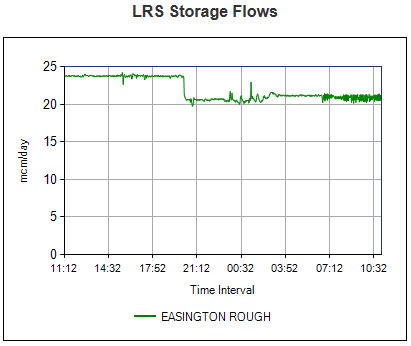
It was clear this was going to happen, because the Entry Zone graphs have been showing gas flowing out of Rough at over 20 mcm/day (image shows 24 hours from 4-5 April 2013):
UK gas flows from Rough 5 April 2013

20mcm is about 220 GWh, so with only 108 GWh in Rough yesterday at 6am, it was clear we were going to dip below zero. The fact that we are now burning through this normally untouched 'cushion gas' reserve is a sign of the problems we have right now, and does not bode well for next winter, as everything that is pumped now ought to be put back in before the end of October to guarantee winter supplies.

According to National Grid, gas can be injected into Rough at a rate of 220 GWh/day, and the maximum capacity is 39,405 GWh. In practice, the injection rate varies according to the stock level, because the more gas is stored, the higher the pressure, so the harder it is to force more gas in. I've plotted injection/withdrawal rates vs. stock level from 2007 to date on the graph below (click for a larger version on Flickr):
UK Rough gas storage withdrawl-injection vs stock level

As you can see, the injection rate can get up to around 300 GWh/day when the store is nearly empty, but drops steadily towards 220 GWh/day as it fills, and drops quickly to 100 GWh/day when it is nearly full. Withdrawals are relatively unaffected by stock level - they are lower at the top end simply because demand is lower, and there are tentative signs of them dropping off a bit at the bottom end, presumably because of the falling pressure.

Anyway, if we assume 220 GWh/day is an average value, this implies 179 days, or about six months, to refill from empty. This year, we will be starting from below what is normally considered 'empty', so it seems unlikely that we will be able to refill the long-range stores by the end of October. Another barrier to refilling storage is planned outages, with the UK's Teeside gas terminal undergoing maintenance from tomorrow and possible reductions in Norwegian gas supplies to the UK from Monday, according to Reuters.

Combine the above with the shutdown of several GW of coal-fired power stations in 2013 and the continuing decline in North Sea gas output, and it is clear that wholesale gas prices are going to stay very high throughout 2013. This will inevitably feed through into higher gas and electricity prices for domestic and business customers, as the alternative is to let the lights go out.

The only action that can be taken in the time available is to launch a crash-programme of energy saving between now and Autumn, insulating homes, improving heating system efficiency and persuading people to wear warmer clothes and turn the thermostat down. Doing this brings a direct benefit, as your heating bills will come down, and if enough of the UK population does it, the reduced demand could help reduce wholesale prices too, as we will be able to import less gas.

Will this action be taken by more than a handful of people? Sadly, I doubt it, as nobody in a position of power is pushing for it.

Mike

Click here to read the rest of this post.

Wednesday, 3 April 2013

April brings more UK gas supply problems

In case you hadn't noticed, winter is not yet over in the UK, and today seems to have brought some new gas supply problems, though there have not been any public announcements about them yet. Below is the raw data, screen-captured from a National Grid website at 10am on 3 April 2013, with some commentary from me.

Here's the first problem - the Bacton interconnector is not flowing (again) - just like on 22nd March. You can see that hte Bacton BBL pipeline has stepped up a bit, but not enough to compensate:

Bacton gas supply graphs

On top of this, the Langeled pipeline has dropped off a bit:

Easington gas supply graphs

Also, one of our own gas field terminals, St Fergus, is showing lower flow, which can only add to the problems:

St Fergus gas supply graphs

Fortunately we have plenty of gas in the LNG stores at the moment, and extra supply is coming online as I type this...

LNG gas supply graphs

Long Range Storage (from Rough) has also started flowing again - but bear in mind that it is all but empty, so can't do this for long.

LRS gas supply graphs

The Medium Range Storage is a bit more healthy, and significant flows are coming out of these stores now:


So it looks like we're coping OK for now, but it really doesn't help the situation - in a normal year we'd be refilling gas storage by now, ready for the coming winter, but right now we're drawing the dregs out of it... Hopefully the Bacton pipeline will come back on soon - I'll keep this site updated.

Mike

UPDATE: Gas imports through the Bacton Interconnector restarted at 17:00 BST, albeit at a low level. Tomorrow's update from National Grid will show how much storage went down as a result of the lack of imports today.

Click here to read the rest of this post.

Friday, 29 March 2013

UK gas stores running down in continued cold weather

Lots of gas was drawn out of storage in the past two days. The previous lowest storage level on record was 17 March 2010, when we had a total of 4,932GWh, split as Long Range Storage (LRS) 2959, Medium Range Storage (MRS) 1357, Short Range Storage (SRS) 616

The 4pm update on 28 March 2013 showed 3,399GWh in storage, split as LRS 1150, MRS 2200, SRS 49, so that's a new record low.

Also, by 28 March 2010, over 3,200GWh had already been reinjected to stores after the low, whereas this year it looks like we won't be putting much back in through the whole of April...

Even if we scrape through the remainder of this winter, we are not in a good position already for next winter...

Get the latest data here: http://marketinformation.natgrid.co.uk/gas/frmPrevalingView.aspx

Snow blizzard

Click here to read the rest of this post.

Monday, 25 March 2013

LNG to the UK's rescue this week?

Some positive news on UK gas supply from Reuters today:

The first of a trio of tanker loads of super-cooled gas from the world's largest LNG exporter docked at the Isle of Grain terminal near London on Sunday, with a second due in Wales on Monday and a third on Friday, tracking data on Reuters shows.

The Qatari tankers could supply a total of around 430 million cubic metres (mcm) of gas to Britain over the next week, compared with daily gas demand of around 370 mcm, while another tanker has set sail from Trinidad on Saturday after UK gas prices leapt on Friday when a key supply link from Belgium shut unexpectedly for 8 hours.
Lng tanker

Of course, the key is that it's only because wholesale gas prices have been so high in the past few weeks that it's arriving:
But it may take sustained high UK wholesale gas prices to lure many more gas tankers away from consistently higher paying buyers in Asia to the UK.
I expect this will enable the UK to scrape through this week's cold weather, and no doubt the government will declare that the market has 'worked'. I imagine many customers will question how well it is 'working' though when their inflated gas bills arrive later this year...

We'll need to keep prices high to keep the LNG arriving and the import pipelines flowing, as the weather is expected to stay colder than average for a few weeks yet. And there's that Norwegian shutdown looming next Monday as well...

Fundamentally we are now in an international bidding war, and we either pay up or the lights go out next winter. Of course, we could always try using less energy, but that doesn't seem to be a very high priority for the government right now...

Mike

Click here to read the rest of this post.

Friday, 22 March 2013

Bacton gas outage - how well did we cope, and what next?

Earlier today I wrote about an outage at the Bacton Interconnector, which imports gas from Belgium to the UK. The outage was caused by the failure of a simple pump, but couldn't have come at a worse time, given the low amount of gas in UK storage and the ongoing cold weather. So how did the UK and National Grid cope with the outage, and what are the consequences? The following graphs were all screen captured from National Grid's Instantaneous Flows Report in 24-hour view at about 7:30pm on Fri 22 March 2013.

This first one shows the problem - the blue line represents gas entering the UK via the Bacton Interconnector. From about 7am to 2pm there was little or no gas coming through, compared to the rest of the day when the flow was about 70mcm/day. So that's about 20mcm that had to be found from other places to meet today's UK gas demand (which is high, due to the cold weather). Demand today was around 350mcm, so this was just under 6% of the day's demand that went missing.

National Grid UK gas graphs Fri 22 Mar 2013

Well, clearly the lights didn't go our (remember that about a third of our electricity is generated by burning gas), so what happened? Well, the first thing was that gas started flowing out of Long Range Storage, which is actually an old gas field called Rough. There was no gas coming out of this prior to the Bacton outage, but about an hour after it, flows started and ramped up close to maximum for the duration of the outage, and stayed a bit above half maximum afterwards. To put this in context, if gas was drawn from LRS at maximum rate continuously, we only have enough in it right now to keep going for about 5 days.

National Grid UK gas graphs Fri 22 Mar 2013

A little bit later on, extra gas started flowing from one of the Liquefied Natural Gas (LNG) terminals. This is gas that arrives on tankers from Qatar and other places, is pumped into storage vessels and released gradually as required. However, we've not been able to import much LNG in the past year, as Japan is buying a lot of the global supply, to replace the output of the nuclear power stations that were shut down after Fukushima. There's about 65% more gas in the LNG stores than there is in LRS right now. At the time of writing the flows coming out of LNG were about 18mcm/day, at which rate the stocks would last about 21 days - but with more cold weather coming, the withdrawal rate could increase.

National Grid UK gas graphs Fri 22 Mar 2013

As the outage continued, gas also started flowing from the Medium Range Stores. There's currently about the same amount of gas in MRS as in LRS, but it can be released faster when required - though clearly that would only then give us a few days' supply.

National Grid UK gas graphs Fri 22 Mar 2013


This final graph was from one of the links on National Grid's Prevailing View page. The black line indicates actual flows, and the orange line indicates the estimate for the day's gas demand at that point in the day. The effect of the Bacton outage is clear, as is the increased supply post-outage to compensate for what went missing.

National Grid UK gas graphs Fri 22 Mar 2013
So the good news is that the 'market' worked, and enough gas arrived despite the outage. The bad news is that the extra supply came out of storage and LNG, reducing stocks. This is a problem because the coming week is forecast to be unseasonably cold for March - check out the 'feels like' temperature map at the Met Office. Add to this the fact that one large coal power station shut for good today (Didcot A, 2,000 MW), and others are to follow - so that means more gas being burned to generate electricity.

So, we have a tight week ahead for gas and electricity supply in the UK, with the cold weather. What about after that? I'm sure we're all hoping Spring will arrive eventually, and be followed by a decent summer. But even if everywhere is lovely and warm, there's still a job to be done - refilling the gas storage and getting the LNG stores back up to a decent level. This will be expensive work - we need to import a lot of gas to do this, and ultimately it's you and I who are going to pay for it, one way or another. But it's not even that simple sadly... Norway needs to take about 40 mcm/day of production offline from 1 April to 2 August to carry out maintenance. This is bound to reduce availability to some extent in the European gas market, so can only push prices higher, and perhaps even limit what it is possible for us to put back into the gas stores before next winter.

Let's hope the summer is a warm one...

Click here to read the rest of this post.

Problem with gas imports at Bacton Interconnector?!?!

OK, this is a bit scary - I just finished writing my previous post, and then went to the National Grid web page that shows live data about gas flow, and was alarmed to see this graph:

Gas flows at Bacton Terminal 7:20am 22 Mar 2013

What it shows is imports from the Bacton Interconnector falling from nearly 80 million cubic meters (mcm) per day down to zero. To put this in perspective, UK demand today is expected to be about 327 mcm, so that's a quarter of today's gas supply gone missing.

No new response at the time of writing from storage sites, and nothing in the news yet... Let's hope they get it back online soon, or we really may have a problem right now...

UPDATE: the mainstream media has caught up with me:
Britain's wholesale gas prices surged to a record high on Friday, after one of its three gas import pipelines shut down unexpectedly.

The operator of the UK-Belgium Interconnector pipeline said a technical problem had forced the shutdown, without giving more details.

If the pipeline remains shut for a number of days, Britain's grid operator will be forced to trigger all emergency supply options, including reducing demand from contracted users, which will cause an even higher price spike, traders said. source

Click here to read the rest of this post.

The media wakes up to the current energy shortage

Today Reuters and the BBC realised we don't have much gas left in UK storage. I've been blogging about this on and off for some years now, and in particular over the past month or so, and finally it's deemed important enough to be in the news.

Britain is grappling with a potential gas supply crisis as a late blast of winter depletes stored reserves, coal power plants close and pending maintenance in Norway threatens to further squeeze supply.

The country risks running out of stored gas by April 8 based on the fall in its reserves seen since the cold hit at the beginning of March, Reuters calculations show.

Gas storage sites have been depleted by 90 percent, with the equivalent of less than two days' consumption remaining, data from Gas Infrastructure Europe shows.

If the cold persists, as is forecast, the UK may need to cut gas supplies to some big industrial customers, as it did in 2010 at a time of severe gas shortages. source
The BBC starts with a message from SSE about the impending electricity crunch, and mentions the gas issue later on:
The boss of the energy firm SSE has warned that "there is a very real risk of the lights going out" in Britain.

Ian Marchant said the government was significantly underestimating the scale of the capacity crunch facing the country.

He was commenting on the company's decision to cut back on power generation at five sites.

The energy regulator, Ofgem, has also warned of an increased risk of a blackout.

In February it predicted power station closures could mean a 10% fall in capacity by April alone.

SSE points out that the regulator did not take into account its plans to cut power generation when the warning was issued and that therefore, makes the warning even more stark.
...
SSE is reducing its energy generation by 2,000MW over the next year. The power stations affected are Ferrybridge, Keadby, Slough, Uskmouth and Peterhead. It is also postponing further investment in gas-fired electricity generation until at least 2015. source
Just to make matters worse, the current cold snap comes just as Didcot A coal power station shuts down - it will stop generating at 2pm today,  so that's 2,000 MW of capacity which will need to be replaced by gas from this afternoon.
Aerial view from Paramotor of Didcot Power Station, Dave Price, from wikimedia

Don't forget you can keep an eye on the current gas supply situation on the National Grid website. The next few days are forecast to be very cold - more news to follow as it happens...

Click here to read the rest of this post.

Tuesday, 19 March 2013

What does the future hold for UK gas supply?

The gas crunch in the UK continues, with the current cold weather pushing demand up and very low storage continuing to be a concern. An article yesterday in the FT explains the situation very well (note, you can go via Google to avoid the paywall):

When a power cut at the Nyhamna gas processing plant in Norway hit production this month, prices in the UK soared 50 per cent in one day. The plant feeds the 1,200km Langeled pipeline that exports gas from the vast Ormen Lange field to Britain.

The loss in output was shortlived but for many in the UK it was indicative of a more worrying trend: an increasing exposure to new supply risks as North Sea production declines and competition for imports of liquefied natural gas increases.

Coming at a time when ageing coal-fired plants are being retired and new nuclear power faces delays, it raises questions over energy security, as the industry undergoes its biggest changes since privatisation in the 1980s. Alistair Buchanan, chief executive of Ofgem, the electricity regulator, warned of higher energy bills last month ahead of a “horrendous” gas supply crunch.
These are all issues I've written about recently on this blog, here and here. Just to summarise, these are the key problems that affect the UK at present or in the near future:
  • Gas production from our own fields is falling, often by around 10% a year.
  • Gas supplies from Norway (18-22% of UK winter demand) are subject to interruption, such as the storm-induced power cut mentioned above, and a technical problem in 2010.
  • Gas supplies from Europe by pipeline are subject to political problems, such as past disputes between Russia and Ukraine. They can also be affected by cold weather in Europe increasing demand there.
  • LNG imports have fallen dramatically since Fukushima, as Japan is outbidding the UK for gas.
  • Several of the UK's coal power stations will shut down for good in twelve days, with more to follow in the coming year. Some of our nuclear plants are also nearing the end of their lives.
The situation right now is that UK gas storage is at its lowest level for this time of year since 2010, and we may yet go lower than that, setting a new record. The difference is that our own gas production now is 37% lower now than it was then, comparing Q3 2012 with Q3 2010.

So while we may scrape though the tail end of this winter without any major panics on gas supply (though it's not over till the fat lady sings...), the low level of storage and limitations on supply mean that we are going to have to pay for a lot more gas imports over the coming months to refill the stores ready for next winter. So, we are virtually guaranteed to see higher domestic gas prices this year, and because about a third of our electricity is generated from burning gas, we will see prices rise there too, especially due to the shift of generation from coal to gas that will happen shortly.

If you've not already insulated and draught-proofed your home, now might be a good time to start...

Mike

Click here to read the rest of this post.

Friday, 8 March 2013

UK gas crunch...

Gas supply is looking very tight for the next few days...

Forecast demand is:
Sat: 300mcm
Sun: 320mcm
Mon-Wed: 360-370mcm

Bearing in mind how low storage is, and that the margin notice trigger level is currently around 400mcm but will drop as storage depletes, I wouldn't be surprised if we have a gas demand warning by the end of next week...

More live gas info at http://marketinformation.natgrid.co.uk/gas/frmPrevalingView.aspx

Click here to read the rest of this post.

Monday, 4 March 2013

UPDATE: UK Gas Jumps to Seven-Year High as Norway Cuts Supply

Quick update to my earlier post, prices have gone even higher, and there's more info on what's going on from Bloomberg this time:

U.K. natural gas for within-day delivery jumped to the highest level since March 2006 as Norway cut supplies following a power failure at its Ormen Lange gas field in the North Sea.
...
Production from Royal Dutch Shell Plc (RDSA)’s Nyhamna gas processing plant in northern Norway, which handles fuel from Ormen Lange, is reduced by 53 million cubic meters a day today and 37 million tomorrow after storms caused a failure in the national power grid, according to Gassco AS. Output was cut by 57 million yesterday and 32 million on March 2, it said.

“The timing and extent of these offshore outages has unsettled a lot of people,” Craig Lowrey, a consultant at The Utilities Exchange Ltd. in Ipswich, England, said in a telephone interview today. “It highlights the nervousness of traders that we have seen this response.”
...
Inventories at Rough, the U.K.’s largest gas-storage facility, were at 6,909 megawatt-hours yesterday, the lowest level for the time of year since at least 2004, National Grid Plc (NG/) data show.

Start saving for your new gas bill now...

Mike

Click here to read the rest of this post.

UK gas hits five-year high as unplanned outages squeeze supply

Just when you thought that there would be no gas supply problems, as winter was over...(see my earlier post on this)

Norway's Nyhamna gas plant connected to Shell's giant Ormen Lange field in the North Sea, which primarily exports gas to Britain, had an outage on Saturday after stormy weather, with production still down by around 53 mcm/d on Monday. The capacity of the plant is 70 mcm/d.

"It's the Nyhamna outage, Ormen Lange's processing plant. With storage so low and Norway running 100 percent it's gone mental," said one British gas broker.

In addition to the Norwegian outage, flows through Britain's St. Fergus terminal were reduced by around 7 mcm/d on Monday, creating an extremely tight supply situation.

Read the full story at Reuters, and keep an eye on the situation here and here.

Mike

Click here to read the rest of this post.

Tuesday, 26 February 2013

Keeping an eye on UK gas supply...

Although winter should be nearly over in the UK, it's still pretty cold, and has been for much of the time since early January. As a result, while UK gas storage was looking pretty healthy earlier in the winter, it's now (again) at the point where it needs to warm up pretty soon or there are going to be some demand reductions enforced on industry.

The trigger level for issuing a Gas Demand Warning has fallen from 473 mcm/day (million cubic metres of gas per day) as recently as 9 Feb 2013 to only 395 mcm/day for 27 Feb 2013. Although demand is some way short of that (352mcm on 26 Feb), the gap between demand and trigger is now tighter than it has been at any other point so far this winter.

This is underlined by the amount of storage left at present (26 Feb):

  • Long range: 8,931 GWh out of ~40,000 max
  • Medium range: 2,871 GWh out of ~12,000 max
  • Short range: 203 GWh out of ~350 max
For comparison, that total GWh storage is equivalent to about 1,100 mcm, or just over three days gas at present consumption. So as you can see, it only takes one industrial accident or a change in gas trading to cause a problem. Let's hope it warms up soon...

If you'd like to view the raw data for the above yourself, you can view the 'Prevailing View', which summarises the current state of the gas system, here. Screenshot:

Also useful are the Entry Zone Graphs, which allow you to view the last few minutes, hour or 24 hours of gas supply, including that coming out of storage. Screenshot:

Click here to read the rest of this post.

Monday, 25 February 2013

The good news and the bad news on UK oil production

A story on BBC news this morning covered a press release from Oil and Gas UK, which is a body representing the companies working in the North Sea. Given that, it's unsurprising that they have some 'good news':

Following the introduction of tax changes designed to encourage growth in the UK oil and gas sector, the industry has responded with the highest investment for more than thirty years.
...
a significant upturn can now be predicted over the next three to four years, rising to approximately two million boe per day by 2017

However, they do acknowledge the reality of where we are right now:
Production fell to 1.55 million boe per day in 2012, down by 14 per cent from 2011 and by 30 per cent from 2010.
...
production may fall again slightly this year to 1.45 – 1.5 million boe per day...
I'm personally not convinced that production will actually rise as they they think, because we seem to have 'one off' factors that affect production every year, and as they are due to ageing infrastructure I see no reason for the next few years to be any different. Even if production does climb as they forecast by 2017, it will still by less than the figure in 2010.

The answer? Obvious really - we have to use less oil and gas, or else face paying a very high price for it.

Click here to read the rest of this post.

Wednesday, 20 February 2013

OFGEM CEO speaks on the 2015/16 UK energy crunch

You may have seen my earlier post covering yesterday's (old) news that quite a few of the UK's older power stations are about to shot down. Well, I've found a couple of important updates since then, so here's the latest. First, it's worth noting that although this news isn't really new, it's in the headlines because it's coming from the Alistair Buchanan, the CEO of OFGEM. He seems to be speaking quite freely as he leaves his post in June 2013, so has nothing to lose... For example, read his letter in the Telegraph, which starts:

On Wednesday January 16, due to unplanned outages and cold weather, National Grid had to find power to supply roughly a million homes to keep the lights on.
Fawley, an oil-fired plant in Hampshire, was one of the power stations that responded.
Next winter Fawley will not be there. Indeed, about 10pc of our current generation stock goes next month as coal and oil-fired power stations close earlier than expected to meet environmental targets.
and goes on to say:
If you can imagine a ride on a roller-coaster at a fairground, then this winter, we are at the top of the circuit and we head downhill – fast. Within three years, we will see the reserve margin of generation fall from about 14pc to less than 5pc. That is uncomfortably tight.
...
Wellington described Waterloo as a close-run thing. Let’s hope that, in the battle to keep the lights on, these measures ensure it isn’t too close. Victory at Waterloo came at a price and we also have to face the likelihood that avoiding power shortages will also carry a price.
More revealing though is a lecture that Buchanan gave to CIBSE back in Nov 2012, when he covered the same material in great detail. The slides are available here, and the video from the lecture is embedded below. His main talk is just over an hour, so if you don't have the time to spare for that, I've listed what I view to be the key points, along with my comments, below the video, and after that a full listing of the points he makes, with time references so you can jump top that point in the video.


My summary of his key points
  • Spare electricity capacity in winter will fall to 5% or below in 2015/16.
  • We made lots of promises and set targets before the financial crash, and now they are proving hard to deliver on. Energy companies are not in a position to invest much money.
  • 11GW of coal plant closing by 2015 – compare to 60GW peak winter demand in UK. Coal plants have been running ahead of plan on LCPD, as coal prices have dropped and owners are trying to run through their allotted hours before carbon tax comes into force.
  • Could we ignore the LCPD? Problems: Could be a judicial review, government reputation would be damaged, government could be sued by plant operators that DID undertake work to comply and avoid shutdown (thus spending money and reducing plant efficiency), closed plants have not been maintained or have been stripped for parts – high restart costs.
  • Gas: old gas plants are being closed as they are uneconomic, or too expensive to clean up to Industrial Emissions Directive standards.
  • Coal has been profitable, gas has been loss-making, hence the shift in fuel use. Future is uncertain on gas policy, so only one new CCGT currently might be built between now and 2017. Between 2008 and 2011, 33GW of gas plant was cancelled in Europe, and 20GW was delayed, due to financial crisis and political uncertainty.
  • New plant coming up? Nuclear: delayed, 2021 at earliest. CCS: zero success rate, no large plants being built. Offshore: delivery slower than planned. Biomass: Siemens/Drax NEW plant on hold, only conversion going ahead. 20GW of coal remains, but needs to be cleaned up, and only 6GW has done this so far. Offshore wind has gone much slower than thought.
  • The outcome is that gas is the only choice for the bridge to a renewable energy future. Rather than falling from 40% to 20-30% by 2020 (as predicted in 2009), it will rise to 60-70% of electricity generation
  • New gas supplies are tight in the short term, and demand is rising
  • Shale gas is expensive
  • Gas storage is small in the UK, and expensive/difficult to build
To be honest, it seems to me that we should be expecting more price rises in gas and electricity, perhaps big enough to make the ones we've had so far seem quite small. Otherwise the lights will go out. And even with higher prices, we still run the risk of some level of power cuts happening within the next few years. The only thing we can really do fast enough is to take action on reducing demand for electricity, and also on gas for heating, and then improve efficiency for the demand that remains. Building renewable energy also needs to progress as fast as possible, but on its own it will not be enough. If we simply depend on importing gas, then we are in deep trouble.

Here's my full notes on what Buchanan said:

2m10s CO2 will only be down 18% by 2020, bills up by 22% at same point. £95bn needed to be invested in generation. These figures account for slow growth since 2009.

3m10s 2012 update from OFGEM has brought capacity shortage forward a couple of years, to 2015. It’s even possible that spare capacity could be zero by this point!

4m30s reasons for this: LCPD, Industrial Emissions Directive (2021-23 target to remove all gas and coal from grid), 20/20/20 targets, 50% CO2 cut by 2020. But these targets were all set before financial crash. The outcome is a need for 33GW of new capacity, but only 13GW will be online by 2016/17, so a further 20GW is needed in the following few years!!!

5m50s The pre-2007 visionary approach, ruling out dirty coal and unabated gas, is expensive and doesn’t work with usual investment approaches by banks, so post-financial crash is a problem.

7m20s UK energy suppliers have good share prices, but mainland European suppliers have done poorly recently. The energy suppliers have also underperformed the average during the recession, which is not what would normally be expected. They are loaded with debt. Causes are, for example, Germany rejecting nuclear, Spain switching fuel preferences, EDF being owned by struggling French govt. Market capitalisation is back to 2004 levels – so nobody is keen to invest in new stuff.

10m40s Reasons we are in more trouble than three years ago: Coal has been used much more in generation, gas use has reduced. Also, past study had assumed zero net exports of electricity, but we usually export to Ireland, and because of German nuclear policy they are importing more from France, so we may not be able to import from them. Not sure we can be guaranteed import from Holland.

13m20s 11GW of coal plant closing – compare to 60GW peak winter demand in UK. Coal plants have been running ahead of plan on LCPD, as coal prices have dropped and owners are trying to run through their allotted hours before carbon tax comes into force.

14m40s List of coal/oil plants due to shut in March 2013

15m10s Could we ignore the LCPD? Problems: Could be a judicial review, government reputation would be damaged, government could be sued by plant operators that DID undertake work to comply and avoid shutdown (thus spending money and reducing plant efficiency), closed plants have not been maintained or have been stripped for parts – high restart costs.

16m35s Gas: old gas plants are being closed as they are uneconomic, or too expensive to clean up to Industrial Emissions Directive standards. Some gas has been mothballed – but there are different levels of this, and ‘deep’ mothballing costs more to reverse.

17m50s Coal has been profitable, gas has been lossmaking, hence the shift in fuel use. Future is uncertain on gas policy, so only one new CCGT currently might be built between now and 2017. Between 2008 and 2011, 33GW of gas plant was cancelled in Europe, and 20GW was delayed, due to financial crisis and political uncertainty.

19m30s New plant coming up? Nuclear: delayed, 2021 at earliest. CCS: zero success rate, no large plants being built. Offshore: delivery slower than planned. Biomass: Siemens/Drax NEW plant on hold, only conversion going ahead. 20GW of coal remains, but needs to be cleaned up, and only 6GW has done this so far. Offshore wind has gone much slower than thought.

23m25s The outcome is that gas is the only choice for the bridge to a renewable energy future. Rather than falling from 40% to 20-30% by 2020 (as predicted in 2009), it will rise to 60-70% of electricity generation. So it is vital to understand the security of our gas supply, and the factors affecting energy supply and demand in the UK and Europe.

25m30s Our European neighbours are using, or planning to use, more gas. Germany is adding 15-38bcm (billion cubic metres) a year of gas to replace nuclear, Belgium will phase out nuclear by 2015 and use more gas, France too may add more gas. So demand is rising.

27m20s We are going to need a lot more gas than we thought we would three years ago. But delivery is lower and demand is higher than planned. Direction of gas flows is away from UK.

28m30s Russia: People thought Russia would supply all Europe’s needs, but many these projects on the map are now cancelled or delayed. The picture has changed drastically.

30m0s Chart shows Europe 2020 annual gas demand of 630bcm, with shortfall of 27bcm, even allowing for some shale supplies and a significant ramp up in LNG imports.

32m45s Shale: Paused in Lancashire, most resources are in south-east England, which is densely populated. Poland looked good, but developers have pulled out due to taxation regime, France has ruled it out, as have some other regions. None are much good in the timespan where the UK has problems. There are many challenges to developing shale, and regulations too. Slide showing Scottish Widows ethical pension fund advice on CO2 emissions from shale. There’s also public opposition, on earthquakes and water contamination.

38m20s Shale gas is expensive.

39m0s In the US, govt support, geography, ownership and regulation were all more favourable for shale gas than in the UK. Even with all this it took 10 years – so no chance of it happening in the UK during our near-term energy crunch.

41m0s Will the US export its shale gas as LNG to Europe? Price will determine this – exports are more likely to go to Asia. But the USA also want to get nearer to energy independence, so exports may be frowned upon. Gas-dependent industries are booming in the US, and creating jobs there. Even if the gas was imported to the UK it would be no cheaper, and likely 60% higher than current UK prices.

43m30s So can we buy LNG on the global market? There’s lots of gas, but at a price, and with delays. LNG from Australia is the only new option that could help, but the cost of the gas is much higher than past LNG, and there have been significant delays in bringing the gas to market. East Africa is very early stage, South America is in decline. Qatar has a moratorium on their North Field until 2015. Further gas in the future there are more potential supplies, but not in time for the UK energy crunch. And demand is growing fast too, especially China, which currently has capacity to import 12 million tonnes of LNG a year, and is building another 46 million tonnes capacity by 2020! On top of this there is new LNG demand for marine use and for cars, to reduce SOx and NOx emissions, as well as CO2. Many ferries and lorries are converting to LNG in the next couple of years.

48m0s RECAP: UK needs gas for generation 2012-2022 (40% rising to 60-70%). We can get it from Norway, but all the other sources are uncertain or lower than previously expected.

48m50s UK has a major position on LNG – we are currently the EU’s single biggest LNG importer, mostly from Qatar, through the Straits of Hormuz (a risky sea route from a security point of view) and the Suez Canal (also risky during the Arab Spring).

50m55s Gas storage – can this help? We store 4 billion cubic metres, but use 100 bcm in a year. For comparison, Europe stores 87 bcm, Germany 21 bcm, while using 90bcm. The UK is so low because we used to depend on North Sea supply which we could just turn up as required, while Germany depended on Russia. Also, almost all of our storage is in the Rough field – risk of single point failure. In Jan 2011, we had 44% of storage capacity full, after a cold winter, but we then had a very warm January, or else we would have run out of storage in February 2011. However, storage is difficult to deliver – it’s expensive and difficult to get planning for.

53m30s Will the market prevail? In 2006 gas left the UK following high prices in Europe, and then when it got cold here and we were short of gas, Europe invoked public supply obligations and prevents gas coming back to the UK. The market failed. OFGEM, together with regulators in Holland and Belgium, are reviewing this. 71% of the time gas flows properly through the interconnectors, but the rest of the time something else is going on. E.g. gas coming in from Holland and then going straight back out to Belgium.

55m15s Do we need a security of supply obligation? Other countries in Europe do this, it is allowed under EU law, as are storage obligations.

56m2s Good news is that the best advice available has been given to government, and that the Energy Bill and Gas Generation strategy will address the challenges we face. The question is whether something needs to be done to promote new power generation capacity, and to promote security of gas supply? You could say “no, leave it to the ongoing recession to destroy demand”, or say we will use active demand side response. But leaving it to demand destruction is not politically acceptable, as it means admitting the economy is doomed. We could say “let National Grid handle it” – but on 13 March 2006, gas prices went to 260p/therm (60p at time of lecture), electricity went to £414/MWh (£50 at time of lecture). This was a one off, but if was sustained, it would be disastrous. Or you could say “OFGEM is wrong” – but they have used numbers from National Grid, so if they don’t know, then who does?

59m50s What are the options if we say “yes”? A range of options are presented for electricity and gas.

62m24s Q&A starts

Click here to read the rest of this post.