Friday, 15 April 2011

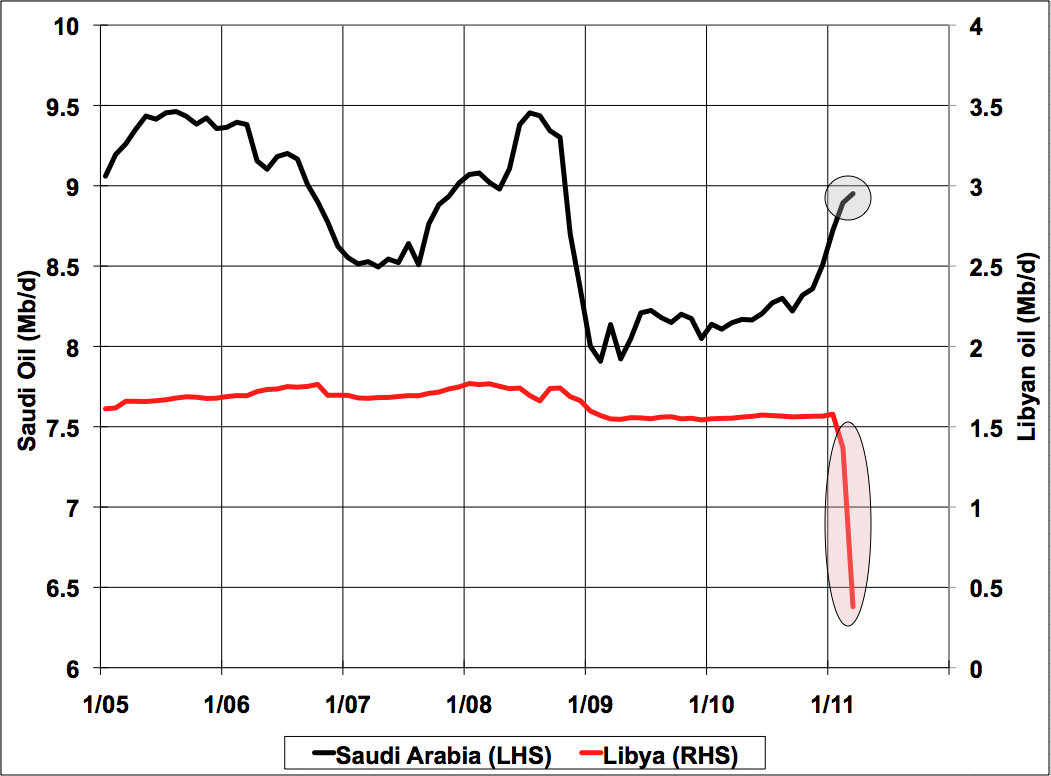
Saudi Arabia did not make up for Libyan oil

A very interesting post on The Oil Drum:

We can put the situation almost entirely down to two things: the fact that Libyan production has plummeted, and that Saudi Arabia has made no significant move to compensate. In fact, Saudi Arabia slowed down production increases that it had been making in prior months.
...
So the world has abruptly lost something like 1.3mbd of oil production between mid February and March.

Read the full story on TOD.

Click here to read the rest of this post.

Tuesday, 5 April 2011

Delays to raising oil output from Kazakhstan

The Telegraph writes:

Kazakhstan is planning a three-year halt to work on the main phase of the super-giant Kashagan oil field development, as international oil companies Royal Dutch Shell and Exxon Mobil fight to convince the country's oil ministry to back a simplified design, which would slash costs by $18bn (£11bn) to $50bn.
...
The Kazakhs are considering shelving the new simplified design, and keeping the field producing at its initial rate of 375,000 barrels per day (bpd) for at least three years, after which the NCOC consortium could use a greater understanding of the geology to produce a better design for the second phase, when production is expected to hit 1.5m bpd. full story
Well, there's another 1m+ barrels per day that's not coming on line when it should have done... Of course, this helps reduce the steepness of the post-peak-oil decline (as this oil will stay in the ground for use later on), but it does bring the start of that decline closer.

Mike

Click here to read the rest of this post.

Wednesday, 30 March 2011

Effects of the new UK tax on oil production start to be felt

A story in the Telegraph says:

One of the world's biggest oil companies, Norway's Statoil, has halted work on two North Sea projects because of the huge tax hit on oil fields in the Budget.
...
It comes after smaller companies such as Valiant Petroleum warned that they are re-evaluating new projects, since the Chancellor increased tax by 12 percentage points to more than 62pc.

There have also been reports that oil majors have withdrawn plans to sell billions of pounds in North Sea fields nearing the end of their lives, leading to fears they will be abandoned with oil still in the ground.

Statoil, the Norwegian state-controlled company, said on Tuesday it will "pause and reflect" on the future of its Mariner and Bressay fields to the south east of Shetland.
Of course, there are pros and cons to this...

On the upside, if oil stays under the seabed for now, it could be extracted later, when North Sea supply has declined further and it will be worth more, and more vital to powering the UK's transition away from oil (assuming we get round to this...). If it stays under the seabed permanently, then that's good for reducing climate change.

On the downside, if existing oil fields are abandoned with oil left in them, it may be that it is difficult (i.e. expensive) to open them up again in years to come, when we might decide we actually really need that oil. In the short term, it will slowly push up oil prices, as new fields come online at a slower rate, so that the declines in output from existing fields are offset to a lesser degree than they would have been.

Overall, my personal opinion is that this is probably positive. It might mean the UK has more indigenous oil left in years to come, when imports have dried up. If abandoned fields can not be accessed again, this won't be the case, but at least then that's some CO2 not released to the atmosphere.

What might have been smarter would have been to have this new tax on oil production, but to also have kept the planned rises in fuel duty, spending the combined revenue on improved and maybe cheaper public transport. But budgets aren't often about doing what's smart, they're about placating the masses to avoid getting voted out of office at the next election, and perhaps also avoiding protests or even riots.

UPDATE
The BBC says:
Scottish Gas-owner Centrica is understood to be reviewing its current and future developments, while Valiant Petroleum also said it had cancelled a project worth up to £93m.
Apparently the government is now meeting with the oil companies to discuss the tax...

Click here to read the rest of this post.
Friday, 11 March 2011

Transcript of Richard Heinberg's presentation at Ecobuild 2011

If you missed Richard Heinberg speaking at Ecobuild 2011, as I did, you'll be pleased to hear that there's a transcript available. Here's the opening paragrpahs:

The premise of my new book, The End of Growth, which will be out in July 2011, is that world economic growth as we know it is hitting up against essential limits.

I am going to argue that the economic crisis that started in 2008 is more significant even than we have been told. To understand it I think we have to look at more than just the financial aspects of the crisis.
Well worth a read of the full transcript.

Click here to read the rest of this post.

Monday, 7 March 2011

Update to Triple Crunch Log from Jeremy Leggett

Jeremy Leggett has just updated his Triple Crunch Log. The email he sent out is well worth a read:

Folks

The triple-crunch log this month, updated now on my website, is dominated by events in the Middle East and the price of oil. As I write, Twitter is ablaze with talk of the protests planned by some Saudi citizens next Friday. Saudi troops are already being deployed around the Kingdom. Before there was any sense that contagion might spread even to Saudi Arabia, some analysts were warning of $220 oil ….”only” if Libyan and Algerian oil production was affected. Now one analyst says this of the prospect of Saudi disruption: “this is when you can come up with pretty much any silly number you want.”

UK Secretary of State for Energy Chris Huhne said yesterday that we face the threat of a 1970s-style soil shock. I fear he is wrong. In the two oil shocks of the 1970s, oil flow rates could be lifted after the respective political crises. This time there is real risk that they can’t, for much longer. The peak oil debate is about both “below ground” (geological) and “above ground” (geopolitical) considerations. The many people who fear that global oil production will drop in the near term, perhaps plunge, stress the potential for below- and above-ground factors to act in concert. Over the last few weeks, above-ground factors have started to hit us hard and fast, while fears continue to build that below-ground there isn't as much readily-recoverable oil left as so many people assume: that reserves and accessible resources are being overstated in the same systemic, cultural, "groupthink", way that the investment bankers overstated their "assets" in the run up to the credit crunch.

The UK Industry Taskforce on Peak Oil and Energy Security has been appealing to the UK government for co-operative contingency planning and proactive risk-abatement for three years now. We remain desperately keen to work with the UK government. The government is belatedly rushing out a plan to wean the UK off oil this week. Let us see what it says.

We are entering a time of consequences. Even if this phase of crisis abates, the core problem is simply delayed. I normally adopt a somewhat apologetic tone in these short monthly missives, but this month please allow me to be a little more strident. Nobody – whether individual, household, community, city, government or business – can responsibly afford simply to hope for a comfortable outcome on the peak-oil risk-issue any longer. We all need to be drawing up contingency plans, and taking whatever proactive measures we can.

Not all the potential outcomes of this latest human drama are negative. There is upside potential for a road to renaissance beyond, including in Saudi Arabia. But we will be challenged, and we will all need to play our parts in holding society together in the tough times ahead. The more proactive we are, obviously, the softer the landing, and the quicker we can engineer the road to renaissance.

For businesses, there is now no longer any excuse for following “business as usual” five year business plans, given the pervasive direct and indirect role of affordable energy costs in those plans. Your board cannot responsibly assume conventional energy prices are going to be in historical brackets over that period.

For those in the corporate world who feel they want to understand the underlying risk issues a little better, I and Chris Skrebowski, consulting editor of Petroleum Review, will offer a 1.5 hour webinar. If your company’s risk managers would like to take part, just send me an e-mail.

Best regards to all

Jeremy

Dr Jeremy Leggett
Founder and Chairman, Solarcentury and SolarAid www.jeremyleggett.net
Twitter: @JeremyLeggett

You can read his Triple Crunch Log here.

Click here to read the rest of this post.

Thursday, 24 February 2011

New all-time high oil price in £/barrel - what it means for the UK

Back in early July 2008, oil prices were at $145/barrel, and with the sterling/dollar exchange rate at the time, this was equivalent to £73/barrel.

This morning, the price of Brent crude oil approached $120/barrel, while the West Texas Intermediate price (a US-focused price) was in the $100-105 range. There's lots of reasons for the difference between the price benchmarks, but the important thing is that WTI is only available in the USA, while Brent is named after production from the North Sea.

Add in the fact that the exchange rate is now $1.62 to the pound, while it was almost $2 to the pound in July 2008, and you now have an oil price this morning of about £74/barrel.

So, in the UK we're now at another all-time high oil price, so expect to see the price of petrol and diesel climbing over the coming days and weeks. Also, consider that the last price spike came at a time of affluence, and helped trigger the biggest recession in decades, while this spike comes while we're still barely out of that recession, and are about to face significant cuts in government spending.

Finally, the persistently high and climbing oil price makes nonsense of the Bank of England's view that the inflation pressure from oil is transient. Expect higher inflation, and interest rate rises to follow. Ultimately, the price of oil will only fall back when enough people decide they are too broke to buy it any more - and that's where we're headed anyway...

At least it's a sunny day.

Mike

Click here to read the rest of this post.

Tuesday, 22 February 2011

The Great Disruption has arrived

Well worth a read:

Why didn’t more of us see it coming? After all, the signals have been clear enough – signals that the ecological system that supports human society is hitting its limits, groaning under the strain of an economy simply too big for the planet. But we didn’t and, as a result, the time to act preventatively has past.

Now we must brace for impact. Now comes The Great Disruption.

It is true that the coming years won’t be pleasant, as our society and economy hits the wall and then realigns around what was always an obvious reality: You cannot have infinite growth on a finite planet. Not ‘should not’, or ‘better not’, but cannot.

Read the full story from Paul Gilding.

Click here to read the rest of this post.