Showing posts with label peak oil. Show all posts

Friday, 12 December 2014

What will the impact of falling oil prices be?

So, oil prices are falling again - down to close to $60, compared to over $100 just a few months ago. Good news for economies and motorists around the world? Or a sign of problems to come?

Prices last fell dramatically in 2008, dropping from $145 in July to $30 in December of that year. Of course, this was due to falling demand caused by a global financial crisis - brought on in part by the rising price of oil forcing homeowners to default on their sub-prime mortgages in order to keep buying ever more expensive food and gasoline. Since then, the oil price crept steadily back up again as economies recovered and expensive oil production was mothballed, clearing $100 in 2011 and staying around that level until the recent fall.

So what's happening this time? Well, two key factors are the risk of weakening demand in some parts of the world due to economic issues, and the increase in USA oil production through the fracking of shale oil. Possible falling demand combined with rising supply has reduced the price. Normally, OPEC would act at this point, reducing oil production to support prices. But this time Saudi Arabia has political motivations, as noted by the BBC recently, wanting to punish countries like Russia and Iran, who are being badly hurt by the falling oil price right now. Saudi Arabia is hurt too, but it has a much bigger financial cushion, so can survive for some time yet on lower prices.

So what will the impact be, beyond lower transport costs in the short term? Most of the new oil supply that has come from US fracking needs a high oil price to be profitable - higher than the price is right now (estimates vary from $65 to $80), so fracking companies will be wondering whether they should pause or halt production, and save the oil for a time when prices are higher and they can make a profit selling it. But the problem is they've borrowed money to get started, and that money has to be paid back no matter what the oil price is. Some people even think this might trigger a new financial crisis, as there is over $200 billion in 'junk bonds' in the energy sector. This isn't a USA-specific issue, Barclays is involved in an $850 million loan which may not be paid back in full.

Looking further ahead, when demand for oil picks up again, the shutdown of expensive oil production like fracking, and also tar sands, would mean that prices could jump up significantly, as it would take time to bring this production back online.

Tar sands in alberta 2008

Finally, there's another factor affecting future oil production - the risk of falling investment. Anybody who's grasped the climate change issue understands that if we want to keep global temperatures from rising too high we can't burn all the fossil fuel resources we know about, never mind resources we haven't found yet. But companies, and even whole countries, are valued by stock and bond markets according to the quantity of fossil fuel reserves they own or have a right to produce. If some of these reserves have to be left in the ground, then the shares of these companies and the national debt of certain countries could be over-valued right now - a 'carbon bubble'. In fact, The Bank of England is researching the risk of this right now, as reported by The Guardian:
The Bank of England is to conduct an enquiry into the risk of fossil fuel companies causing a major economic crash if future climate change rules render their coal, oil and gas assets worthless.

The concept of a “carbon bubble” has gained rapid recognition since 2013, and is being taken increasingly seriously by some major financial companies including Citi bank, HSBC and Moody’s, but the Bank’s enquiry is the most significant endorsement yet from a regulator.

The concern is that if the world’s government’s meet their agreed target of limiting global warming to 2C by cutting carbon emissions, then about two-thirds of proven coal, oil and gas reserves cannot be burned. With fossil fuel companies being among the largest in the world, sharp losses in their value could prompt a new economic crisis.

CarbonBubble ENG

The UK Energy Secretary, Ed Davey, has also been talking about this issue with regard to pension funds, as reported by The Telegraph:
"One has got to worry about the investments for pensioners.

If pension funds are investing in companies or banks that have on their balance sheets huge amounts of assets in fossil fuels, and those assets don’t give the return that people expect – because of changes in technology where low-carbon becomes cheaper or because of the world having to take action against carbon emissions – one has got to protect those pensioners and those investments."
 In summary, there are more than simple market forces at play in the oil price right now, and the consequences of any action, or inaction for that matter, will be far-reaching. Governments would do well to give some serious thought to two key problems - how to get off our addiction to oil (and fossil fuels in general), and how how do it without causing another financial crisis as the big fossil fuel companies are wound down.

Click here to read the rest of this post.

Saturday, 14 June 2014

Catcher - 'major' new North Sea Oil field in context

Numerous news sources are busy celebrating the planned development of the new Catcher oil field in the North Sea. But few of them put it in context, with even the BBC describing it as "a major North Sea field", saying it could ultimately produce 100 million barrels of oil, and other sources mention a peak production of 50,000 barrels per day. These sound like big numbers, but let's compare to the real major oil field of the North Sea - Forties.

PlatformHolly.jpg

Forties is expected to produce over 4 billion barrels during its operational lifetime, and reached a peak output of  520,000 barrels per day in 1978. So that's forty times bigger than the Catcher field, and ten times the peak output. Catcher doesn't look so big now, does it?

Let's also compare it to our current oil production: 925,000 barrels per day, and our oil consumption of 1.5 million barrels per day. So it's basically going to produce 3.3% of our national consumption. Great, that'll make a huge difference... not.

Peak oil is still alive and well, and the IEA's recent report showed that over 80% of investment in energy oil and gas is just to make up for declining production from existing fields. So don't expect to see cheaper petrol or diesel any time soon. Or ever, in fact.


Image: "PlatformHolly" by employee of the U.S. government: public domain - http://www.netl.doe.gov/technologies/oil-gas/Petroleum/projects/EP/ResChar/15127Venoco.htm -- U.S. Department of Energy. Licensed under Public domain via Wikimedia Commons.

Click here to read the rest of this post.

Friday, 10 January 2014

Former BP geologist: peak oil is here and it will 'break economies'

If you thought peak oil had gone away, or at least turned out to be not as bad as you thought it might, perhaps it is time to think again. I expect this story was missed by many, being published as it was the day before Christmas Eve, indeed I only just became aware of it myself. I suggest you go and read the full article in The Guardian, but to show you why, here's a few quotes from the article, which itself is quoting Dr Richard Miller, who worked as a geologist for BP from 1985 to his retirement in 2008.


Dr. Miller critiqued the official industry line that global reserves will last 53 years at current rates of consumption, pointing out that "peaking is the result of declining production rates, not declining reserves." Despite new discoveries and increasing reliance on unconventional oil and gas, 37 countries are already post-peak, and global oil production is declining at about 4.1% per year, or 3.5 million barrels a day (b/d) per year: "We need new production equal to a new Saudi Arabia every 3 to 4 years to maintain and grow supply... New discoveries have not matched consumption since 1986. We are drawing down on our reserves, even though reserves are apparently climbing every year. Reserves are growing due to better technology in old fields, raising the amount we can recover – but production is still falling at 4.1% p.a. [per annum]."
...
"... a sustained decline in global conventional production appears probable before 2030 and there is significant risk of this beginning before 2020... on current evidence the inclusion of tight oil [shale oil] resources appears unlikely to significantly affect this conclusion, partly because the resource base appears relatively modest."

In fact, increasing dependence on shale could worsen decline rates in the long run: "Greater reliance upon tight oil resources produced using hydraulic fracturing will exacerbate any rising trend in global average decline rates, since these wells have no plateau and decline extremely fast - for example, by 90% or more in the first 5 years."
...
"The final peak is going to be decided by the price - how much can we afford to pay?", Dr. Miller told me in an interview about his work. "If we can afford to pay $150 per barrel, we could certainly produce more given a few years of lead time for new developments, but it would break economies again."

And the 'least worst' it gets is:
"We are probably in peak oil today, or at least in the foot-hills. Production could rise a little for a few years yet, but not sufficiently to bring the price down; alternatively, continuous recession in much of the world may keep demand essentially flat for years at the $110/bbl price we have today. But we can't grow the supply at average past rates of about 1.5% per year at today's prices."

Like I said, go and read the full article...

The Royal Society journal it all comes from  is available free online too - I'll read through it when I have time and post some comments, but if you want to take a look now, it's here.

IPC oil derrick

Click here to read the rest of this post.

Wednesday, 24 July 2013

Peak oil lives, but will kill the economy

Interesting story in the Guardian this week, noting that the BBC had lined up a row of 'experts' to tell us that there's no need to worry about the future of oil supplies. The point they seem to have missed is that the cheap oil is declining fast, and the gap is being filled by expensive oil, and that this expensive oil also takes more energy to get it out of the ground and turned into usable fuel.

"Global production of crude oil and condensates... has essentially remained on a plateau of about 75 million barrels per day (mb/d) since 2005 in spite of a large increase in the price of oil. Even more important, the global net oil exports from oil-exporting countries (oil production minus internal consumption) have peaked and are in decline."
...
The Eos paper goes on to point out that while "total oil production has plateaued, production of oil from older existing fields has been in decline, dropping roughly 5% annually, corresponding to a loss of 3-4 mb/d." Although production from unconventional oil and gas has balanced this decline, they are "difficult and expensive" with "very low energy return on investment (EROI)." In simpler terms, "it takes energy to get energy, and more is required to produce energy from unconventional sources."

The outcome is of course that oil will cost more, and that limits economic growth.
The result is an undulating production plateau correlating with higher but more volatile oil prices, as well as a prolonged recession punctuated by small cycles of 'recovery' and contraction.

Hmmm, 'prolonged recession punctuated by small cycles of 'recovery' and contraction.' - sound familiar to anyone?

You can read the full article here.

Click here to read the rest of this post.

Wednesday, 12 June 2013

Interview with Kjell Aleklett, one of the Peak Oil 'founding fathers'

An interesting interview with Kjell was published a couple of days ago, where he sets out the story so far on Peak Oil. Good to hear it from one of the pair who coined the term originally. A few quotes:

How have attitudes shifted since you first made your predictions?
Attitudes have changed considerably. Traditionally, economists have stated that if the price of a commodity is high, you should be able to produce more of it. However, this doesn’t necessarily hold true for a finite resource. Previous IEA and EIA estimates suggested that by 2030, oil production would have reached 120 million barrels per day. They have since revised their estimates to 95 million barrels per day: a reduction of 25 million barrels per day.
...
Do you think that sufficient measures are being taken by policymakers to plan for our transition to the second half of the age of oil?
No. It is clear that in this respect, we have a big problem. It is very difficult for any politician to admit that something is wrong, and that we might need to do something about it. If they were to do this, another politician would come along and say, ‘There’s no problem; vote for me and we can carry on as we are’.

This is the democratic dilemma. Drastic action is necessary, but it is very difficult to achieve. Education will be crucial if we are to succeed in implementing the required measures. Alternatively, it might take a crisis to precipitate change.
This last point is key - how can a politician get elected by telling people that they must consume less and pay more for it? Or is a crisis the only option?

You can read the full interview at Science Omega.
Los-angeles-oil-rigs

Click here to read the rest of this post.

Friday, 7 December 2012

TOD review of OECD oil production, including UK

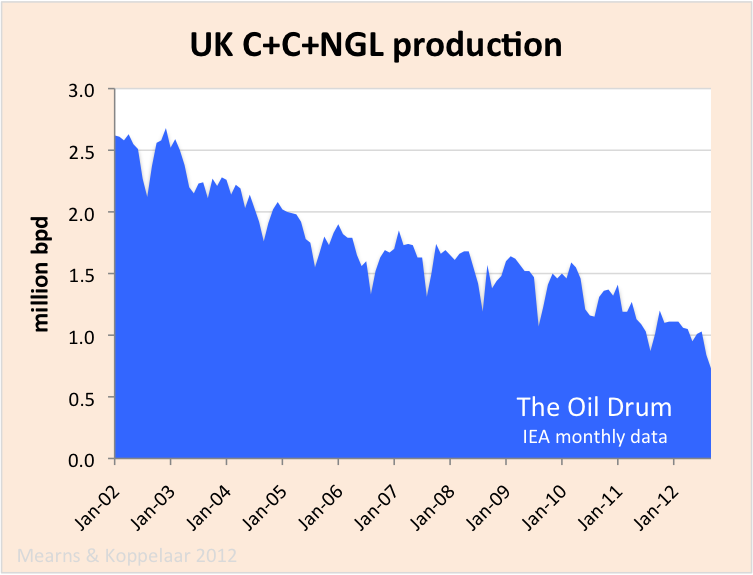
Just a quick note to say there's a good article over on The Oil Drum, looking at oil production trends in the OECD. This includes the UK, and I think this graph pretty much tells the story...


Click here to read the rest of this post.

Thursday, 27 September 2012

UK energy decline continues - DECC Energy Trends Sep 2012

DECC has just published their latest quarterly Energy Trends, and surprise surprise, the UK's energy production is continuing to plummet. The headline figure is that total indigenous energy production has fallen by 10.1%, but this includes nuclear power, which isn't really indigenous as we have to buy uranium for reactors from other countries. So excluding nuclear, the drop is actually 11.4% compared to a year ago.

Here's the breakdown of the overall changes in production from Q2 2011 to Q2 2012:

  • Coal: down 2.9%
  • Oil: down 12.2%
  • Gas: down 12.9%
  • Nuclear: down 3.3%
  • Renewables: up 6.5%

While it's pleasing to see renewables up 6.5%, we should bear in mind the relative quantities of energy we're talking about... So here's the amounts produced in Q2 2012 in Mtoe (million tonnes of oil equivalent):

  • Coal: 3.8 Mtoe
  • Oil: 12.9 Mtoe
  • Gas: 10.2 Mtoe
  • Nuclear: 4.2 Mtoe
  • Renewables: 0.43 Mtoe
Still a very long way to go to get off fossil fuels then...

The Energy Trends table 1.3a (page 11) conveniently tells us the total energy import dependency of the UK as well. Here's the results for Q2 over the past 3 years:
  • Q2 2010: 26.0% imports
  • Q2 2011: 31.8% imports
  • Q2 2012: 42.1% imports
Anyone else spot a trend here? 42.1% is a new record level of dependency on imports, and if the trends keep going the same way as in previous years, we'll set some new record imports in the next two quarters as well.

Here's a few graphs from the report for the key energy sources:

 Oil import/export/production

Gas import/export/production

Coal imports/production
 

Fuel used to generate electricity
 Renewable sources of energy

So, with ever lower energy production, and the changes to gas storage I mentioned in my previous post, we may be in for interesting times if this winter is a cold one...

Mike

Click here to read the rest of this post.

Friday, 21 September 2012

Saudi Arabia burning more of its own crude oil

Following up on an earlier post about falling Saudi oil exports, there's some recent news illustrating the problem:

Saudi Arabia burned record monthly volumes of oil in June and July, official government figures show, contrary to the top crude producer's plan to temper its summer oil burning spree this year with more gas.
The report notes that from 2004 to 2010, Saudi domestic consumption of crude oil for power generation increased by 240%!!! Much of this goes to run air conditioning and desalination - both of which are important facilities when you live in a desert... This leaves ever smaller amounts remaining to be exported, so the only way Saudi can balance its budget is with prices steadily rising. But as that's happening anyway, they don't need to do anything on this front...

Full news article is here.

Mike

Click here to read the rest of this post.

Thursday, 6 September 2012

Saudi Arabia to stop exporting oil by 2030?

Interesting story in the Telegraph today, commenting on a report released by Citigroup on the Saudi petrochemical industry. The main issue is that domestic energy demand is rising fast in Saudi, so more and more of their oil production is being used at home, providing power for air conditioning, desalination, etc.

The report says Saudi could be an oil importer after 2030 - but this is of course not going to happen, as if they stop exporting oil they won't have any money, so importing is out of the question. That does leave me wondering what will happen as exports dwindle, as unless prices keep rising (and the world economy may simply not support that beyond a certain point), then Saudi won't have enough money to keep the country running - and we've seen what's happened in other Arab countries in recent years...

None of this is really news of course - the Export Land Model described the situation years ago - but it's interesting to see the same conclusion coming out of Citigroup!

The quote at the end of the article sums it up for me:

Jeremy Leggett, the head of the UK Taskforce on Peak Oil and Energy Security, says Britain is sleepwalking into a potential disaster by failing to prepare fully for a global supply crunch. The refusal to listen to warning signals is comparable to the complacency in the build-up to the financial crisis, he argues, but with graver implications for the British economy.

Mike

Click here to read the rest of this post.

Tuesday, 7 August 2012

Shrinking size of UK oil and gas fields

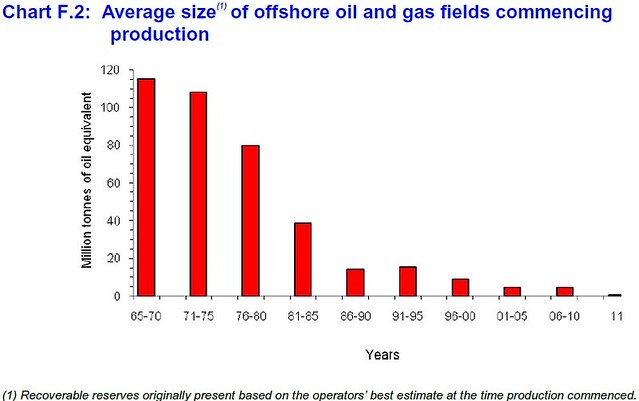
I just came across this graph on page 110 of the 2012 Digest of UK Energy Statistics (internet content) from DECC, showing the size of new UK oil and gas fields coming into production in the UK over the past 55 years. Speaks for itself really...

Declining size of oil/gas fields in the UK North Sea

Page 2 of the Long Term Trends section of DUKES has this cheery paragraph too:
Trends in the production of primary fuels in the United Kingdom are illustrated in Chart 1.1.2. In 2011, total energy production was 137 million tonnes of oil equivalent, an increase of 24 per cent on production in 1970, but down by a record 13.2 per cent on 2010. Total energy production has fallen in each of the last 12 years since it peaked in 1999. In the last ten years, UK energy production has declined at a rate of 6.8 per cent per year; within this natural gas production has declined at the fastest rate, down 8.1 per cent per year, followed by petroleum down 7.8 per cent, coal down 5.3 per cent with primary electricity down 1.9 per cent per year. Bioenergy and waste has grown by an average 8.5 per cent per year over this same time period, though in 2011 accounted for only 4.2 per cent of the UK’s energy production.

Can't help thinking that the growing energy import bill must be having a growing impact on the economy, but it doesn't seem to make the headlines very often...

Click here to read the rest of this post.

Thursday, 19 July 2012

Biofuels and climate change pushing up food prices again

It's been about five years now since biofuel production started to get serious, and right at the outset there were concerns about it taking away land from food production. Well, there's a story in the news in the past couple of days on this topic:

"The time of cheap food prices is over," says Nestle chairman Peter Brabeck-Letmathe.

He is highly critical of the rise in the production of bio-diesel, saying this puts pressure on food supplies by using land and water that would otherwise be used to grow crops for human or animal consumption.

"If no food was used for fuel, the prices would come down again - that is very clear," he says.

"We are now in a new world with a completely different level of food prices because of the direct link with fuel," he says.

BBC News

Of course the important thing is that now the link between food and fuel is there, it's not going to go away very easily. So if you were thinking "well I'm not making it worse as I just burn normal diesel/petrol" then think again - every litre of fuel burned represents demand, and as there's no scope to increase oil supplies now, new demand is going to be met through biofuels. We're all responsible, and we all need to use less liquid fuel for travelling. Besides, ALL petrol and diesel in the UK includes a small percentage of biofuels now anyway...

But it's not just demand for liquid fuels that's the problem. The historic (and continuing) burning of fossil fuels is having an indirect effect on food prices through climate change. Now I know you can't link a specific weather event to climate change, but the 'stuck' jet stream which we've heard so much about recently is possibly partly due to reduced ice cover in the Arctic. While this has been soaking us in the UK, in the US it's brought drought conditions:
US Agriculture Secretary Tom Vilsack has warned the worst drought in decades will result in higher crop prices.

Mr Vilsack met President Barack Obama on Wednesday to discuss the US response to drought concerns, with little rain forecast to ease the crisis.

By the end of June, 55% of the continental US was in a moderate to extreme drought, officials reported.

Crops including corn and soybeans have been hit by the dry conditions, and several states have seen wildfires.

Mr Vilsack announced in a press conference on Wednesday that the US Department of Agriculture had added 39 counties in eight states as "natural disaster areas", making farmers in those counties eligible for low-cost emergency loans.
...
On Monday, a weekly US report said that just 31% of the corn crop and 34% of the soybean crop were in good to excellent shape.

BBC News
Maybe it's time to cycle or walk a bit more?

Click here to read the rest of this post.

Friday, 29 June 2012

Decline in UK energy production continues: DECC

DECC published the latest instalment of its quarterly Energy Trends yesterday, here's a quick summary of the key figures:

Oil

  • Production down 13% on a year ago.
  • Imports increased by 21.7% on a year ago.
  • Crude oil stocks have been declining gradually over the past few years.
  • About 34% of UK oil demand was met by imports over the past 12 months.

Gas

  • Gas production was down 14% on a year ago.
  • Imports shifted away from LNG and towards pipelines compared to a year ago - this isn't surprising given that Japan has been importing extra LNG due to the shutdown of its nuclear reactors since Fukushima.
  • Net imports were down 13% on a year ago, due to milder weather and a significant fall in the use of gas for electricity generation (coal use increased in its place).
  • Despite the fall in net imports, the UK still imported 42% of its gas over the past 12 months.

Coal

  • Coal production was down 12% on a year ago.
  • Coal imports were up 20.8% on a year ago. This was still lower than Q1 2009, but it's worth noting that stocks of coal are much lower now than then, so it seems the imports would have been higher still if not for this.
  • Over the past 12 months, about 66% of our coal has been imported.

Nuclear

  •  Generation fell 11.6% compared to a year ago.

Renewables

  • Generation was up 39% compared to a year ago, though down a bit on the record set in Q4 2011. High rainfall and stronger wind have helped here, as well as increased capacity.
  • Renewable share of total electricity was 11.1%, compared to 7.7% a year ago.
  • Installed capacity was up 36% on a year ago, to 13GW.

Page 72 also had a really interesting graph, showing industrial energy and fuel prices:
Note the steady run up in prices to the peak in 2008, followed by a dip as recession took hold. However, you can see that since that dip, prices have reached new highs (in £ sterling) for crude oil, fuel oil and coal, while in 2011 electricity and gas are pretty much back where they were in 2008.

I think this is why the economic problems are not going to go away - the high and rising prices make it progressively more difficult for the economy to grow, even without the growing pile of debt and austerity measures to deal with it.
    You can download a copy of DECC's latest Energy Trends here.

    Mike

    Click here to read the rest of this post.

    Wednesday, 25 April 2012

    Double dip for anyone?

    After the main course (2005-8 oil price spike and ensuing financial collapse), and going back for seconds (2011-12 oil price spike), we now get that delicious desert - the 'double dip'.

    Though if you look at the graph in this article, you can see that on average the UK has been in recession for 4 years. It's just the 'technical definition' that needs to consecutive quarters of economic contraction.

    And of course energy prices are staying high at the moment, and will continue to do so unless economic activity slows down globally, so we're pretty much stuck with the situation.

    Mike

    Click here to read the rest of this post.

    Monday, 5 March 2012

    Rising oil prices during a recession?

    So somebody at the Telegraph has noticed that oil prices aren't doing what they should... Of course, back in 2008 it was all playing out as normal - prices reached a peak, most economies in the world went into recession, and the price plummeted back down again.

    But look what's happened since 2002:

    • 2002 - Jul 2006: run up from $20 to $76 
    • Jan 2007: dropped to around $52 
    • Jul 2008: up to $147 
    • Dec 2008: drop to around $35 
    • Apr 2010: up to $85 
    • May 2010: drop to $65 
    • Dec 2010: Brent and WTI start to diverge (around $85 at the time) 
    • Apr 2011: Brent at $125, WTI at $110 
    • Oct 2011: Brent at $105, WTI at $77 
    • Feb 2012: Brent at $126, WTI at $108 
    So right now many countries are back in recession, or close to it, but the price keeps heading upwards.  Also, from the UK point of view, note that $125 today is about £79.60, while $147 in July2008 was about £73.50 - so in £ sterling, the oil price is at a new high now.

    Check out the average prices as well:


    Year WTI ($) Brent ($)
    2007 average 72.34 72.44
    2008 average 99.67 96.94
    2009 average 61.95 61.74
    2010 average 79.48 79.61
    2011 average 94.87 111.26
    2012 average 101.09 114.82


    So what the guy in the Telegraph has realised is:

    The unpleasant fact we must all face is that the relentless supply crunch - call it `Peak Oil’ if you want, or `Plateau Oil’ - was briefly disguised during the Great Recession and is already back with a vengeance before the West has fully recovered.
    ...
    So we have a remarkable situation. China alone will be adding 125m cars to its roads over the next five years, with auto production targets of 30m annually by 2016. India is spending $1 trillion on infrastructure projects over the next five years.
    ...
    The West has the disquieting experience of watching crude soar even as we languish in stagnation. This never used to happen. If we faltered, energy costs would fall too, acting as a stabilizer. This harsh new reality is going to become uncomfortable when the emerging world enters a new cycle of growth, leaving us behind. Rising utility costs have already raised the numbers of UK households in poverty from a fifth to a quarter.

    We should not be defeatist. Engineers and scientists are forever at work. A quantum-leap is possible in solar technology. The Chinese may crack cheap and safe nuclear power from thorium, abdicated by the British. But we should not be complacent either. Windmills anybody?
    Read the full story here.

    Click here to read the rest of this post.

    Thursday, 23 February 2012

    Record drop in UK energy production in 2011

    DECC has just released some preliminary information on UK energy statistics for 2011 (download here). Here's the headlines for you:

    • primary energy production fell by a record 14 per cent on a year earlier
    • petroleum [crude oil] was down by 17 per cent
    • gas production down by 20 per cent
    • nuclear output was up 11 per cent, due to increased availability following a number of outages in 2010
    • wind output from major power producers was up by 59 per cent on additional capacity and higher wind speeds
    • hydro up by 70 per cent following strong rainfall in Northern Scotland
    • primary energy consumption was down by 7 per cent, and on a temperature adjusted basis, was down 2 per cent continuing the downward trend of the last five years.

    The falling energy use (after temperature adjustment) is not really down to efficiency, though that may play a part, it's down to continuing low economic activity - it's no coincidence the trend's been going on since 2007, when the overhang of debt in the world economy finally started crumbling under the weight of high oil prices. But at least there's some good news on increasing renewable generation from wind and hydro, even if it did only contribute about 9% of electricity in Q3 2011, or about 1.25% of total energy (from here) Actually, the quarterly data for Q3 is more alarming than the year as a whole, so it'll be interesting to see the data for Q4 when it comes out in late March. For example:
    • Total energy production was a record 19 per cent lower than in the third quarter of 2010... which resulted in net import dependency of 42 per cent, a record high.
    • Oil production fell by 22½ per cent when compared with the third quarter of 2010. This is the largest annual quarterly decrease since quarterly reporting began in 1995, and reflects near record decreases in crude oil production and record decreases in NGL production.
    • Natural gas production was 29½ per cent lower than the third quarter of 2010. This is the lowest quarterly production as well as the largest year-on-year quarterly decrease since quarterly reporting began in 1998. Gas imports increased by 33½ per cent, with shipped imports of LNG accounting for nearly half of all imports.
    • Coal production in the third quarter of 2011 was 10½ per cent lower than the third quarter of 2010.
    Good job we've had a mild winter, or we might have been in a bit of trouble...

    Mike

    Click here to read the rest of this post.

    Friday, 27 January 2012

    Has Petroleum Production Peaked, Ending the Era of Easy Oil?

    An interesting summary of an article in Nature can be found in Scientific American:

    Despite major oil finds off Brazil's coast, new fields in North Dakota and ongoing increases in the conversion of tar sands to oil in Canada, fresh supplies of petroleum are only just enough to offset the production decline from older fields. At best, the world is now living off an oil plateau—roughly 75 million barrels of oil produced each and every day—since at least 2005, according to a new comment published in Nature on January 26.

    The article's by David King, who used to be chief scientific advisor to the UK government, and oceanographer James Murray (University of Washington, Seattle).

    They point out that oil production from conventional resources (i.e. not the inefficient and polluting tar sands and NGLs) has been flat since 2005, despite wide swings in price. Basically, we now have 'inelastic supply', where the volume of oil that can be pumped is fixed, no matter what happens to the demand and price. Finding new oil reserves won't make any significant difference, because we already have a huge base of declining production - more than half the current production will have gone by 2030. This leaves a huge gap to be filled, so the chances of being able to actually increase production are zero.

    They also state what has been obvious to many people:
    Of the 11 recessions in the United States since the Second World War, 10, including the most recent, were preceded by a spike in oil prices. It seems clear that it wasn't just the 'credit crunch' that triggered the 2008 recession, but the rarely-talked-about 'oil-price crunch' as well. High energy prices erode family budgets and act as a head wind against economic recovery.

    So although the banks and sub-prime lending were clearly a problem, it's the oil shock of 2005-08 that really set the whole thing off, and it's the current persistently high oil prices that are preventing a sustained recovery:
    The global economy is severely knocked by oil prices of $100 per barrel or more, creating economic downturn and preventing economic recovery.

    They also point out that economic growth requires a growth in energy supply, and say:
    We need to decouple economic growth from fossil-fuel dependence... This is not happening due to industrial, infrastructural, political and human behavioral inertia. We are stuck in our ways.

    The problem is that economic growth always results in more consumption of resources, both energy and material. Otherwise, what's the point of it? If you can't use your increased wealth to go somewhere, do something or buy something then you may as well not have it. Of course if prices go up, there can be notional 'growth', but because of inflation you're actually getting the same or less than you did before. This applies whether the source of energy is renewable or not.

    So we're back to the problem of economic growth itself... time to watch money as Debt again I think...

    Mike

    UPDATE: the article from nature can be found here

    Click here to read the rest of this post.

    Saturday, 10 December 2011

    What Peak Oil Looks Like

    Thoughtful article over on Energy Bulletin, by John Michael Greer:

    Thus our civilization has entered what John Kenneth Galbraith called “the twilight of illusion,” the point at which the end of a historical process would be clearly visible if everybody wasn’t so busy finding reasons to look somewhere else. A decade ago, those few of us who were paying attention to peak oil were pointing out that if the peak of global conventional petroleum production arrived before any meaningful steps were taken, the price of oil would rise to previously unimagined heights, crippling the global economy and pushing political systems across the industrial world into a rising spiral of dysfunction and internal conflict. With most grades of oil above $100 a barrel, economies around the world mired in a paper “recovery” worse than most recessions, and the United States and European Union both frozen in political stalemates between regional and cultural blocs with radically irreconcilable agendas, that prophecy has turned out to be pretty much square on the money, but you won’t hear many people mention that these days.
    ...
    It’s no longer necessary to speculate, then, about what kind of future the end of the age of cheap abundant energy will bring to the industrial world. That package has already been delivered, and the economic rigor mortis and political gridlock that have tightened its grip on this and so many other countries in the industrial world are, depending on your choice of metaphor, either part of the package or part of the packing material, scattered across the landscape like so much bubble wrap.
    He goes on to talk about how the industrial system is a kind of arbitrage, making profit off the difference between relatively cheap fossil fuels and expensive human labour. Of course, the price of the former has been rising, and the latter may no be falling, so the game changes...

    Read the full article here.

    Mike

    Click here to read the rest of this post.

    Sunday, 30 October 2011

    The Energy Trap

    I just read an interesting post on The Oil Drum. Not a new idea, but a good, clear explanation of it. Basically, it goes like this:

    • after peak, fossil fuel supplies decline at a certain rate per year.
    • renewable (or nuclear) energy can be used to replace the energy supply that is being lost.
    • building new energy supplies USES energy for the construction process.
    • if there was spare fossil fuel, this extra energy needed to build the supplies wouldn't be a problem, but instead we have declining fossil fuel supplies.
    • as a result, starting a big effort to build new energy supplies, of whatever sort, means that there is less energy available globally for other uses.
    • it is then several years before the new energy supplies being built manage to make up for both the fossil fuels lost and the energy used in their own construction - at any given point, giving up on the construction of new supplies would free up some energy and provide a few years of relief from the high energy prices, after which the problem would get worse again.
    As you can see, we need to take several years of pain in higher energy prices to fund a new energy infrastructure that will keep us going in the long run. But since when has anyone voted in a government to do that kind of thing?

    Take for example the impending cut in the UK solar PV feed-in-tariff. Granted, it was probably too generous form the start, which is why it has been 'too successful' - the result is people grumbling about the extra few pounds added to their electricity bills, rather than congratulating the government on getting lots of new energy supply infrastructure installed.

    People want jam today, not tomorrow. We'll all be paying the price later...

    Mike

    Read the full article on TOD

    Click here to read the rest of this post.

    Thursday, 27 October 2011

    TOD: Are We Reaching “Limits to Growth”?

    From a new post on the Oil Drum:

    It looks to me as though 2012 is likely to be a truly awful financial year, with several crises converging:
    • Either very high oil prices or recession,
    • The US governmental debt limit crisis,
    • The Euro crisis,
    • The Chinese debt problem,
    • Debt deleveraging in the US and elsewhere,
    • Further MENA (Middle East/North Africa) political problems, and
    • Conflict between need for greater resources and pollution issues.
    ...
    If a person follows through the expected effects of high oil prices and debt, the financial system would appear to be the most vulnerable part of the system. The financial system would also appear to be what telegraphs problems from one part of the system to another. Unless a solution is found, failure of the financial system could ultimately bring down the whole system.
    ...
    Nothing happens overnight with the world economy, so changes are likely to take place over a period of years, rather than all at once. We can’t know exactly what the future will bring, but the handwriting on the wall is worrisome.

    Well worth reading the full story.

    Mike

    Click here to read the rest of this post.

    Friday, 30 September 2011

    UK oil output drops 16% in a year

    The Telegraph reports:

    Britain's oil production from the North Sea has fallen by 16pc since last year in a drastic drop that will cost the Treasury millions of pounds in lost taxes. Officials from the Department for Energy and Climate Change put the unexpectedly large fall down to "maintenance and other production issues" on top of the long-term trend of declining output.
    ...
    The Health and Safety Executive has warned that only one in 30 of the UK's North Sea oil rigs is in a good condition. A number of large platforms have closed for major maintenance this year. Full story
    So on top of a declining natural resource, we've got a creaking and rusting and infrastructure... Doesn't bode well for energy security, or for the UK balance of payments...

    Mike

    Click here to read the rest of this post.