Showing posts with label winter. Show all posts

Friday, 16 October 2015

UK gas supply outlook for winter 2015/16

It was back in April that I blogged about the cut Centrica had made in the capacity at Rough, due to problems with some of the wells limiting the maximum operating pressure. At the time, Centrica hoped that by now the capacity would have been restored, but a press release in July said that they now didn't expect to know if this would be possible until some time between September and December 2016! The net result is that the capacity of Rough has been reduced by 25%.

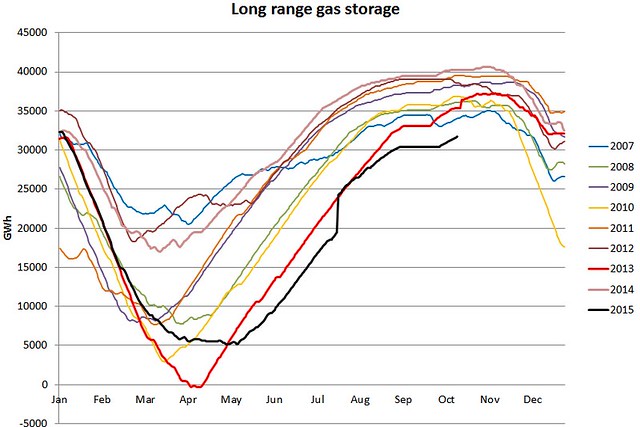
Clearly this presents a problem for UK winter gas supply, so it's not surprising that another July press release stated that the Oil and Gas Authority had given Centrica permission to reduce the minimum operating pressure of Rough, thus 'converting' some of the cushion gas (which would normally be left in the store) into working gas, which can be withdrawn and re-injected. This shows up on the chart below (black line = 2015), where a sudden jump up in July can be seen, due to the addition of about 4,625 GWh (or about 400 mcm). The same trick was pulled in 2013 (red line in chart below), after dipping into the cushion gas in April 2013, capacity was increased arbitrarily in the October 2013. It's a bit like keeping driving your car after the fuel gauge has gone into the red - it works OK for a while, but you can't do it for long...

Despite this bit of creative accounting, the chart below shows that we are still going into this winter with a record low amount of gas in storage, and National Grid's Winter Outlook notes this on page 43, saying storage is reduced by 14%, from 4.9 bcm to 4.2 bcm. It would have been 22% less if Centrica hadn't fiddled the figures by dipping even further into the cushion gas.

UK long range gas storage 16 Oct 2015

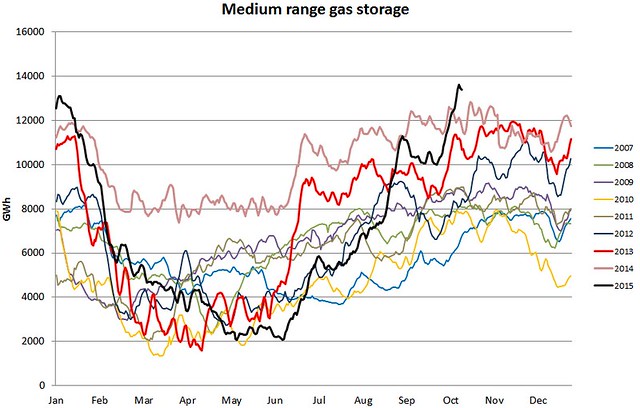
Medium range storage is looking better, with increased capacity and a record amount in storage, but nowhere near enough to make up for the shortfall at Rough.

UK medium range gas storage 16 Oct 2015

So, the big question has to be about demand. We have fewer coal power stations than we did a year ago (which is a good thing, of course!), which could in theory mean that more gas gets burned to generate electricity. But the big factor will be the weather as always, which is hard to predict at this stage, as there are several extra factors to bear in mind:
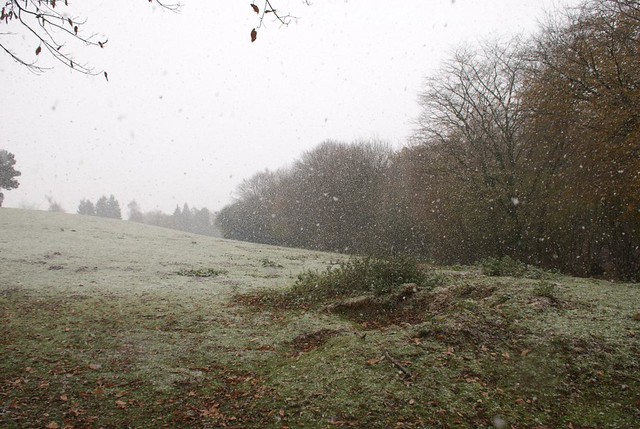
Time will tell, and we'll soon see if this winter looks like this:
DSC_5364

or like this:
DSC_5428

Click here to read the rest of this post.

Saturday, 11 April 2015

UK gas storage capacity slashed

A couple of weeks ago Centrica Storage quietly made an announcement on its website:

As part of CSL’s assurance programme and as a responsible operator and given the age of the field and installation, CSL has decided to limit the maximum operating pressure of the Rough wells to 3000 psi. CSL has decided to take the prudent step to test and verify the operating parameters of the Rough wells. It is anticipated that this limitation will last up to 6 months.
 Rough is an undersea gas storage facility, connected by pipeline to the terminal at Easington in Yorkshire:
Easington Langeled Terminal

It's able to store about 4 billion cubic metres of gas - or at least it was before the above announcement. Some more detail from Platts indicates that the reduction in operating pressure will reduce Rough's capacity by about a quarter. Because Rough comprises about 72% of the UK's total gas storage, this is equivalent to losing just under 20% from total storage capacity.

Now, Centrica Storage has said this is for six months, while tests are carried out, but Platts notes that the tests are needed because of concerns about well integrity - so it's possible that the capacity will be permanently reduced. Even if it isn't, the coming six months are exactly when the storage is normally refilled, so if full capacity is restored at the end of the testing period, it may well be too late to completely fill the storage.

So, let's assume the UK goes into next winter with 1 billion cubic metres of gas less in storage than usual - what might the impact be? 2013/14 was a mild winter, and Rough still had over 1.5 billion cubic metres left in it in March 2014. It was a different matter in April 2013, when it had actually gone below 'zero', eating into the gas cushion that was supposed to be left untouched. This year, there's about 0.5 billion cubic meters left in it right now - the situation was similar every year from 2008-2011 inclusive. This means that if the coming winter is mild, we should have no problems; if it is average, then we will probably need to increase imports, which will bump up prices; if it is cold, then we could well have a problem.

The graph below shows the levels in Rough over the past few years in GWh (10 GWh is about the same as 1 million cubic metres), so you can see the situation for yourself. Any year where the level dropped below 10,000 GWh is a year when the announced capacity reduction might have been a problem:
UK long range gas storage

Let's hope and pray for a mild winter!

Click here to read the rest of this post.

Wednesday, 3 September 2014

UK National Grid asks for help keeping the lights on this winter

After a fire put one of the 370MW generators at E.ON's Ironbridge coal-fired power station out of action in February, another fire knocked out two 500MW coal-fired units at SSE's Northbridge power station too, with one expected to return to service no earlier than November 2014, and the other after March 2015. Then EDF announced the shutdown of the 1190MW Heysham 1 and the 1150MW Hartlepool nuclear power stations in August, due to concerns over a design flaw in the boilers - these are expected to return to service during October.

So it's hardly a surprise that National Grid has asked if anybody can commit to providing extra reserves of electricity generation for this winter...

Of course, we don't know how cold the winter may be yet - if it's mild like 2013/14 then we probably wouldn't have a problem. At least the gas storage is nice and full, after light usage last winter. But if it happens to be cold, or if there are further outages at our ageing power stations, then things might get a bit tight...

Heysham Power Station, from dockside

UPDATE (4 Sep 2014): EDF has now said the reactors will only come gradually back online between October and December...

Click here to read the rest of this post.

Thursday, 28 November 2013

Blown fuse in Norway reduces UK gas supply

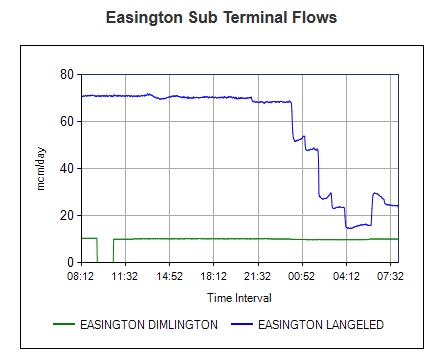
OK, well not a blown fuse literally, but a circuit breaker tripped and shut down a chunk of output from the Ormen Lange gas field, which is one of the main sources of gas for the UK, via the Langeled pipeline. This story indicates the cut should only be for 24 hours. You can see the effect on this graph of Langeled output taken from a National Grid website:

Langeled shortfall 28Nov2013
Not a huge problem today, but this is exactly the kind of thing that can cause dangerously low supplies when it happens in colder weather - of which there is more to come in the next few months...

Mike

Click here to read the rest of this post.

Monday, 14 October 2013

Keeping the lights on? UK gas supplies and prices in winter 2013/14

With the UK weather turning colder over the last week, it's time to take a look at how our creaking gas and electricity infrastructure might cope this winter. I'll look at two areas - first, National Grid's Winter Outlook for 2013/14, and second, my own analysis of their data on UK gas storage.

Most of National Grid's Winter Outlook is dedicated to gas, as the supply/demand is affected much more than electricity by the availability of imports and how cold the weather is. The report indicates that there is, in theory, plenty of gas supply for even the coldest weather that the UK could experience. In practice, however, situations can arise where supplies are far from secure. For example, earlier this year an unseasonably cold March coincided with a brief outage in the Bacton Interconnector, resulting in gas storage levels dropping to record lows. LNG imports were low at the same time, due to demand from Japan and China - this has not changed since then. The situation is illustrated well by a graph from from page 13 of the Winter Outlook, where the 2012/13 line can be seen going off the cold end of scale in March:
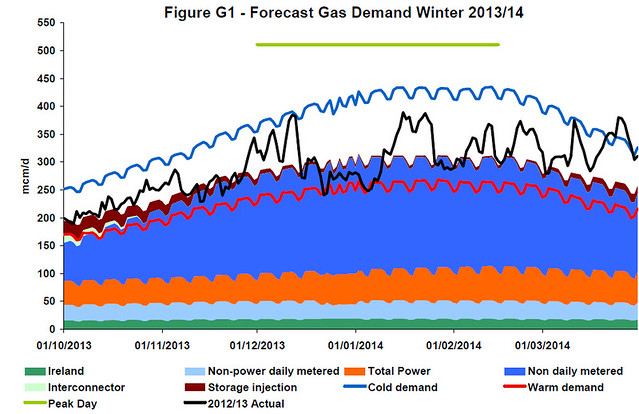
Fig G1 from National Grid Winter Outlook 2013-14

This exposes the other flaw in our gas market - if it is cold in Europe at the same time as it is cold here, there's no guarantee that gas suppliers in France, Germany and elsewhere won't keep gas for local use due to obligations placed upon them. Alastair Buchanan, the former head of OFGEM who stepped down from his post in June after 10 years’ service, comments on this in an interview with The Telegraph, and goes on to say that uncertain gas supplies combine with ageing power stations in the UK to create a real risk of temporary blackouts if the weather is cold over the next few winters. Over 40% of the UK's electricity is generated by burning gas, so the two are closely linked. In the Winter Outlook, National Grid notes that the margin of spare electricity generating capacity this winter would only be 5% during a cold spell, compared to 17% just two years ago.

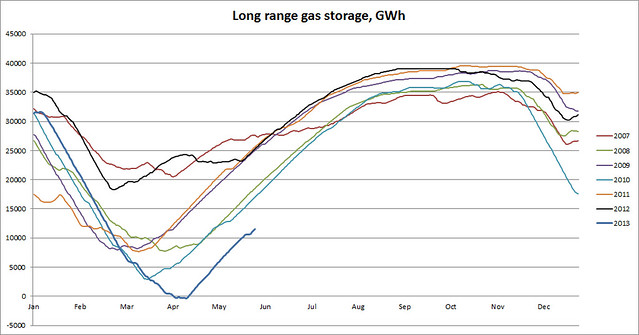
Moving on to the current state of our gas stores, here's some graphs I've plotted using data available from the National Grid website. First, here's the amount of gas in Long Range Storage, which is basically a single depleted gas field known as Rough, owned by Centrica. 2013 is in red on the graph.
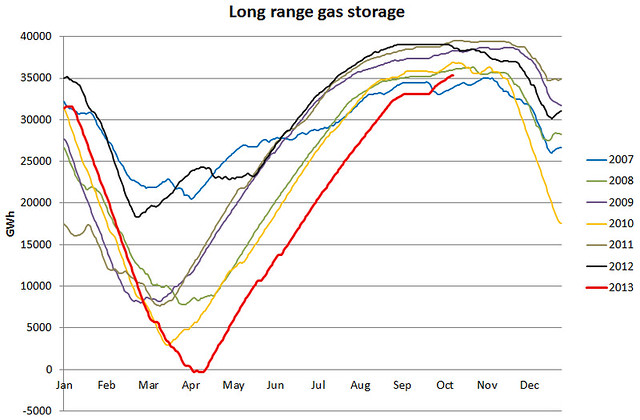
UK gas long range storage 14 Oct 2013

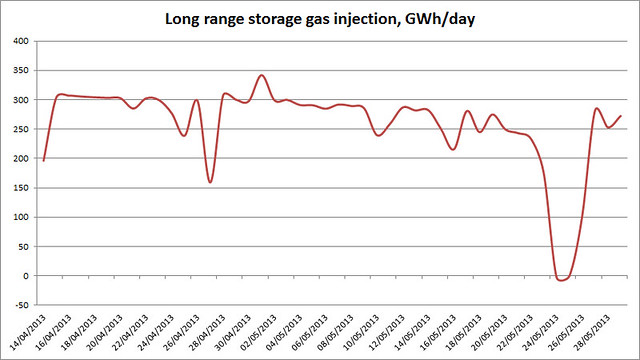
As you can see, the main factor affecting the storage levels in Rough this winter is what happened last winter. The cold weather dragging on through March and April resulted in the storage level actually going below 'zero' (see my blog at the time for an explanation), so we've been playing catch-up all summer and the current level is lower for this date in October than any time since 2007 (when North Sea supplies were much greater than today...). There's little hope of the storage getting filled up to the higher levels seen in the past few years, partly due to physical limits to how fast gas can be pumped in and partly due to the rising cost as we go into winter. The rate at which Rough has been filled this year is shown in the graph below. Why they decided to take a break from filling it at some points is beyond me...
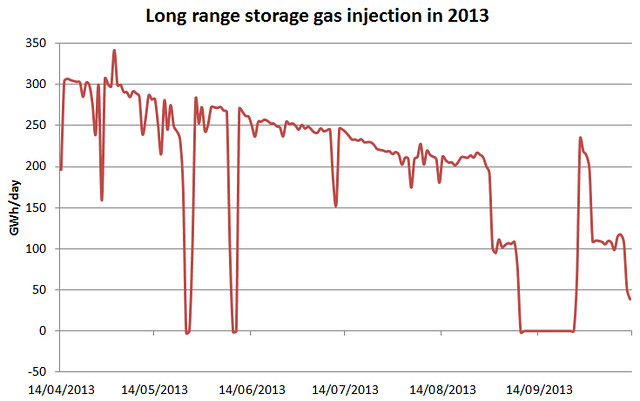
UK gas LRS injection 14 Oct 2013

You'd think that someone would be building more storage space for gas, but a recent story in The Telegraph noted that:

Centrica has written off £240m in wasted costs after scrapping its £1.4bn plan to convert an empty North Sea gas field into a gas storage site, and shelving another smaller project indefinitely.

The situation with Medium Range Storage is not so bad, though this doesn't fully compensate for the current shortfall at Rough:
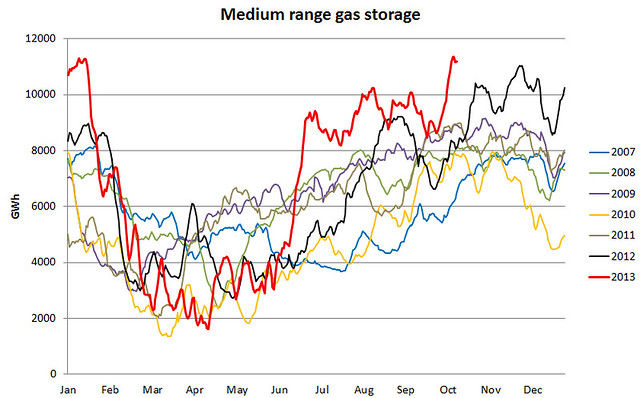
UK gas medium range storage 14 Oct 2013

Short Range Storage is very low, but the amounts required to fill it up are relatively small. It does still need doing though, as these stores are critical to cover unexpected outages, which seem to occur regularly enough that the may as well be expected these days...
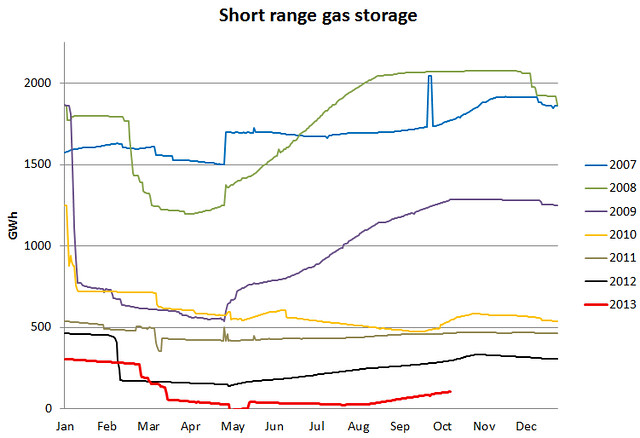
UK gas short range storage 14 Oct 2013

Of course, the question that most people will be asking is 'What will happen to prices?' Well, I said in a post on this blog in May 2013:
This can only translate into higher bills eventually, although the bumper profits made last winter may result in a short delay before this happens. Boosted gas prices will feed through into electricity prices too.
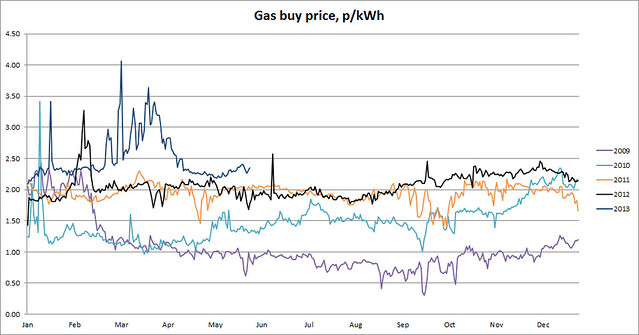
Lo and behold, one of the 'big six' have already put up their prices, and I'm sure the others will follow suit. I know they blame 'green taxes' and transportation costs, while the government blames fat profits in the upstream sections of the energy companies, and there is a little truth in all these claims, but the simple fact is that in the year ending 30 June 2013 we imported over 50% of our gas (data from DECC). This means that we are at the mercy of European and global demand and weather. The graph I've plotted below shows spot market prices as reported by National Grid over the past few years. The trend is clear, and the average price this year so far is currently up 18% on the year before, in part due to the very low storage levels at the start of the summer.

UK gas buy price history 14 Oct 2013


I will of course be keeping an eye on gas storage levels, and the weather forecast, over the coming 4-5 months, and don't forget you can check the current gas situation yourself at National Grid's Prevailing View page.

If you're wondering what else you can do, at the risk of repeating myself, you can:
  • Reduce demand (wear warmer clothes, turn the thermostat down, don't boil a saucepan without a lid on it, etc.)
  • Improve efficiency (insulate your house, draughtproof, double-glaze, etc.)
  • Use renewable energy
There's some examples of what we've done at home for the above points here, and you can check out some inspiring ideas on the Ashden website too.

Keep warm, and pray that we don't get too many days that look like this in the coming winter...
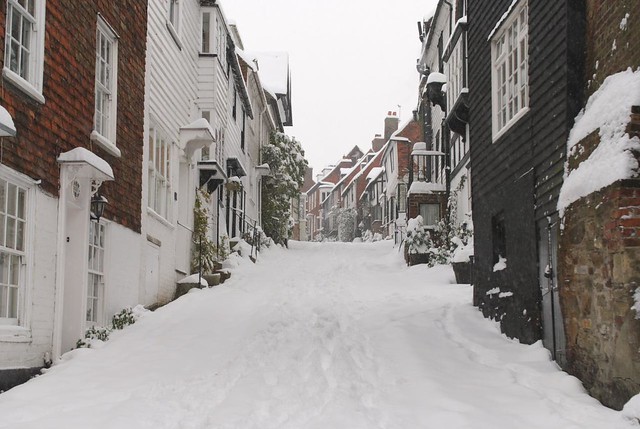
DSC_5464

Mike

Click here to read the rest of this post.
Wednesday, 29 May 2013

UK gas supply and prices for winter 2013/14

Yeah, yeah, I know summer's not even started yet, but the UK gas markets are already planning ahead to next winter. Time to take a first look at how things are shaping up...

As you will remember, winter dragged on a bit this year in the UK, and it was only seven weeks ago that our gas supplies were running on empty. As I noted at the time, this leaves us with a problem, as there is now not enough time to easily refill the long range gas storage before next winter, as there are technical limits to how fast gas can be injected back into the store at Rough.

To illustrate the problem here's a graph showing long range gas stock levels for the past few years (click for a larger version):

UK long range gas storage level 29 May 2013
As you can see, we are starting from an all-time low and are several weeks behind the next worst case (which was 2010). Here's another graph showing the rate at which gas has been injected into Rough since the cold weather stopped:
UK long range gas storage injection rate 29 May 2013
Centrica have actually been making a good effort to get gas in there as fast as possible, actually setting a new record on 1 May, but there have still been some blips due to cold weather or other issues that have slowed things down.

So how has this been affecting price? The exceptionally low storage level following last winter represents itself as extra demand in the gas market between now and next winter, so it's no surprise that average wholesale prices are up 23% for the year to date compared to 2012:
UK gas buy price 29 May 2013

This can only translate into higher bills eventually, although the bumper profits made last winter may result in a short delay before this happens. Boosted gas prices will feed through into electricity prices too.

So what can you do? Well, the message hasn't changed - insulate and draught-proof your house, upgrade your heating controls and thermostats, get a new boiler if you need to. Switching supplier will make little difference, especially in the long run, so the only answer is to use less gas.

I'll post more updates over the summer when I see how things are going in preparation for the coming winter.

Mike

Click here to read the rest of this post.
Friday, 29 March 2013

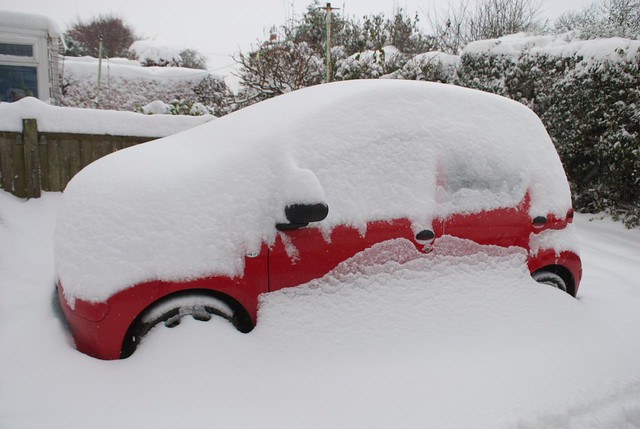
UK gas stores running down in continued cold weather

Lots of gas was drawn out of storage in the past two days. The previous lowest storage level on record was 17 March 2010, when we had a total of 4,932GWh, split as Long Range Storage (LRS) 2959, Medium Range Storage (MRS) 1357, Short Range Storage (SRS) 616

The 4pm update on 28 March 2013 showed 3,399GWh in storage, split as LRS 1150, MRS 2200, SRS 49, so that's a new record low.

Also, by 28 March 2010, over 3,200GWh had already been reinjected to stores after the low, whereas this year it looks like we won't be putting much back in through the whole of April...

Even if we scrape through the remainder of this winter, we are not in a good position already for next winter...

Get the latest data here: http://marketinformation.natgrid.co.uk/gas/frmPrevalingView.aspx

Snow blizzard

Click here to read the rest of this post.
Monday, 25 March 2013

LNG to the UK's rescue this week?

Some positive news on UK gas supply from Reuters today:

The first of a trio of tanker loads of super-cooled gas from the world's largest LNG exporter docked at the Isle of Grain terminal near London on Sunday, with a second due in Wales on Monday and a third on Friday, tracking data on Reuters shows.

The Qatari tankers could supply a total of around 430 million cubic metres (mcm) of gas to Britain over the next week, compared with daily gas demand of around 370 mcm, while another tanker has set sail from Trinidad on Saturday after UK gas prices leapt on Friday when a key supply link from Belgium shut unexpectedly for 8 hours.
Lng tanker

Of course, the key is that it's only because wholesale gas prices have been so high in the past few weeks that it's arriving:
But it may take sustained high UK wholesale gas prices to lure many more gas tankers away from consistently higher paying buyers in Asia to the UK.
I expect this will enable the UK to scrape through this week's cold weather, and no doubt the government will declare that the market has 'worked'. I imagine many customers will question how well it is 'working' though when their inflated gas bills arrive later this year...

We'll need to keep prices high to keep the LNG arriving and the import pipelines flowing, as the weather is expected to stay colder than average for a few weeks yet. And there's that Norwegian shutdown looming next Monday as well...

Fundamentally we are now in an international bidding war, and we either pay up or the lights go out next winter. Of course, we could always try using less energy, but that doesn't seem to be a very high priority for the government right now...

Mike

Click here to read the rest of this post.
Friday, 22 March 2013

Bacton gas outage - how well did we cope, and what next?

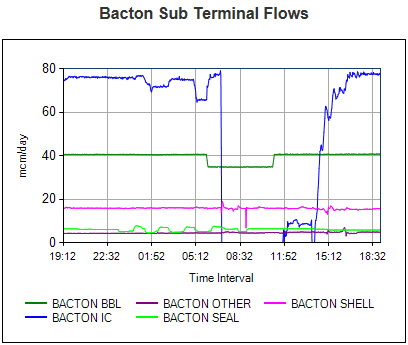
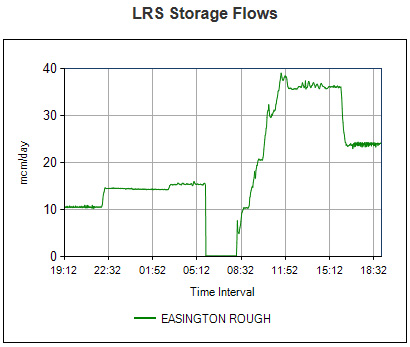
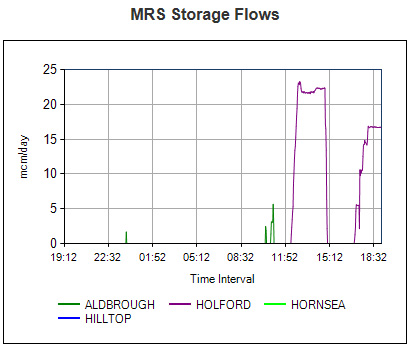
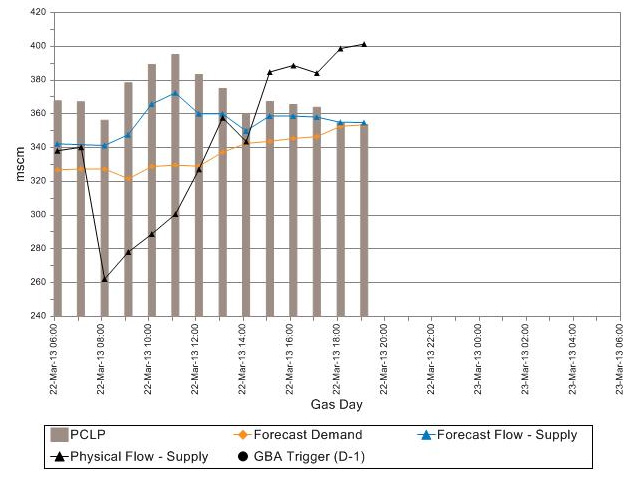
Earlier today I wrote about an outage at the Bacton Interconnector, which imports gas from Belgium to the UK. The outage was caused by the failure of a simple pump, but couldn't have come at a worse time, given the low amount of gas in UK storage and the ongoing cold weather. So how did the UK and National Grid cope with the outage, and what are the consequences? The following graphs were all screen captured from National Grid's Instantaneous Flows Report in 24-hour view at about 7:30pm on Fri 22 March 2013.

This first one shows the problem - the blue line represents gas entering the UK via the Bacton Interconnector. From about 7am to 2pm there was little or no gas coming through, compared to the rest of the day when the flow was about 70mcm/day. So that's about 20mcm that had to be found from other places to meet today's UK gas demand (which is high, due to the cold weather). Demand today was around 350mcm, so this was just under 6% of the day's demand that went missing.

National Grid UK gas graphs Fri 22 Mar 2013

Well, clearly the lights didn't go our (remember that about a third of our electricity is generated by burning gas), so what happened? Well, the first thing was that gas started flowing out of Long Range Storage, which is actually an old gas field called Rough. There was no gas coming out of this prior to the Bacton outage, but about an hour after it, flows started and ramped up close to maximum for the duration of the outage, and stayed a bit above half maximum afterwards. To put this in context, if gas was drawn from LRS at maximum rate continuously, we only have enough in it right now to keep going for about 5 days.

National Grid UK gas graphs Fri 22 Mar 2013

A little bit later on, extra gas started flowing from one of the Liquefied Natural Gas (LNG) terminals. This is gas that arrives on tankers from Qatar and other places, is pumped into storage vessels and released gradually as required. However, we've not been able to import much LNG in the past year, as Japan is buying a lot of the global supply, to replace the output of the nuclear power stations that were shut down after Fukushima. There's about 65% more gas in the LNG stores than there is in LRS right now. At the time of writing the flows coming out of LNG were about 18mcm/day, at which rate the stocks would last about 21 days - but with more cold weather coming, the withdrawal rate could increase.

National Grid UK gas graphs Fri 22 Mar 2013

As the outage continued, gas also started flowing from the Medium Range Stores. There's currently about the same amount of gas in MRS as in LRS, but it can be released faster when required - though clearly that would only then give us a few days' supply.

National Grid UK gas graphs Fri 22 Mar 2013


This final graph was from one of the links on National Grid's Prevailing View page. The black line indicates actual flows, and the orange line indicates the estimate for the day's gas demand at that point in the day. The effect of the Bacton outage is clear, as is the increased supply post-outage to compensate for what went missing.

National Grid UK gas graphs Fri 22 Mar 2013
So the good news is that the 'market' worked, and enough gas arrived despite the outage. The bad news is that the extra supply came out of storage and LNG, reducing stocks. This is a problem because the coming week is forecast to be unseasonably cold for March - check out the 'feels like' temperature map at the Met Office. Add to this the fact that one large coal power station shut for good today (Didcot A, 2,000 MW), and others are to follow - so that means more gas being burned to generate electricity.

So, we have a tight week ahead for gas and electricity supply in the UK, with the cold weather. What about after that? I'm sure we're all hoping Spring will arrive eventually, and be followed by a decent summer. But even if everywhere is lovely and warm, there's still a job to be done - refilling the gas storage and getting the LNG stores back up to a decent level. This will be expensive work - we need to import a lot of gas to do this, and ultimately it's you and I who are going to pay for it, one way or another. But it's not even that simple sadly... Norway needs to take about 40 mcm/day of production offline from 1 April to 2 August to carry out maintenance. This is bound to reduce availability to some extent in the European gas market, so can only push prices higher, and perhaps even limit what it is possible for us to put back into the gas stores before next winter.

Let's hope the summer is a warm one...

Click here to read the rest of this post.

Tuesday, 19 March 2013

What does the future hold for UK gas supply?

The gas crunch in the UK continues, with the current cold weather pushing demand up and very low storage continuing to be a concern. An article yesterday in the FT explains the situation very well (note, you can go via Google to avoid the paywall):

When a power cut at the Nyhamna gas processing plant in Norway hit production this month, prices in the UK soared 50 per cent in one day. The plant feeds the 1,200km Langeled pipeline that exports gas from the vast Ormen Lange field to Britain.

The loss in output was shortlived but for many in the UK it was indicative of a more worrying trend: an increasing exposure to new supply risks as North Sea production declines and competition for imports of liquefied natural gas increases.

Coming at a time when ageing coal-fired plants are being retired and new nuclear power faces delays, it raises questions over energy security, as the industry undergoes its biggest changes since privatisation in the 1980s. Alistair Buchanan, chief executive of Ofgem, the electricity regulator, warned of higher energy bills last month ahead of a “horrendous” gas supply crunch.
These are all issues I've written about recently on this blog, here and here. Just to summarise, these are the key problems that affect the UK at present or in the near future:
  • Gas production from our own fields is falling, often by around 10% a year.
  • Gas supplies from Norway (18-22% of UK winter demand) are subject to interruption, such as the storm-induced power cut mentioned above, and a technical problem in 2010.
  • Gas supplies from Europe by pipeline are subject to political problems, such as past disputes between Russia and Ukraine. They can also be affected by cold weather in Europe increasing demand there.
  • LNG imports have fallen dramatically since Fukushima, as Japan is outbidding the UK for gas.
  • Several of the UK's coal power stations will shut down for good in twelve days, with more to follow in the coming year. Some of our nuclear plants are also nearing the end of their lives.
The situation right now is that UK gas storage is at its lowest level for this time of year since 2010, and we may yet go lower than that, setting a new record. The difference is that our own gas production now is 37% lower now than it was then, comparing Q3 2012 with Q3 2010.

So while we may scrape though the tail end of this winter without any major panics on gas supply (though it's not over till the fat lady sings...), the low level of storage and limitations on supply mean that we are going to have to pay for a lot more gas imports over the coming months to refill the stores ready for next winter. So, we are virtually guaranteed to see higher domestic gas prices this year, and because about a third of our electricity is generated from burning gas, we will see prices rise there too, especially due to the shift of generation from coal to gas that will happen shortly.

If you've not already insulated and draught-proofed your home, now might be a good time to start...

Mike

Click here to read the rest of this post.

Monday, 24 September 2012

UK gas storage and winter 2012/13

It's a bit early yet to start thinking in earnest yet about the UK's gas supply for this coming winter, though if some of the concerns about melting Arctic ice causing cold European winters prove correct, we may have problems.

However, there is one little snippet of information that came out this summer from national Grid about the closing of two of the three short range gas storage sites. These facilities stored gas in liquefied form (LNG), and could rapidly reinject it into the national grid in periods of high demand. The couldn't do it for long, perhaps just a few days, but it would usually be enough to save us from serious problems.

Here's what National Grid said:

Closure of Partington and Glenmavis LNG Storage Facilities

27 June 2012

Following the LNG Storage Strategic Review in 2010, Commercial Storage Services have not been offered from our sites at Partington in Manchester and Glenmavis near Glasgow since early 2011.

Our LNG stocks were withdrawn from Partington in March 2011, following which a
decommissioning process has been undertaken and the site was formally closed on 31
March this year. A demolition contract has been awarded to Masterton Ltd who will demolish the tanks and remove all the other equipment on site over the next six to twelve months.

In the absence of any contracts to fund ongoing LNG storage services from Glenmavis, the decision has been taken to close the facility and the remaining LNG stocks were withdrawn in May. The decommissioning process has now commenced and when this has been completed the LNG storage facility will formally be closed.

These decisions do not affect the provision of services from our remaining LNG storage facility at Avonmouth near Bristol.

The net result is that back in Sep 2010 we could inject 389.8GWh of gas a day from short range storage into the grid, and now the figure is only 143GWh/day. For comparison, this is equivalent to 22mcm/day of storage supply going offline, or about 5% of peak UK winter gas demand. This wasn't a problem last winter, as it didn't get too cold. But this winter the supplies from the North Sea will be lower (as they are every year), so if it gets cold for very long, we may have problems...

Mike

Click here to read the rest of this post.