Showing posts with label gas prices. Show all posts

Wednesday, 29 May 2013

UK gas supply and prices for winter 2013/14

Yeah, yeah, I know summer's not even started yet, but the UK gas markets are already planning ahead to next winter. Time to take a first look at how things are shaping up...

As you will remember, winter dragged on a bit this year in the UK, and it was only seven weeks ago that our gas supplies were running on empty. As I noted at the time, this leaves us with a problem, as there is now not enough time to easily refill the long range gas storage before next winter, as there are technical limits to how fast gas can be injected back into the store at Rough.

To illustrate the problem here's a graph showing long range gas stock levels for the past few years (click for a larger version):
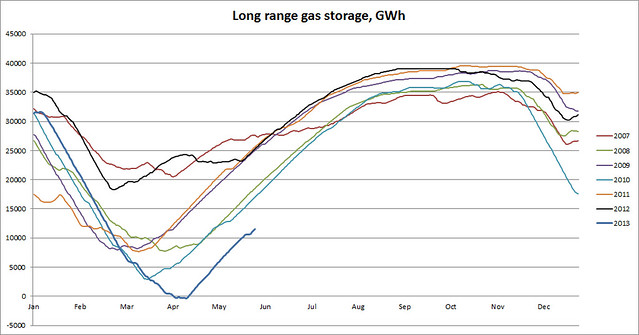
UK long range gas storage level 29 May 2013
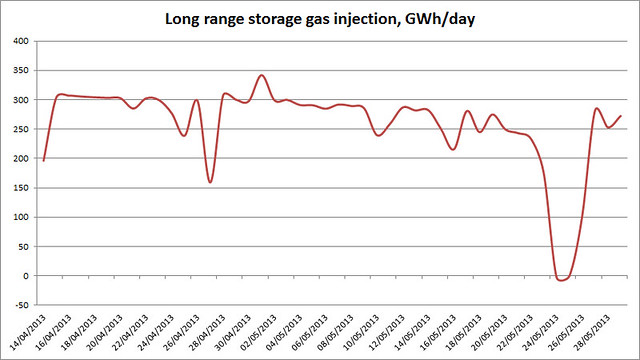
As you can see, we are starting from an all-time low and are several weeks behind the next worst case (which was 2010). Here's another graph showing the rate at which gas has been injected into Rough since the cold weather stopped:
UK long range gas storage injection rate 29 May 2013
Centrica have actually been making a good effort to get gas in there as fast as possible, actually setting a new record on 1 May, but there have still been some blips due to cold weather or other issues that have slowed things down.

So how has this been affecting price? The exceptionally low storage level following last winter represents itself as extra demand in the gas market between now and next winter, so it's no surprise that average wholesale prices are up 23% for the year to date compared to 2012:
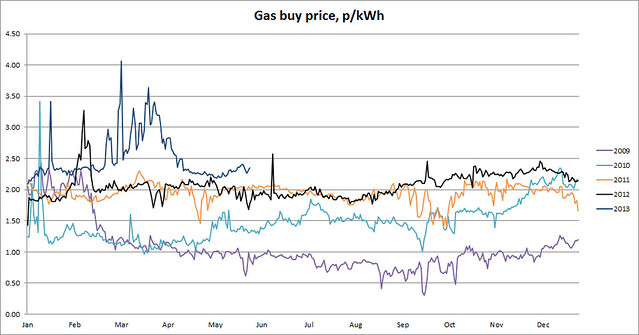
UK gas buy price 29 May 2013

This can only translate into higher bills eventually, although the bumper profits made last winter may result in a short delay before this happens. Boosted gas prices will feed through into electricity prices too.

So what can you do? Well, the message hasn't changed - insulate and draught-proof your house, upgrade your heating controls and thermostats, get a new boiler if you need to. Switching supplier will make little difference, especially in the long run, so the only answer is to use less gas.

I'll post more updates over the summer when I see how things are going in preparation for the coming winter.

Mike

Click here to read the rest of this post.

Saturday, 16 July 2011

Continuing Fukushima impact on oil and gas prices

Back in April I wrote about the effect of the nuclear disaster in Japan on gas prices globally and in the UK. Well, the situation continues to develop... Not only are the reactors at Fukushima still not in cold shutdown, but other reactors are being shut down for problems which previously might have been ignored, due to the public reaction to the situation. On top of this, there is a strong possibility that Japan may try to become nuclear-free.

A recent Reuters article gives some more info, suggesting that if all nuclear plants are shut down in Japan their crude oil imports may almost triple as crude oil and fuel oil are burned to generate electricity. Of course, this would mean high CO2 emissions, so in practice they will be burning a lot more gas so that oil doesn't increase by so much. LNG imports are already up 30% on a year ago, and the article predicts that ultimately we could see global prices go up by almost 50% from where they are now.

What this really comes down to is that globally we are now close to a zero-sum game for energy. If one source (Japanese nuclear plants) disappears, and is replaced by oil and gas from the global market, then someone else has to do without that energy. We don't have physical rationing, so instead we will get rationing by price - the cost of fuel will rise until some consumers can no longer afford it, whether that's entire countries or individual households.

Mike

Click here to read the rest of this post.

Wednesday, 8 June 2011

News roundup - prices of food, gas and electricity, and OPEC output

A few interesting news stories in recent days.

The Telegraph reported that food prices are rising at the fastest pace in 23 months in the UK. What's this got to do with oil? Well, here's some quotes from the article:

Disappointing crops and demand from the biofuel industry have helped corn prices rise 112pc in an year and wheat 72pc.
...
Rising energy prices have also pushed up the costs experienced throughout the supply chain, said the BRC.   full article
So there you go, flat or falling supplies of conventional cheap crude oil are boosting food prices through increased demand for biofuels and also through the energy used in growing, processing, transporting, storing and selling food. Expect more of this to come - it is not a 'blip'.

Moving onto gas and electricity, several weeks ago I was warning on this blog of rising prices, and since then the price of wholesale gas in the UK has been hovering around 2p/kWh, which is getting on for double what it was a year ago. So, it was only a matter of time before this fed through into domestic bills. Scottish and Southern has been the first to move:
Scottish Power is to raise the cost of gas by 19% and the cost of electricity by 10%. The utility firm said the increase, which would affect 2.4 million households in the UK, would come into effect from 1 August.
...
Scottish Power's latest rise will mean that customers who take gas and electricity from the company but pay quarterly by cash will see their annual bills rise by an average of £180 to £1,391.   full article
So if you needed another incentive to improve your home's energy efficiency and reduce your reliance on fossil fuels, now you have it.

So what next? Well, OPEC have today announced that they are not going to boost levels of crude oil production, so the price of oil has ticked up another dollar or so. Of course, it may all be academic - nobody really knows if Saudi Arabia actually has any spare capacity, and if it does, how long it could be maintained...

And finally, all of this feeds into inflation, which makes it ever harder for the Bank of England to resist raising interest rates. But if they don't and inflation stays high, then they are effectively taxing everyone's savings and delivering real-terms pay cuts to anyone whose pay isn't going up by 5 or 6% a year...

Mike

Click here to read the rest of this post.