Thursday, 8 September 2011

Why UK oil and gas production will keep falling fast

In this post I'm going to show you a few graphs from a UK government department, and explain what they mean for future UK oil and gas production.

The Department of Energy and Climate Change has recently published the 2011 Digest of UK Energy Statistics (DUKES), which is a fairly lengthy document. Of particular interest is the 'internet booklet' version, which includes the graphs I'll show you in a moment. A bit of background first...

When an oil or gas field is discovered and developed, production initially rises, then reaches a peak, and finally falls away. The rate at which production falls tends to drop over time, so you end up with a 'long tail' of low production that can carry on for many years - or until the field's owner decides it is no longer generating enough income to be worth maintaining. However, this pattern has changed in the past couple of decades, as explained by this quote from the DUKES internet booklet:

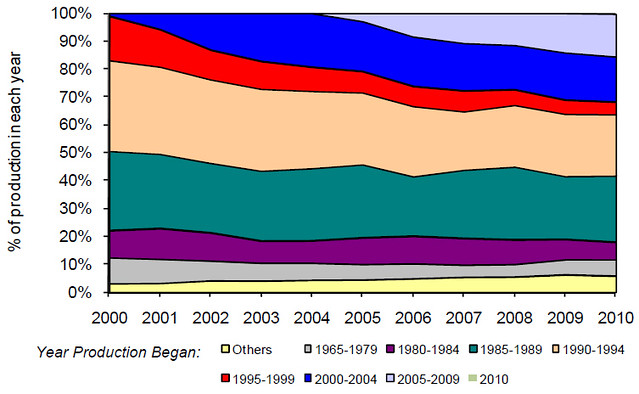
It can be seen from the production chart that during the 2000s the amount of oil produced from older established fields was in general decline. It is also noticeable that the decline in post 1994 developments is greater than in earlier developments. This is because later technology meant crude oil could be extracted at a relatively greater rate leading to a quicker exhaustion of the reserves. In 2010, these newer (post 1994) fields accounted for 69 per cent of the UK’s oil production.
Here's the chart it is referring to, showing oil production, with fields grouped by the year they started production (all charts can be clicked to view a larger version):
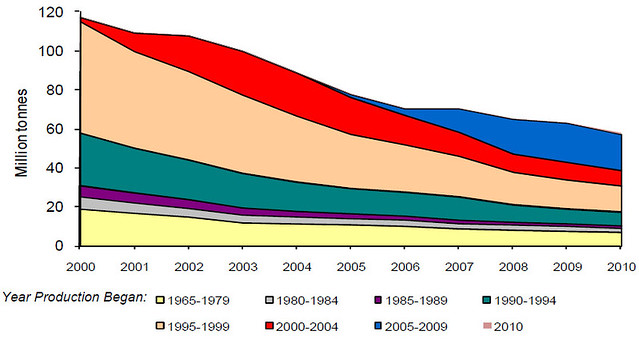
UK oil field production by year started

The older fields had new technology applied as it became available, maintaining steady but lower production over longer periods of time, but the newer fields have had all the advanced technology applied very quickly (to make money faster), and as a result the production rises quickly, but also falls quickly once peak production is passed. This has allowed the rather small oil fields discovered in the past couple of decades to offset the slow decline from the much larger, older fields, but now that some of them are declining, and declining fast, there is really nowhere left to turn other than importing oil (the UK has been a net importer since 2005). The following chart shows the same data, but as percentage share of total production:
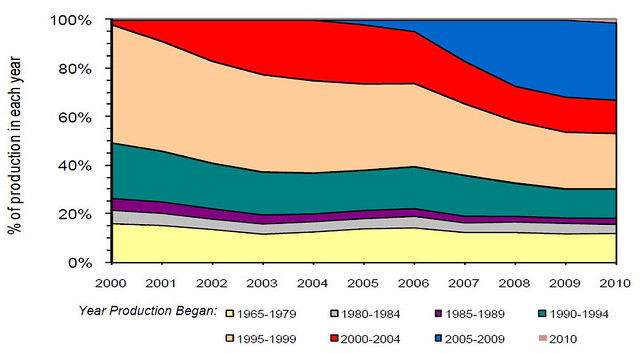
UK oil field production share
As you can see, the majority of our oil production is now from recently developed smaller fields, which experience shows us will decline quickly - so we've got quite a long way to fall before we bottom out on the 'long tail' of oil production which we can reasonably count on for a longer period.

And just to complete the picture, here's the same graphs for gas fields (bear in mind that in 2010 over 40% of our electricity was generated by burning gas...):
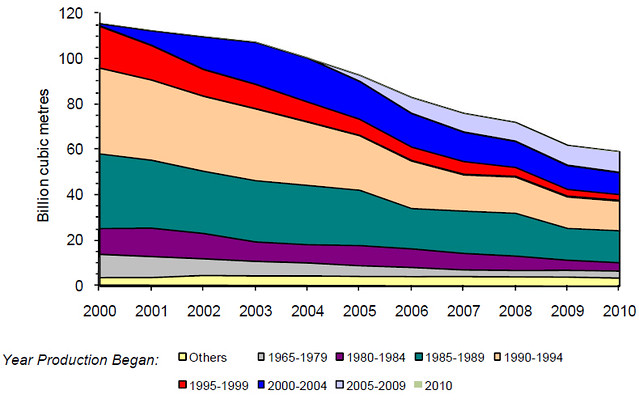
UK gas field production by year started

UK gas field production share

Ever played a game of Snakes and Ladders? I think the UK is half way down a snake...

Mike

Click here to read the rest of this post.

How much oil will Saudi Arabia have spare to export?

For a long time the Export Land Model has been used to argue that as a country's internal oil consumption rises, less is available for it to export. This makes sense, and as long as oil prices rise, the exporting country may continue to earn sufficient income from its reduced exports. Normally we think of this increased domestic oil demand as coming from greater economic activity, resulting in more cars and trucks driving around, or more oil being used in industry. In Saudi Arabia however there are two other significant sources of demand...

The first is air conditioning, which needs electricity. Most countries avoid burning oil or oil-derived fuels to generate electricity as they are too expensive, but Saudi Arabia burns crude oil in some of its power plants, so more air conditioning results in more domestic oil use.

The second is desalination. Saudi Arabia has very little water, and oil-fired desalination plants are used to produce the water needed for agricultural, industrial and domestic use.

A recent article from Reuters said:

The International Energy Agency and analysts at HSBC bank estimated Saudi Arabia's rate of direct crude burning more than doubled from 2008 to 2010 because of a rapid rise in power demand and a shortage of natural gas. How much of that went to desalination is not known but experts believe it is significant.
Of course, the ideal would be that water is used more carefully, but if this doesn't happen, and demand for aircon keeps rising, the rate of oil exports from Saudi Arabia could be falling pretty quickly before too long...

Mike

Click here to read the rest of this post.

Friday, 5 August 2011

Who killed economic growth?

Great little video here from the Post Carbon Institute, featuring Richard Heinberg (author of 'The Party's Over'):


Click here to read the rest of this post.
Saturday, 16 July 2011

Continuing Fukushima impact on oil and gas prices

Back in April I wrote about the effect of the nuclear disaster in Japan on gas prices globally and in the UK. Well, the situation continues to develop... Not only are the reactors at Fukushima still not in cold shutdown, but other reactors are being shut down for problems which previously might have been ignored, due to the public reaction to the situation. On top of this, there is a strong possibility that Japan may try to become nuclear-free.

A recent Reuters article gives some more info, suggesting that if all nuclear plants are shut down in Japan their crude oil imports may almost triple as crude oil and fuel oil are burned to generate electricity. Of course, this would mean high CO2 emissions, so in practice they will be burning a lot more gas so that oil doesn't increase by so much. LNG imports are already up 30% on a year ago, and the article predicts that ultimately we could see global prices go up by almost 50% from where they are now.

What this really comes down to is that globally we are now close to a zero-sum game for energy. If one source (Japanese nuclear plants) disappears, and is replaced by oil and gas from the global market, then someone else has to do without that energy. We don't have physical rationing, so instead we will get rationing by price - the cost of fuel will rise until some consumers can no longer afford it, whether that's entire countries or individual households.

Mike

Click here to read the rest of this post.
Friday, 1 July 2011

Huge decline in UK oil and gas production in Q1 2011

The latest instalment of DECC's Energy Trends series has just been published, covering Q1 2011. You can download a copy here (1.8MB PDF).

The summary page says it all really, with these bullet points:

  • Total energy production was 11 per cent lower than in the first quarter of 2010.
  • Oil production was 15½ per cent lower than in the first quarter of 2010, due to maintenance activity and slowdowns.
  • Natural gas production was 17½ per cent lower compared with the first quarter of 2010. Net imports of gas increased by ½ per cent. Liquefied Natural Gas (LNG) accounted for 43½ per cent of gas imports.
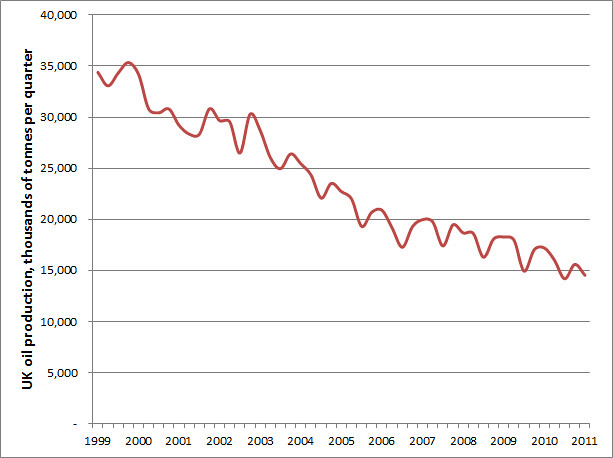
If, like me, you prefer to see it represented graphically, you'll be pleased with what I've prepared for you below...

Here's a chart of quarterly oil production in the UK, from the start of 1999 to Q1 2011:
UK oil production 1999-2011

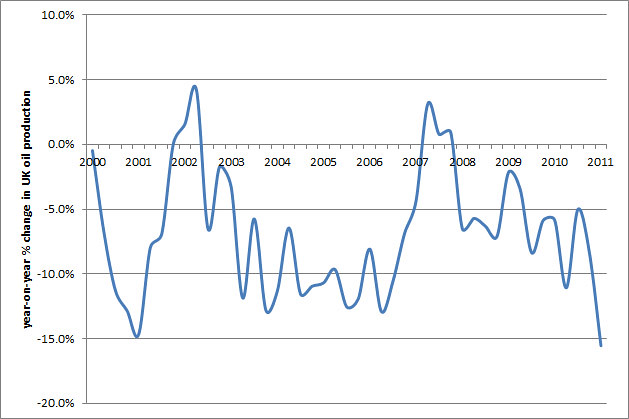
Not looking too promising, is it? To help see the trend, here's a graph showing the % change year-on-year from 2000 to 2011:
UK oil production change 1999-2011

As you can see, there's been the odd blip where production has risen, but the last time was in 2007, and the first quarter for this year set a new record for the decline.

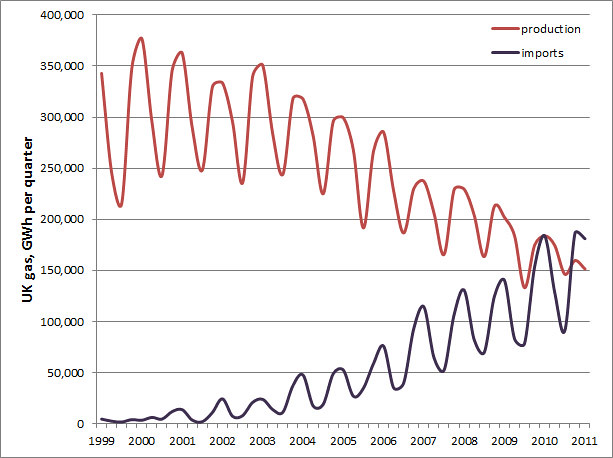
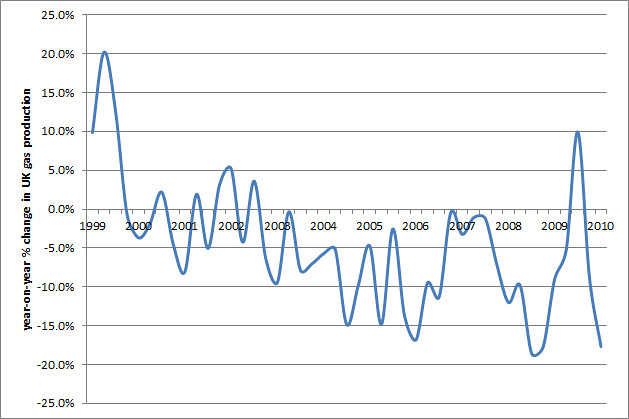
Moving on to gas, here's the another production graph, but this time I've added on the amount being imported as well:

As you can see, there's a similar trend as for oil, though with greater seasonal fluctuations. I think this is probably because the gas market is more fluid, with pipelines connecting us to Europe, meaning production is often slowed down while prices are low. Here's a percentage change graph again, with the same high fluctuations, and close to a new record on decline:
UK gas production change 1999-2011

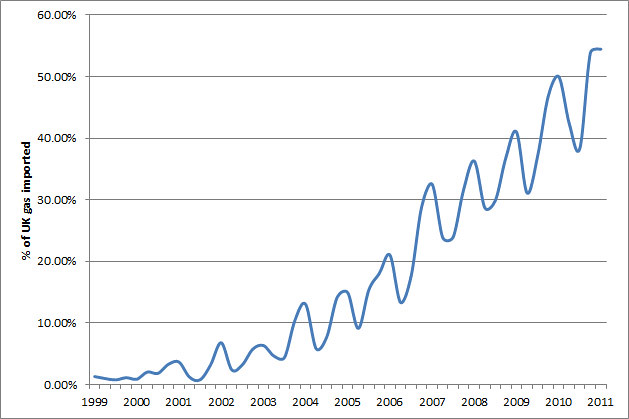
Just to reiterate the problem we have with gas, here's another graph showing the percentage of UK gas supplied by imports, on a quarterly basis:
share of UK gas imported 1999-2011

As you can see, we imported more than half our gas in the final quarter of 2010, which isn't surprising as it was very cold, but also in the first quarter of 2011 - when it was actually relatively mild!

Many thanks to DECC for providing these figures publicly - shame the government isn't taking the urgent action which the graphs above should prompt them to. It's not just about energy security and keeping the lights on this winter, it's also about whether we can afford the imports. To put it in context, wholesale gas has been trading on the National Grid at about 2p/kWh this summer. The graphs above are in GWh, one of which would cost £20,000 at the same rates.

In the past two quarters we've imported over 367,000 GWh - that's about £7.3 billion worth of gas. So if anyone was still wondering why gas prices are going up,  now you have part of the answer...

It's summer now, but winter is coming - take the time over the coming months to insulate your walls and loft if you've not already done so, and if you want to do even more, take a look at my other blog for some ideas.

Click here to read the rest of this post.
Friday, 24 June 2011

IEA oil release from emergency reserves - start of a slippery slope?

Yesterday the IEA announced it was releasing 60m barrels of oil from its 'emergency' reserves, at a rate of 2m barrels per day. The interesting question is: what is the emergency? OK, Libyan oil is not flowing, but that's been the case for months now. Japan is using extra LNG, though it's not clear if oil use there is higher than before the tsunami, but once again, this is not a recent change.

The only reason that can be seen for releasing this 'emergency' oil is that high prices are choking off the economic recovery in developed countries. But if the high prices are due to restricted supply, then this is just the market doing its work - 'rationing by price'. If we don't like it, we should try physical rationing or other ways to get people to use less oil. If the market is signalling a shortage through rising prices, then doesn't trying to reduce those prices without fixing the underlying problem (excessive oil consumption) just push the problem a month or two further down the road?

Worse still, if we're using 'emergency' reserves when there isn't really an emergency, and if this starts happening more often, what will happen when these reserves are gone?

Of course there's always more going on behind the scenes than we know about in public. Take this news story from last week as an example:

The government was warned by its own civil servants two years ago that there could be "significant negative economic consequences" to the UK posed by near-term "peak oil" energy shortages.

Ministers were told it was impossible to know exactly when production might fail to meet supply but when it did there could be global consequences, including "civil unrest".

Yet ministers consistently played down the threat with the contemporaneous Wicks review into energy security effectively dismissing peak oil as alarmist and irrelevant.
full story
Basically, some smart, forward-thinking civil servants in DECC were researching peak oil and its impact on the UK in 2007, and in June 2009 a report was prepared, but ministers ignored it. This has only become public now because of Freedom of Information requests... You can download the slides here, but they are pretty in depth (which is good to see). Slide 16 is interesting, as most of the impacts which were researched in 2007 have now happened to one degree or another. So, coming back to the IEA oil release, maybe it ties in well with this stuff from DECC - they are perhaps trying to mitigate some of the immediate impacts of peak oil. Unfortunately this can't go on for much longer, as our emergency reserves are just as finite as the oil under the ground...

Mike

Click here to read the rest of this post.
Wednesday, 8 June 2011

News roundup - prices of food, gas and electricity, and OPEC output

A few interesting news stories in recent days.

The Telegraph reported that food prices are rising at the fastest pace in 23 months in the UK. What's this got to do with oil? Well, here's some quotes from the article:

Disappointing crops and demand from the biofuel industry have helped corn prices rise 112pc in an year and wheat 72pc.
...
Rising energy prices have also pushed up the costs experienced throughout the supply chain, said the BRC.   full article
So there you go, flat or falling supplies of conventional cheap crude oil are boosting food prices through increased demand for biofuels and also through the energy used in growing, processing, transporting, storing and selling food. Expect more of this to come - it is not a 'blip'.

Moving onto gas and electricity, several weeks ago I was warning on this blog of rising prices, and since then the price of wholesale gas in the UK has been hovering around 2p/kWh, which is getting on for double what it was a year ago. So, it was only a matter of time before this fed through into domestic bills. Scottish and Southern has been the first to move:
Scottish Power is to raise the cost of gas by 19% and the cost of electricity by 10%. The utility firm said the increase, which would affect 2.4 million households in the UK, would come into effect from 1 August.
...
Scottish Power's latest rise will mean that customers who take gas and electricity from the company but pay quarterly by cash will see their annual bills rise by an average of £180 to £1,391.   full article
So if you needed another incentive to improve your home's energy efficiency and reduce your reliance on fossil fuels, now you have it.

So what next? Well, OPEC have today announced that they are not going to boost levels of crude oil production, so the price of oil has ticked up another dollar or so. Of course, it may all be academic - nobody really knows if Saudi Arabia actually has any spare capacity, and if it does, how long it could be maintained...

And finally, all of this feeds into inflation, which makes it ever harder for the Bank of England to resist raising interest rates. But if they don't and inflation stays high, then they are effectively taxing everyone's savings and delivering real-terms pay cuts to anyone whose pay isn't going up by 5 or 6% a year...

Mike

Click here to read the rest of this post.