Thursday, 1 March 2018

National Grid UK Gas Deficit Warning 1 Mar 2018 - LNG supply problems

I woke up to an interesting text and email this morning:
National Grid NTS has issued a Gas Deficit Warning
Please see Prevailing View for the latest information.
The Gas Deficit Warning will remain in place until it is withdrawn by National Grid NTS.

A quick glance at the Entry Zone Graphs in 24-hour mode shows why. Yesterday evening, with demand of a bit under 400mcm/day, over 100mcm was coming from LNG supplies stored at Milford Haven and Isle of Grain, about and nearly 80mcm from medium range storage. Long range storage (Rough)  is pumping out the dregs prior to shutting down for good, and was supplying 8mcm.

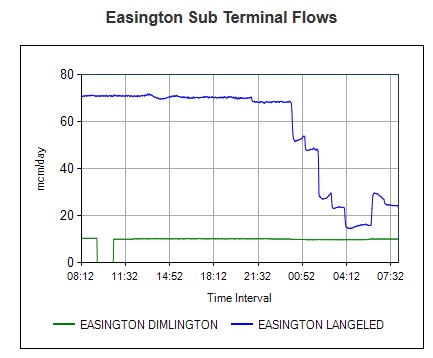
But early this morning, all four supplies of LNG into the gas network dropped significantly, and the smaller supply from Rough dropped to zero as well:

Of course, the immediate question is why? The REMIT website for South Hook LNG shows that the regasification plant went out of action at 05:23, though it's strange that output from Grain and Dragon dropped too, as they don't say much about it yet. South Hook does say that normal operations resumed at 06:55, so maybe things will get back to normal soon - output is indeed rising there, and at Dragon. 

Still, it should serve as a warning as to just how little slack there is in the UK's energy supply system right now, and the Grain LNG flow still looks to be staying low, so we may not be out of the woods yet. The REMIT section at Isle of Grain website simply says: "Grain LNG Terminal are currently experiencing capacity and gas flow restrictions." Let's wait and see what happens...

Click here to read the rest of this post.

Thursday, 22 June 2017

Centrica has given up on Rough UK gas storage

Easington Langeled Terminal

Centrica has finally given up on Rough, the UK’s only long-term gas storage facility, after two years of problems. This will mean increased prices averaged over a year, as we can no longer store significant quantities of gas in the summer to be released in the winter, and will make us more susceptible to international incidents that affect gas supplies, whether by pipeline or LNG tanker. It’s worth noting that we import a lot of LNG from Qatar, which is currently in the middle of a diplomatic crisis. The only ameliorating factor is that the ‘cushion gas’ that is currently in Rough can still be produced, so although no new gas can be put in, there will still be some to take out for a few years – but this will be at a lower flow rate than when the store was full, which would have been the case at the start of each winter in the past. To sum up the numbers:
  • Rough represented 70% of the UK’s gas storage volume.
  • It was able to supply 300 GWh of gas per day, which represents 6% of the peak daily winter demand in 2010 of 5,000GWh
  • It could hold over 40,000GWh – so could supply gas at peak rate for 4 months (though in practice the flow rate dropped as it emptied).
  • The remaining gas stores can supply a higher daily rate, but can only do it for a much shorter period, as their total capacity is just over 14,000GWh
  • About 14,000 GWh of LNG can be stored, but depends on a stream of tankers to top it up, and we have to bid on the world market to get them.
  • There is perhaps up to 57,000 GWh of gas still in Rough, which will provide supplies for several years at a progressively declining flow rate.

In some ways this could be good news, creating more incentive for renewable energy and alternative forms of energy storage, but it could also increase demand for fracking in the UK, which would be a bad thing environmentally...

News stories on this: Guardian, FT, Reuters.

Click here to read the rest of this post.

Wednesday, 30 November 2016

UK winter energy supply 2016-17

Following on from my previous post on gas supply, here's an update on the overall energy situation in the UK this winter.

The good news is that the gas storage site at Rough is due to come back online by 9 Dec, according to Centrica. Of course, it's still only 1/3 full, so we're not out of the woods yet.

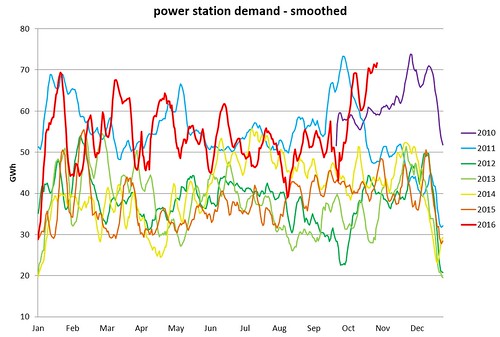
The bad news is that several nuclear power stations in France have been offline for safety checks for some time now, and the result is that instead of importing up to 2GW of electricity from France, the UK is importing less, or even exporting to France. You can see this live on the graphs at Gridwatch. This extra power is largely coming from our CCGT (gas) power stations, which of course means increased gas use - this was already showing up in the graph I posted a few weeks ago, and has continued since then. (The red line is 2016 - click for a larger version)

It's also proving to be a colder than average winter so far in the UK, so we'll have to wait and see how things turn out over the coming months...

Click here to read the rest of this post.

Thursday, 3 November 2016

Outlook for UK gas supply in winter 2016/17

The UK Met Office has released it's long range outlook for Nov 2016 to Jan 2017, and it's expecting at least the first part of the winter to be a bit colder than average - there's some in depth discussion of it in this BBC video. So now's a good time to review what shape UK gas supplies are in.

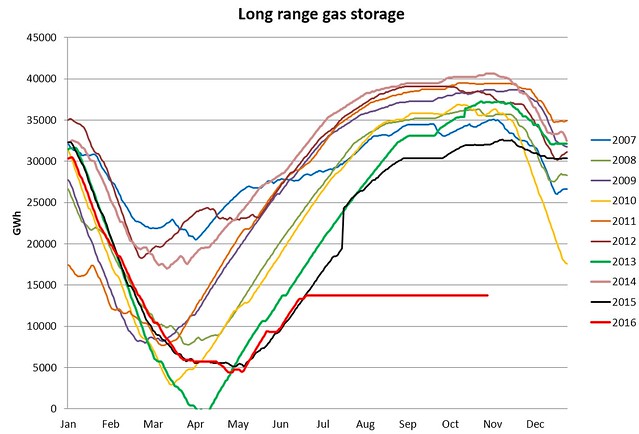
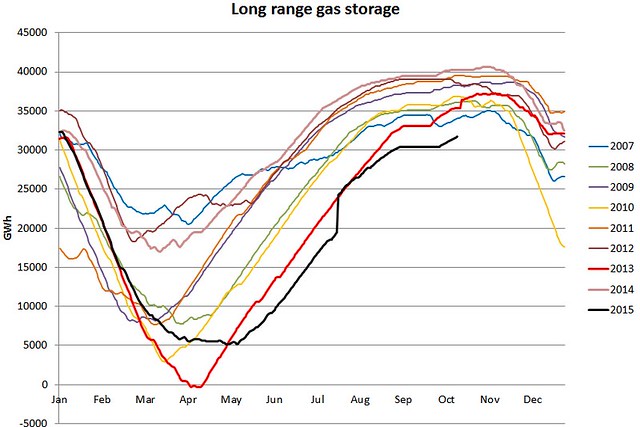
A few months ago I commented on the news that the long range storage at Rough was out of action and only about one third full. At the time Centrica was expecting withdrawal from Rough to be possible by 1 Nov, but the latest statement on their website now says second half of November. The graph below (click it for a larger version) shows the storage level in Rough over the past decade, with 2016 in red. As you can see, no gas has been injected for some months, leaving the store short of about 26,000 GWh of gas, which is unprecedented in the past decade.
UK long range gas storage 3nov2016

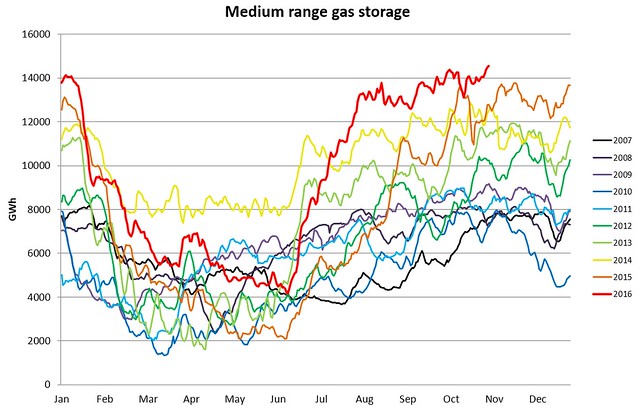
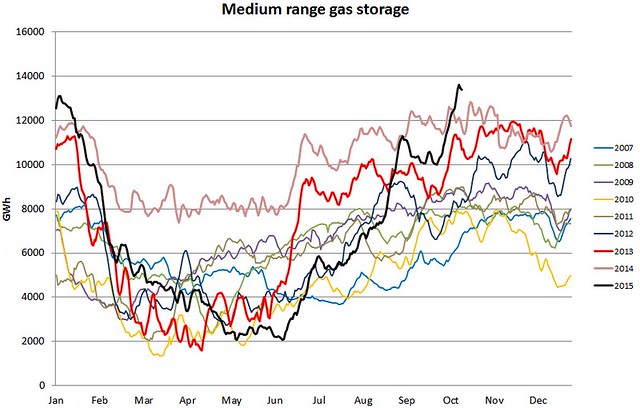
To be fair, the operators of the medium range storage sites have done their best, with gas stored at record levels - but this only equates to an extra couple of thousand GWh compared to recent years, so does not offset the missing gas from Rough.
UK medium range gas storage 3nov2016

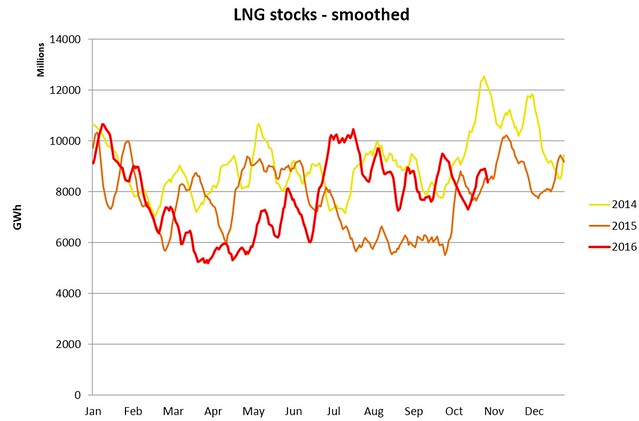
LNG stocks are at a fairly typical level, but these fluctuate as imports arrive periodically - the hope will be that more LNG tankers will arrive this winter than a year ago.
UK LNG stocks 3nov2016

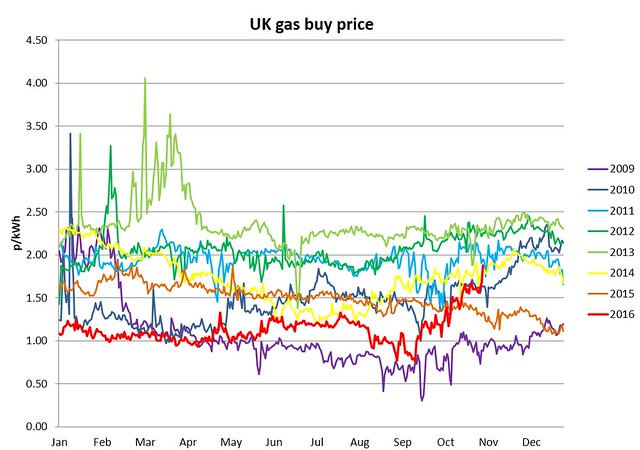
The impact of Rough's outage and low stock is showing up in wholesale gas prices, which have more than doubled over the past two months - this has yet to feed through into consumer bills.
UK gas buy price 3nov2016

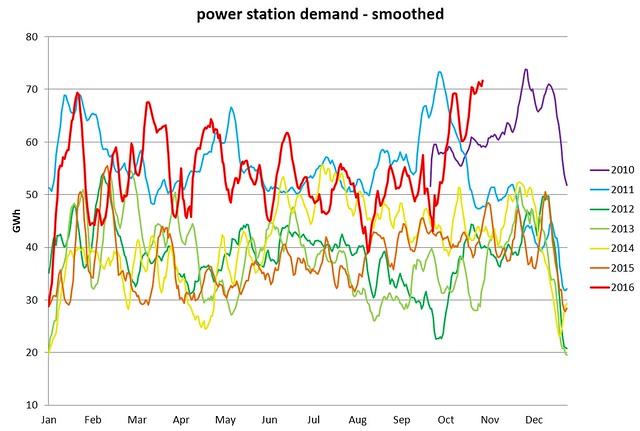
The other important factor to bear in mind is what's happening with electricity generation. A significant number of coal-fired power plants have closed in the past year or two, and this is good as they are high emitters of CO2. But the slack has been taken up by gas-fired power plants instead, rather than solely renewable energy or nuclear power. The graph below shows how power station demand for gas is at a multi-year high for this time of year.
UK power station gas demand 3nov2016

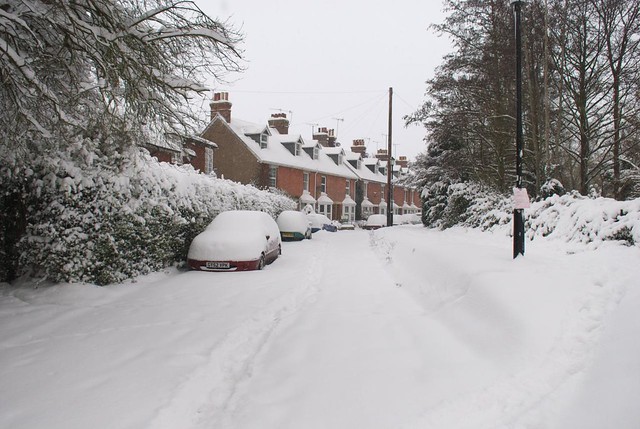
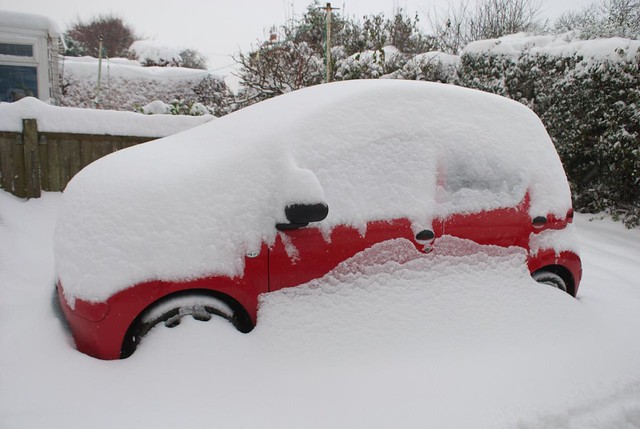
So what's the conclusion? Well, if it doesn't get too cold, Rough comes back online as planned, nothing else breaks and we get enough LNG deliveries, then we'll just see prices rise. If one or more of those factors doesn't work out favourably, then it may become necessary to restrict industrial gas or electricity usage, to ensure that gas supply to homes can be maintained. Let's hope and pray that we don't get another winter like 2010/11:
DSC_5438

Mike

Click here to read the rest of this post.

Monday, 18 July 2016

Bad news for UK gas supply winter 2016/17

If Rough was a car, you'd scrap it and buy a new one. But it's actually the UK's biggest gas storage facility, and supplies up to 10% of peak winter demand for gas. A few weeks ago I wrote about how planned maintenance was preventing Rough being filled with gas until early August. Well, the news has now got worse. The BBC summarises it here, but here's the detail straight from Centrica's website:

On 22 June 2016, CSL announced that in the course of conducting the testing works it had identified an additional issue with one of the wells. This resulted in CSL ceasing all injection and withdrawal operations pending the further testing in relation to the issue identified. This program of testing was estimated to last at least 42 days.
CSL has now ended the 42-day testing program early and has plugged the affected well. However, the affected well has identified potential uncertainties in the remaining untested wells. CSL will therefore continue with an enhanced version of its original calliper run and seal testing program. We estimate completion in March to April 2017. In the meantime because of the uncertainty as a prudent and safe operator CSL cannot inject or withdraw gas from Rough.
CSL is also examining the feasibility of returning a number of wells to service for the Winter 2016/2017 withdrawal season. CSL anticipates it will complete this study by 30 October 2016. CSL currently anticipates that at least 4 wells will return to service for withdrawal operations by 1 November 2016. In respect of injection CSL cannot increase the Rough reservoir pressure during the testing programme.
If you're wondering how big an impact plugging one well is, and what possibly having four wells open in November means, the Operational Guide to Rough from 2015 says that it had 24 operating wells for injection, and 29 for withdrawal. Rough is currently about a third full, so opening some wells for withdrawal in November is of some use, but with no chance to inject any new gas, the UK is going to be left exposed to any further malfunctions or international incidents, and may even struggle to cope with a moderately cold winter. The ability to import LNG will be crucial to maintaining supply over this winter - this may work fine, but will cost us more, as we will have to outbid other countries to make sure we get what we need.

It's worth remembering that in Q1 2016 38% of the UK's electricity was generated by burning gas - this represents 25% of total gas use in the UK (data from here). So a shortage of gas implies a potential shortage of electricity, especially with more of our ageing coal plants having shut down over the past year.

One slightly odd thing is that National Grid's Prevailing View website is missing information on gas storage. One could be forgiven for thinking they're trying to avoid scaring people...

We may get more news, good or bad, on Rough over the coming months, but the key thing to look out for now will be long range winter weather forecasts. Time to start praying for a mild winter I think...


Click here to read the rest of this post.

Friday, 24 June 2016

While you were watching the EU referendum, something happened at Rough...

While we were all caught up in the EU referendum this week, there was an item in the news about the UK's largest gas storage facility, Rough:

Wholesale gas prices have been volatile following news that the UK's largest gas storage facility is being shut down for 42 days.
Normally, gas would be being injected into Rough right now, and was being until a couple of days ago, as you can see from the first graph on this page. The update on Centrica's website says:
In March 2015, CSL began conducting testing and verification works on the Rough wells. In the course of conducting these works, CSL has identified an additional issue on one of the wells tested. As a consequence, CSL has ceased all Rough injection and withdrawal operations. CSL will seek to expedite testing on the issue identified and expects this period of testing to last at least 42 days.
The current restart date is 3 August, but of course it could be later, given the above update says "at least 42 days". If storage isn't filled quickly enough over the summer, we'd better hope for a mild winter, or we might run into difficulties... One thing that's clear is that Rough is showing its age, and has had several mechanical breakdowns in the past 10 years. Worth keeping an eye on over the summer...

Easington Langeled Terminal

Click here to read the rest of this post.

Friday, 16 October 2015

UK gas supply outlook for winter 2015/16

It was back in April that I blogged about the cut Centrica had made in the capacity at Rough, due to problems with some of the wells limiting the maximum operating pressure. At the time, Centrica hoped that by now the capacity would have been restored, but a press release in July said that they now didn't expect to know if this would be possible until some time between September and December 2016! The net result is that the capacity of Rough has been reduced by 25%.

Clearly this presents a problem for UK winter gas supply, so it's not surprising that another July press release stated that the Oil and Gas Authority had given Centrica permission to reduce the minimum operating pressure of Rough, thus 'converting' some of the cushion gas (which would normally be left in the store) into working gas, which can be withdrawn and re-injected. This shows up on the chart below (black line = 2015), where a sudden jump up in July can be seen, due to the addition of about 4,625 GWh (or about 400 mcm). The same trick was pulled in 2013 (red line in chart below), after dipping into the cushion gas in April 2013, capacity was increased arbitrarily in the October 2013. It's a bit like keeping driving your car after the fuel gauge has gone into the red - it works OK for a while, but you can't do it for long...

Despite this bit of creative accounting, the chart below shows that we are still going into this winter with a record low amount of gas in storage, and National Grid's Winter Outlook notes this on page 43, saying storage is reduced by 14%, from 4.9 bcm to 4.2 bcm. It would have been 22% less if Centrica hadn't fiddled the figures by dipping even further into the cushion gas.

UK long range gas storage 16 Oct 2015

Medium range storage is looking better, with increased capacity and a record amount in storage, but nowhere near enough to make up for the shortfall at Rough.

UK medium range gas storage 16 Oct 2015

So, the big question has to be about demand. We have fewer coal power stations than we did a year ago (which is a good thing, of course!), which could in theory mean that more gas gets burned to generate electricity. But the big factor will be the weather as always, which is hard to predict at this stage, as there are several extra factors to bear in mind:
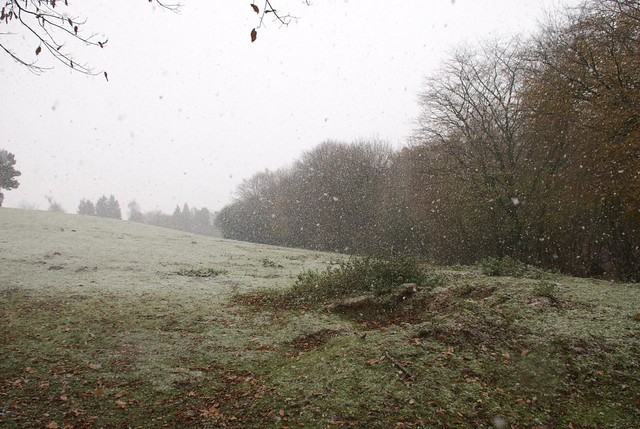
Time will tell, and we'll soon see if this winter looks like this:
DSC_5364

or like this:
DSC_5428

Click here to read the rest of this post.

Saturday, 11 April 2015

UK gas storage capacity slashed

A couple of weeks ago Centrica Storage quietly made an announcement on its website:

As part of CSL’s assurance programme and as a responsible operator and given the age of the field and installation, CSL has decided to limit the maximum operating pressure of the Rough wells to 3000 psi. CSL has decided to take the prudent step to test and verify the operating parameters of the Rough wells. It is anticipated that this limitation will last up to 6 months.
 Rough is an undersea gas storage facility, connected by pipeline to the terminal at Easington in Yorkshire:
Easington Langeled Terminal

It's able to store about 4 billion cubic metres of gas - or at least it was before the above announcement. Some more detail from Platts indicates that the reduction in operating pressure will reduce Rough's capacity by about a quarter. Because Rough comprises about 72% of the UK's total gas storage, this is equivalent to losing just under 20% from total storage capacity.

Now, Centrica Storage has said this is for six months, while tests are carried out, but Platts notes that the tests are needed because of concerns about well integrity - so it's possible that the capacity will be permanently reduced. Even if it isn't, the coming six months are exactly when the storage is normally refilled, so if full capacity is restored at the end of the testing period, it may well be too late to completely fill the storage.

So, let's assume the UK goes into next winter with 1 billion cubic metres of gas less in storage than usual - what might the impact be? 2013/14 was a mild winter, and Rough still had over 1.5 billion cubic metres left in it in March 2014. It was a different matter in April 2013, when it had actually gone below 'zero', eating into the gas cushion that was supposed to be left untouched. This year, there's about 0.5 billion cubic meters left in it right now - the situation was similar every year from 2008-2011 inclusive. This means that if the coming winter is mild, we should have no problems; if it is average, then we will probably need to increase imports, which will bump up prices; if it is cold, then we could well have a problem.

The graph below shows the levels in Rough over the past few years in GWh (10 GWh is about the same as 1 million cubic metres), so you can see the situation for yourself. Any year where the level dropped below 10,000 GWh is a year when the announced capacity reduction might have been a problem:
UK long range gas storage

Let's hope and pray for a mild winter!

Click here to read the rest of this post.

Friday, 12 December 2014

What will the impact of falling oil prices be?

So, oil prices are falling again - down to close to $60, compared to over $100 just a few months ago. Good news for economies and motorists around the world? Or a sign of problems to come?

Prices last fell dramatically in 2008, dropping from $145 in July to $30 in December of that year. Of course, this was due to falling demand caused by a global financial crisis - brought on in part by the rising price of oil forcing homeowners to default on their sub-prime mortgages in order to keep buying ever more expensive food and gasoline. Since then, the oil price crept steadily back up again as economies recovered and expensive oil production was mothballed, clearing $100 in 2011 and staying around that level until the recent fall.

So what's happening this time? Well, two key factors are the risk of weakening demand in some parts of the world due to economic issues, and the increase in USA oil production through the fracking of shale oil. Possible falling demand combined with rising supply has reduced the price. Normally, OPEC would act at this point, reducing oil production to support prices. But this time Saudi Arabia has political motivations, as noted by the BBC recently, wanting to punish countries like Russia and Iran, who are being badly hurt by the falling oil price right now. Saudi Arabia is hurt too, but it has a much bigger financial cushion, so can survive for some time yet on lower prices.

So what will the impact be, beyond lower transport costs in the short term? Most of the new oil supply that has come from US fracking needs a high oil price to be profitable - higher than the price is right now (estimates vary from $65 to $80), so fracking companies will be wondering whether they should pause or halt production, and save the oil for a time when prices are higher and they can make a profit selling it. But the problem is they've borrowed money to get started, and that money has to be paid back no matter what the oil price is. Some people even think this might trigger a new financial crisis, as there is over $200 billion in 'junk bonds' in the energy sector. This isn't a USA-specific issue, Barclays is involved in an $850 million loan which may not be paid back in full.

Looking further ahead, when demand for oil picks up again, the shutdown of expensive oil production like fracking, and also tar sands, would mean that prices could jump up significantly, as it would take time to bring this production back online.

Tar sands in alberta 2008

Finally, there's another factor affecting future oil production - the risk of falling investment. Anybody who's grasped the climate change issue understands that if we want to keep global temperatures from rising too high we can't burn all the fossil fuel resources we know about, never mind resources we haven't found yet. But companies, and even whole countries, are valued by stock and bond markets according to the quantity of fossil fuel reserves they own or have a right to produce. If some of these reserves have to be left in the ground, then the shares of these companies and the national debt of certain countries could be over-valued right now - a 'carbon bubble'. In fact, The Bank of England is researching the risk of this right now, as reported by The Guardian:
The Bank of England is to conduct an enquiry into the risk of fossil fuel companies causing a major economic crash if future climate change rules render their coal, oil and gas assets worthless.

The concept of a “carbon bubble” has gained rapid recognition since 2013, and is being taken increasingly seriously by some major financial companies including Citi bank, HSBC and Moody’s, but the Bank’s enquiry is the most significant endorsement yet from a regulator.

The concern is that if the world’s government’s meet their agreed target of limiting global warming to 2C by cutting carbon emissions, then about two-thirds of proven coal, oil and gas reserves cannot be burned. With fossil fuel companies being among the largest in the world, sharp losses in their value could prompt a new economic crisis.

CarbonBubble ENG

The UK Energy Secretary, Ed Davey, has also been talking about this issue with regard to pension funds, as reported by The Telegraph:
"One has got to worry about the investments for pensioners.

If pension funds are investing in companies or banks that have on their balance sheets huge amounts of assets in fossil fuels, and those assets don’t give the return that people expect – because of changes in technology where low-carbon becomes cheaper or because of the world having to take action against carbon emissions – one has got to protect those pensioners and those investments."
 In summary, there are more than simple market forces at play in the oil price right now, and the consequences of any action, or inaction for that matter, will be far-reaching. Governments would do well to give some serious thought to two key problems - how to get off our addiction to oil (and fossil fuels in general), and how how do it without causing another financial crisis as the big fossil fuel companies are wound down.

Click here to read the rest of this post.

Wednesday, 3 September 2014

UK National Grid asks for help keeping the lights on this winter

After a fire put one of the 370MW generators at E.ON's Ironbridge coal-fired power station out of action in February, another fire knocked out two 500MW coal-fired units at SSE's Northbridge power station too, with one expected to return to service no earlier than November 2014, and the other after March 2015. Then EDF announced the shutdown of the 1190MW Heysham 1 and the 1150MW Hartlepool nuclear power stations in August, due to concerns over a design flaw in the boilers - these are expected to return to service during October.

So it's hardly a surprise that National Grid has asked if anybody can commit to providing extra reserves of electricity generation for this winter...

Of course, we don't know how cold the winter may be yet - if it's mild like 2013/14 then we probably wouldn't have a problem. At least the gas storage is nice and full, after light usage last winter. But if it happens to be cold, or if there are further outages at our ageing power stations, then things might get a bit tight...

Heysham Power Station, from dockside

UPDATE (4 Sep 2014): EDF has now said the reactors will only come gradually back online between October and December...

Click here to read the rest of this post.

Friday, 27 June 2014

DECC Energy Trends - some good news on renewables!

Just to make a change, the latest Energy Trends publication from DECC is not all bad news! The statistical press release actually starts with this graph, showing how renewable energy supply has grown rapidly in the UK recently:

Energy Trends 2014 overall renewable energy

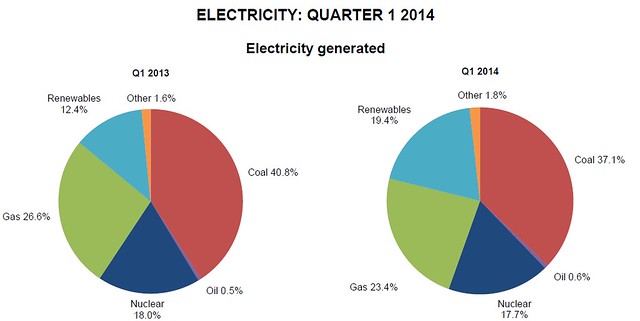
The biggest chunk of this is electricity, so here's how the overall electricity supply looked in the first quarter of 2014, compared to a year ago:

Energy Trends 2014 renewable electricity

What's interesting to note here is that while renewable energy supply did increase significantly in absolute terms, from 12.7 TWh a year ago to 18.1 TWh this year (43% increase), the reason its share in the chart above increased so dramatically is because the mild winter reduced demand for electricity by 10.4% compared to a year ago. What's really significant here to me is that the cut in demand was reflected in a big reduction in coal and gas burned to generate electricity - which is of course what is supposed to happen as renewable energy generation increases. But it underlines the fact that cutting demand has a huge impact on the proportion of energy we supply from renewable sources.

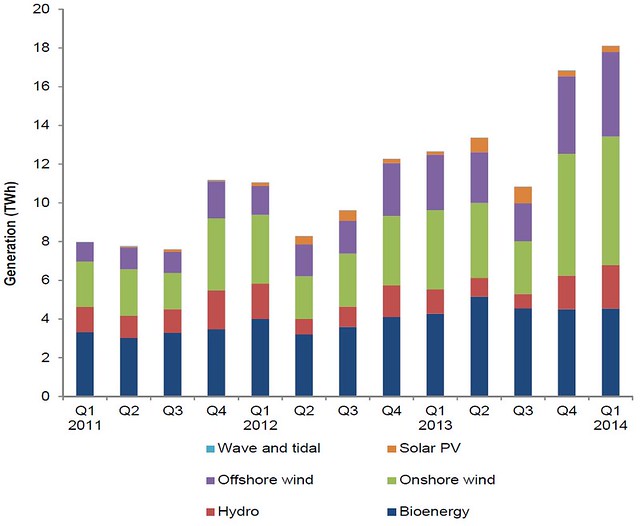
Although renewable energy capacity had increased over the past year, the other thing that boosted generation was the exceptionally wet and windy weather the UK experienced this winter. Probably not enough of a 'silver lining' to make it worth it for the people who got flooded though... The effect of the weather is shown clearly in the breakdown of renewable energy generation below, with wind and hydro well up on a year ago.

Energy Trends 2014 renewable electricity breakdown
The seasonal trend of more solar power in the summer and more wind/hydro in the winter is clearly shown above as well, which makes a good case for increasing the amount of installed solar PV to even out renewable supply across the year. Though having said that, demand is higher in the winter anyway, so maybe it's not too big a deal.

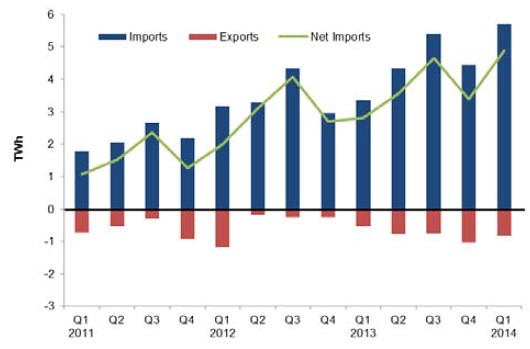
I'm afraid there's one not so good chart included for electricity though, and that's the one showing our net imports, which are steadily rising:

Energy Trends 2014 electricity net imports
Clearly this isn't a good thing for energy security, or for the UK balance of payments. Perhaps it's a sign of our steadily ageing generation infrastructure?

Moving on to fossil fuels, there's not a huge amount to report really:
  • Coal production was down 27.7% on a year ago.
  • Gas production was down 0.2%, but imports were down significantly due to the mild winter
  • Oil production was actually up 3.5% for a change!
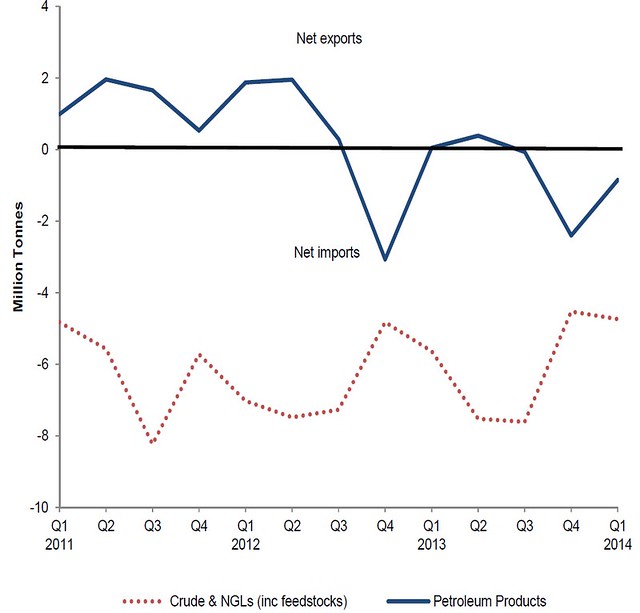
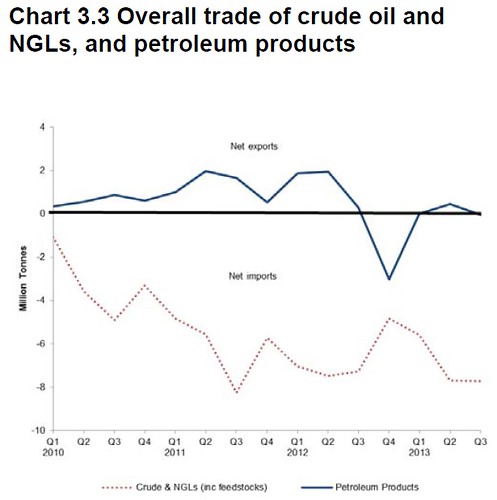
Of course, we are still a major energy importer - the graph below shows net imports for crude oil (red) and also for petroleum products (blue). We've been a net importer of crude oil for a long time, and the recent rise in production is too small to make a dent in that. But our change to being a net importer of products (diesel, petrol, etc.) is relatively new, and due to reductions in refinery capacity in the UK.

Energy Trends 2014 oil net imports 

So, nice to have some good news to report on the renewables front, even if the overall picture hasn't changed a great deal.

Click here to read the rest of this post.

Saturday, 14 June 2014

Catcher - 'major' new North Sea Oil field in context

Numerous news sources are busy celebrating the planned development of the new Catcher oil field in the North Sea. But few of them put it in context, with even the BBC describing it as "a major North Sea field", saying it could ultimately produce 100 million barrels of oil, and other sources mention a peak production of 50,000 barrels per day. These sound like big numbers, but let's compare to the real major oil field of the North Sea - Forties.

PlatformHolly.jpg

Forties is expected to produce over 4 billion barrels during its operational lifetime, and reached a peak output of  520,000 barrels per day in 1978. So that's forty times bigger than the Catcher field, and ten times the peak output. Catcher doesn't look so big now, does it?

Let's also compare it to our current oil production: 925,000 barrels per day, and our oil consumption of 1.5 million barrels per day. So it's basically going to produce 3.3% of our national consumption. Great, that'll make a huge difference... not.

Peak oil is still alive and well, and the IEA's recent report showed that over 80% of investment in energy oil and gas is just to make up for declining production from existing fields. So don't expect to see cheaper petrol or diesel any time soon. Or ever, in fact.


Image: "PlatformHolly" by employee of the U.S. government: public domain - http://www.netl.doe.gov/technologies/oil-gas/Petroleum/projects/EP/ResChar/15127Venoco.htm -- U.S. Department of Energy. Licensed under Public domain via Wikimedia Commons.

Click here to read the rest of this post.

Friday, 10 January 2014

Former BP geologist: peak oil is here and it will 'break economies'

If you thought peak oil had gone away, or at least turned out to be not as bad as you thought it might, perhaps it is time to think again. I expect this story was missed by many, being published as it was the day before Christmas Eve, indeed I only just became aware of it myself. I suggest you go and read the full article in The Guardian, but to show you why, here's a few quotes from the article, which itself is quoting Dr Richard Miller, who worked as a geologist for BP from 1985 to his retirement in 2008.


Dr. Miller critiqued the official industry line that global reserves will last 53 years at current rates of consumption, pointing out that "peaking is the result of declining production rates, not declining reserves." Despite new discoveries and increasing reliance on unconventional oil and gas, 37 countries are already post-peak, and global oil production is declining at about 4.1% per year, or 3.5 million barrels a day (b/d) per year: "We need new production equal to a new Saudi Arabia every 3 to 4 years to maintain and grow supply... New discoveries have not matched consumption since 1986. We are drawing down on our reserves, even though reserves are apparently climbing every year. Reserves are growing due to better technology in old fields, raising the amount we can recover – but production is still falling at 4.1% p.a. [per annum]."
...
"... a sustained decline in global conventional production appears probable before 2030 and there is significant risk of this beginning before 2020... on current evidence the inclusion of tight oil [shale oil] resources appears unlikely to significantly affect this conclusion, partly because the resource base appears relatively modest."

In fact, increasing dependence on shale could worsen decline rates in the long run: "Greater reliance upon tight oil resources produced using hydraulic fracturing will exacerbate any rising trend in global average decline rates, since these wells have no plateau and decline extremely fast - for example, by 90% or more in the first 5 years."
...
"The final peak is going to be decided by the price - how much can we afford to pay?", Dr. Miller told me in an interview about his work. "If we can afford to pay $150 per barrel, we could certainly produce more given a few years of lead time for new developments, but it would break economies again."

And the 'least worst' it gets is:
"We are probably in peak oil today, or at least in the foot-hills. Production could rise a little for a few years yet, but not sufficiently to bring the price down; alternatively, continuous recession in much of the world may keep demand essentially flat for years at the $110/bbl price we have today. But we can't grow the supply at average past rates of about 1.5% per year at today's prices."

Like I said, go and read the full article...

The Royal Society journal it all comes from  is available free online too - I'll read through it when I have time and post some comments, but if you want to take a look now, it's here.

IPC oil derrick

Click here to read the rest of this post.

Saturday, 21 December 2013

DECC Energy Trends - UK energy decline continues

The latest Energy Trends have been published by DECC, so here's a summary... (all graphs are copied from the publication)

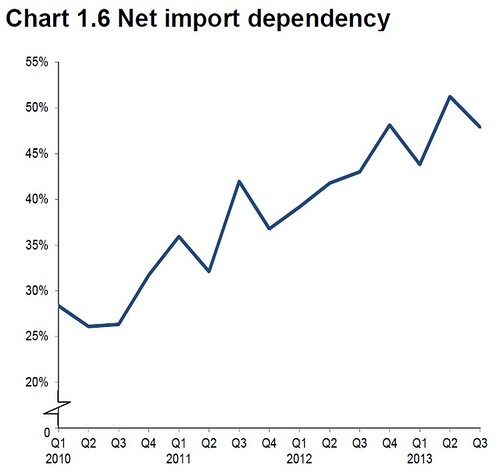
Unsurprisingly, the upward trend in net UK energy imports continues:

UK Net Energy Import Dependency Q3 2013

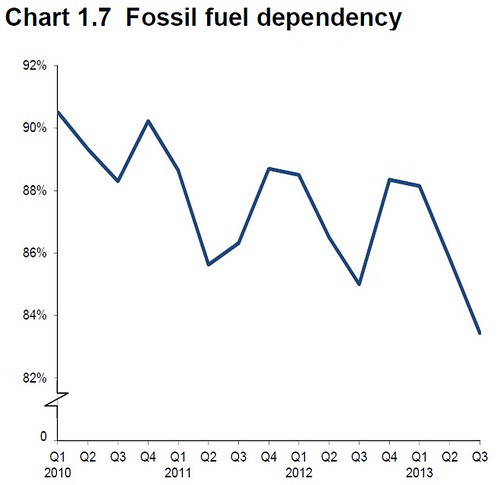
At least fossil dependency is coming down, though this includes nuclear:

UK Fossil Fuel Dependency Q3 2013

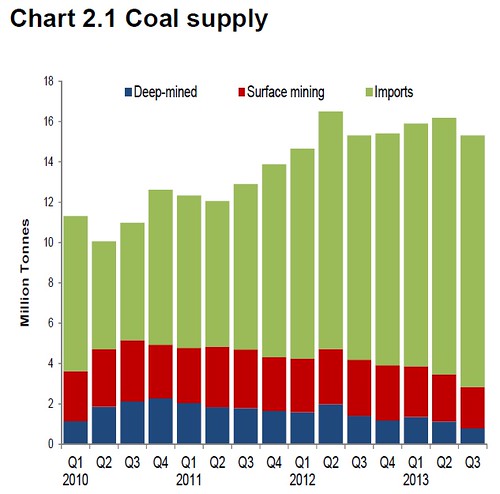
Coal

Coal mines have been closing - production is down 32% over last year. Imports are up 12%, and mainly come from Russia, Columbia and the USA. Total consumption is actually down 2.8% on a year ago, due to a reduction in the use of coal for generating electricity - coal use in other areas increased significantly.

UK Coal supply Q3 2013

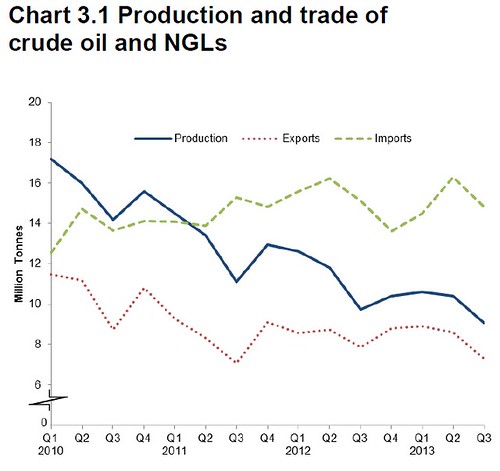
Oil and petroleum products

The downward trend of oil and NGL production has continued, with a new post-peak low being hit in Q3 - down 7% on a year ago:

UK Oil production and trade Q3 2013

The following graph shows net trade in both crude oil and petroleum products. Unsurprisingly, the UK is importing a lot of crude oil, but our traditional position as an exporter of petroleum products is also being eroded as refineries are closed down:

UK Oil and product trade Q3 2013

Gas

Gas production actually declined less than in recent times, with a drop of 3.8% compared to a year ago. However, this is due to the return to production of the Elgin field, which shut down due to a leak in March 2012, rather than any pause in the overall decline. Demand for gas was down 8.2% on a year ago, due to warmer temperatures and less gas being burned to generate electricity.

UK Gas production and trade Q3 2013

Electricity

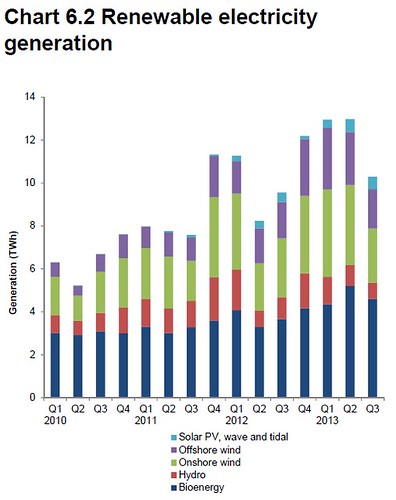
Electricity demand was down 0.6% compared to a year ago, although this combines a rise in industrial use and a fall in domestic use. Interestingly, domestic use was the lowest for Q3 for fourteen years! Electricity generated from renewable sources increased from 11.7% in Q3 a year ago to to 13.2% this year, although this is lower than the 15.4% reached in Q2 2013. Lower wind speeds resulted in reduced generation despite increased capacity, but this was compensated for by conversion of coal fire power stations to burn biomass instead. This is controversial though, as the biomass used is imported rather than being sourced from within the UK.

Generation from solar PV was up 31.9%, due to increased capacity, but hydro was down 26.6% due to low rainfall. In terms of installed capacity:
  • onshore wind was up 25% at 7,120MW
  • offshore wind was up 36.3% at 3,657MW
  • solar PV was up 57% at 2,542MW
  • anaerobic digestion was up 33.5% at 122MW

UK Renewable Electricity Generation Q3 2013

So, nothing shocking this quarter - a continued decline in fossil fuel production, a steady but slow rise in renewable energy, and a few new highs and lows set compared to recent years.

Mike

Click here to read the rest of this post.

Friday, 29 November 2013

IEA World Energy Outlook 2013 video presentation

The 2013 IEA World Energy Outlook is now out, but as it's pretty expensive, and long, you might like to watch the videos of the key facts being presented by some of the key people, that the IEA has kindly uploaded to YouTube. There's three - intro, main presentation, and Q&A:


Mike

Click here to read the rest of this post.

Thursday, 28 November 2013

Blown fuse in Norway reduces UK gas supply

OK, well not a blown fuse literally, but a circuit breaker tripped and shut down a chunk of output from the Ormen Lange gas field, which is one of the main sources of gas for the UK, via the Langeled pipeline. This story indicates the cut should only be for 24 hours. You can see the effect on this graph of Langeled output taken from a National Grid website:

Langeled shortfall 28Nov2013
Not a huge problem today, but this is exactly the kind of thing that can cause dangerously low supplies when it happens in colder weather - of which there is more to come in the next few months...

Mike

Click here to read the rest of this post.

Tuesday, 12 November 2013

Gas Bills 'Could Rise' Due To Low Reserves

Good to see that some people are aware of the issues the UK has with gas supply - Sky News in this case!

Gas prices could soar this winter if the national supply runs short during another cold snap, an energy expert has warned. Industry analyst Peter Hughes told Sky News that a "perfect storm" last March of extreme weather and the shutdown of two major pipelines caused prices to double. And that could happen again because the Government has refused to support the storage of more gas. "It foreshadows things to come," he said.

"The situation in terms of the risks will only get worse as North Sea production runs down and demand rises. That's the double whammy. And if you don't have more storage that translates into real vulnerability."

Britain currently stores enough gas for 13 days of supply. But Germany has reserves to last 69 days, in case there is a problem with the supply from countries such as Russia.

Even the gas storage that we DO have is not always working properly... News out today from Reuters says that withdrawals from Centrica's Rough storage site, the largest in the UK, will be limited for a few hours today and for four days from 21 Nov. More importantly perhaps, no gas can be injected back into for two weeks starting on 18 Nov. Presumably this is all down to maintenance work, but that really should have been completed earlier in the year... Let's hope we get a mild winter!

Easington Langeled Terminal

Click here to read the rest of this post.

Monday, 14 October 2013

Keeping the lights on? UK gas supplies and prices in winter 2013/14

With the UK weather turning colder over the last week, it's time to take a look at how our creaking gas and electricity infrastructure might cope this winter. I'll look at two areas - first, National Grid's Winter Outlook for 2013/14, and second, my own analysis of their data on UK gas storage.

Most of National Grid's Winter Outlook is dedicated to gas, as the supply/demand is affected much more than electricity by the availability of imports and how cold the weather is. The report indicates that there is, in theory, plenty of gas supply for even the coldest weather that the UK could experience. In practice, however, situations can arise where supplies are far from secure. For example, earlier this year an unseasonably cold March coincided with a brief outage in the Bacton Interconnector, resulting in gas storage levels dropping to record lows. LNG imports were low at the same time, due to demand from Japan and China - this has not changed since then. The situation is illustrated well by a graph from from page 13 of the Winter Outlook, where the 2012/13 line can be seen going off the cold end of scale in March:
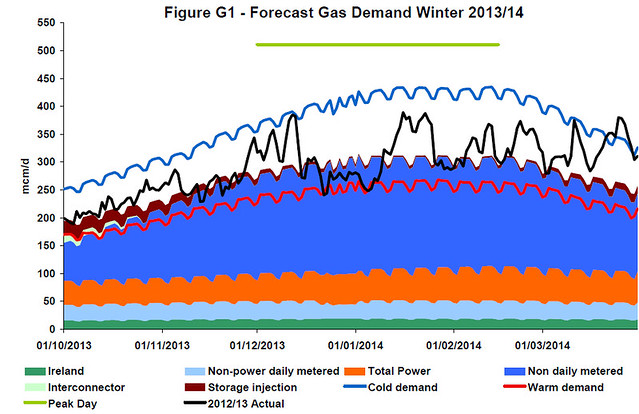
Fig G1 from National Grid Winter Outlook 2013-14

This exposes the other flaw in our gas market - if it is cold in Europe at the same time as it is cold here, there's no guarantee that gas suppliers in France, Germany and elsewhere won't keep gas for local use due to obligations placed upon them. Alastair Buchanan, the former head of OFGEM who stepped down from his post in June after 10 years’ service, comments on this in an interview with The Telegraph, and goes on to say that uncertain gas supplies combine with ageing power stations in the UK to create a real risk of temporary blackouts if the weather is cold over the next few winters. Over 40% of the UK's electricity is generated by burning gas, so the two are closely linked. In the Winter Outlook, National Grid notes that the margin of spare electricity generating capacity this winter would only be 5% during a cold spell, compared to 17% just two years ago.

Moving on to the current state of our gas stores, here's some graphs I've plotted using data available from the National Grid website. First, here's the amount of gas in Long Range Storage, which is basically a single depleted gas field known as Rough, owned by Centrica. 2013 is in red on the graph.
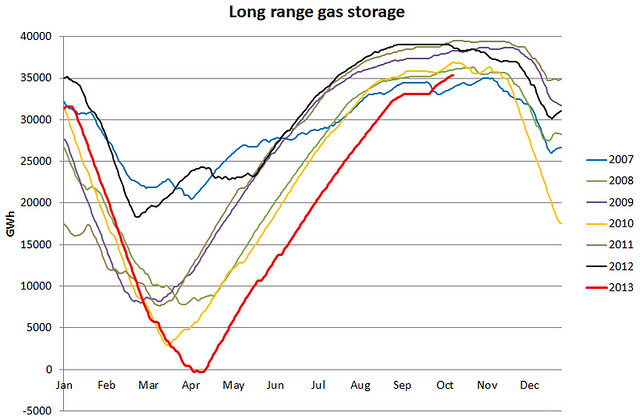
UK gas long range storage 14 Oct 2013

As you can see, the main factor affecting the storage levels in Rough this winter is what happened last winter. The cold weather dragging on through March and April resulted in the storage level actually going below 'zero' (see my blog at the time for an explanation), so we've been playing catch-up all summer and the current level is lower for this date in October than any time since 2007 (when North Sea supplies were much greater than today...). There's little hope of the storage getting filled up to the higher levels seen in the past few years, partly due to physical limits to how fast gas can be pumped in and partly due to the rising cost as we go into winter. The rate at which Rough has been filled this year is shown in the graph below. Why they decided to take a break from filling it at some points is beyond me...
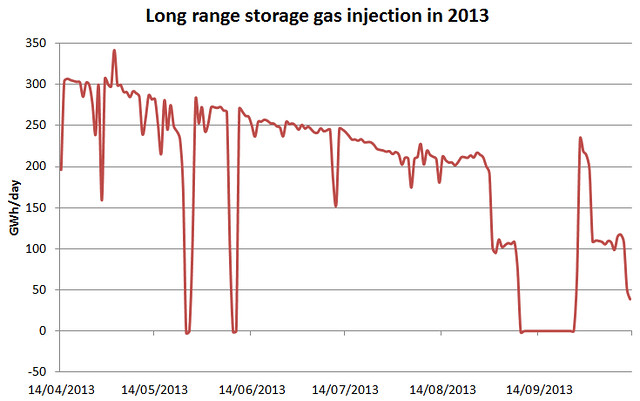
UK gas LRS injection 14 Oct 2013

You'd think that someone would be building more storage space for gas, but a recent story in The Telegraph noted that:

Centrica has written off £240m in wasted costs after scrapping its £1.4bn plan to convert an empty North Sea gas field into a gas storage site, and shelving another smaller project indefinitely.

The situation with Medium Range Storage is not so bad, though this doesn't fully compensate for the current shortfall at Rough:
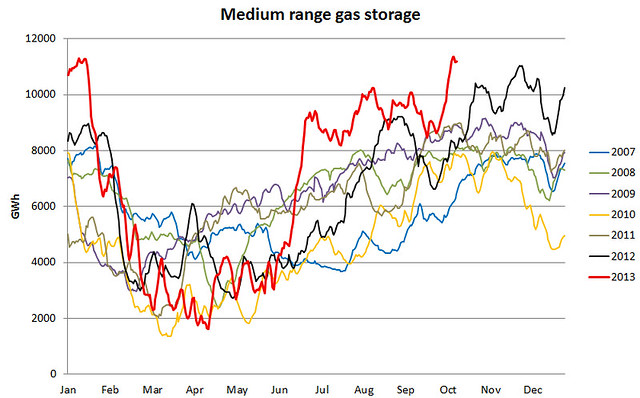
UK gas medium range storage 14 Oct 2013

Short Range Storage is very low, but the amounts required to fill it up are relatively small. It does still need doing though, as these stores are critical to cover unexpected outages, which seem to occur regularly enough that the may as well be expected these days...
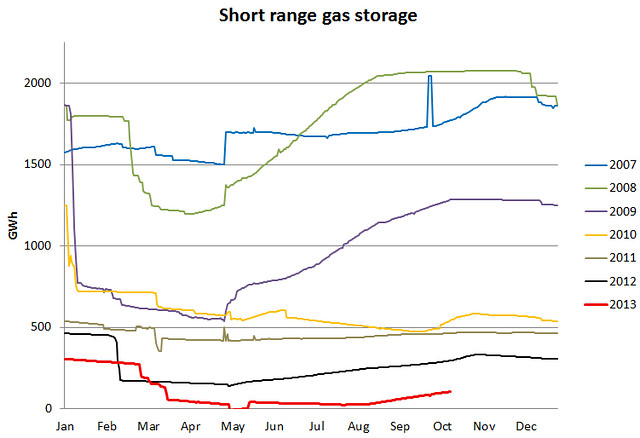
UK gas short range storage 14 Oct 2013

Of course, the question that most people will be asking is 'What will happen to prices?' Well, I said in a post on this blog in May 2013:
This can only translate into higher bills eventually, although the bumper profits made last winter may result in a short delay before this happens. Boosted gas prices will feed through into electricity prices too.
Lo and behold, one of the 'big six' have already put up their prices, and I'm sure the others will follow suit. I know they blame 'green taxes' and transportation costs, while the government blames fat profits in the upstream sections of the energy companies, and there is a little truth in all these claims, but the simple fact is that in the year ending 30 June 2013 we imported over 50% of our gas (data from DECC). This means that we are at the mercy of European and global demand and weather. The graph I've plotted below shows spot market prices as reported by National Grid over the past few years. The trend is clear, and the average price this year so far is currently up 18% on the year before, in part due to the very low storage levels at the start of the summer.

UK gas buy price history 14 Oct 2013


I will of course be keeping an eye on gas storage levels, and the weather forecast, over the coming 4-5 months, and don't forget you can check the current gas situation yourself at National Grid's Prevailing View page.

If you're wondering what else you can do, at the risk of repeating myself, you can:
  • Reduce demand (wear warmer clothes, turn the thermostat down, don't boil a saucepan without a lid on it, etc.)
  • Improve efficiency (insulate your house, draughtproof, double-glaze, etc.)
  • Use renewable energy
There's some examples of what we've done at home for the above points here, and you can check out some inspiring ideas on the Ashden website too.

Keep warm, and pray that we don't get too many days that look like this in the coming winter...

DSC_5464

Mike

Click here to read the rest of this post.

Thursday, 26 September 2013

DECC: UK imported more than half its energy in Q2 2013

The latest DECC Energy Trends was published today, and it's no surprise that the decline in indigenous energy production has continued. The killer statistic is:

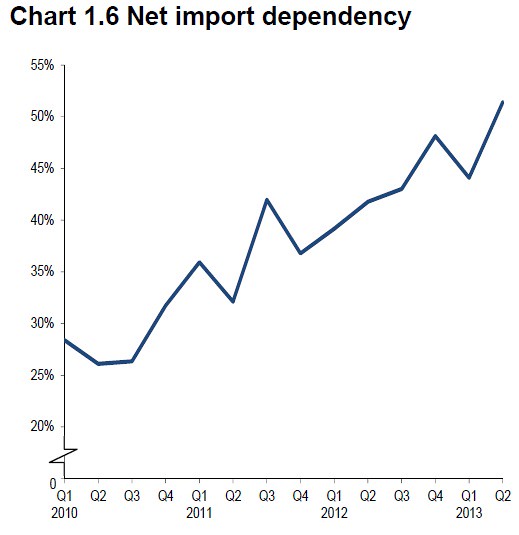
In the second quarter of 2013 net import dependency rose to 51.4 per cent, up 9.6 percentage points from the second quarter of 2012.
The chart on page 10 tells the story:
Uk energy import dependency
Here's the reasons, all comparing Q2 2013 to Q2 2012...

Coal: Production was down 24.3% on a year ago, and the proportion of our coal that came from imports rose from 81.7% to 93%. These imports came mostly from Russia (nearly half of the total!), USA and Columbia.

Oil: Production was down 13.4% on a year ago, and the proportion of our oil and oil products that came from imports rose from 40.5% to 45.1%. On a related note, the closure of the Coryton refinery resulted in a 5.6% drop in production of fuels from oil.

Gas: Production was down 2.8% on a year ago, and the proportion of our gas that came from imports rose from 43.6% to 52.5%. These imports came mostly from Norway, Qatar and the Netherlands.

Electricity: Production from nuclear power fell 16.5% due to several outages, but wind and PV generation rose by 58.6% (due to increased capacity), and hydro generation rose by 29% (due to higher rainfall). We imported 4.4% of our electricity.

Renewables
The key points here are:
  • Share of electricity supply up from 9.7% to 15.5%, due to increased capacity for wind and PV and increased rainfall to power hydro stations. There was also more generation from power stations converted to biomass, although co-firing with coal has reduced.
  • There's now 1,918 MW of capacity on a feed-in-tariff, 127 MW of which joined during Q2 2013.
  • Total renewable capacity in the UK was 19.5 GW, compared to 14.2 GW a year ago.

Large Combustion Plant Directive
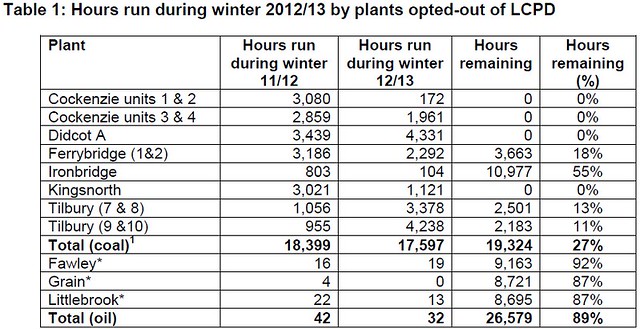
There's a helpful table (page 72) that shows how many of the coal power stations that were running over winter 2012/13 won't be running this winter. It's for reasons like this that Ed Miliband's promise to freeze energy prices seems a bit foolhardy.
LCPD hours remaining

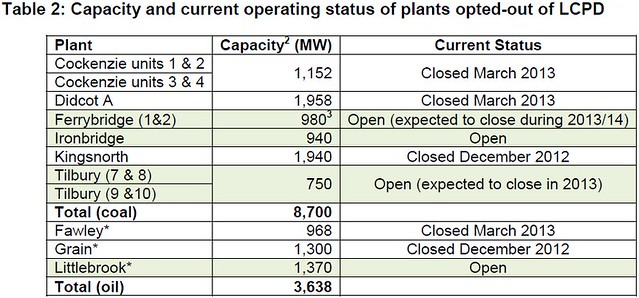
The status of the plants that opted out is given in another table:
LCPD plant staus

This shows that there's 5,050 MW of coal plant that ran last winter and won't be running this winter, and another 2,268 MW of oil plant that has shut - this didn't run much last winter, but when it did run it was urgently needed... On top of this there's another 1,730 MW of coal plant that is currently open but will close at some point during this winter. DECC also notes that:
From 1st January 2016 the remaining large combustion plants will be subject to more stringent emissions controls outlined in the Industrial Emissions Directive (IED). Plants that chose to opt-out of this directive will be limited to 17,500 hours between 2016 and 2023.
So there's more shutdowns to come!

Mike

Click here to read the rest of this post.

Wednesday, 21 August 2013

North Sea faces record fall in oil and gas production

Montrose Alpha

According to a story in The Telegraph today, this year could see a record fall in oil and gas production for the UK:
North Sea oil and gas production could decline by as much as 22pc this year - the biggest annual slump on record – as maintenance on ageing infrastructure hits operations, the industry body has warned. Oil & Gas UK said it now expected average output to fall to between 1.2m and 1.4m barrels of oil and gas per day (boepd) this year, down from 1.54m boepd in 2012.
Full story
The decline has been in the region of 10% a year for some time now anyway, but some major technical issues in the past year have pushed production down faster than has been typical. In some ways this isn't all bad - it means that oil and gas is still there to use later on, when prices are higher. But there's always the risk that it's not worth repairing failing machinery if there's not much left to be extracted from a particular field, leaving it locked underground for good. (Of course, from a climate change point of view that's a good thing!)

This trend doesn't fully show up in the latest DECC Energy Trends, as it only covered up to Q1 2013, but even then oil production was down 15% from a year ago, and gas down 14.5%. It'll be interesting to see what's in the September edition...

On a slightly more positive note, it seems that more attention is being paid to thorium as a nuclear fuel. Obviously nuclear energy of any sort has numerous downsides, but thorium does seem to be be 'less bad' than uranium in several ways, so it'll be interesting to watch for more developments...

Click here to read the rest of this post.